A lot of language learners look at the Chinese, Japanese languages and assume it’s “basically the same, but with different vibes.”
You’d also think two languages that share characters would be at least kinda similar, right?
Yeah… no.
While both Chinese and Japanese use characters derived from Classical Chinese, this shared feature is where the true similarities essentially end.
By the end of this article, you will learn exactly why both are different!
Overview of the Chinese vs Japanese Language
Let’s kill the first myth: Japanese is not “a dialect of Chinese.”
- Mandarin Chinese
- Language family: Sino-Tibetan → Sinitic branch
- Structure: analytic, relies on strict word order + small particles
- Speakers: about 1.1–1.14 billion total as of 2025
- Reach: lingua franca across Mainland China, Taiwan, Singapore
- Japanese
- Language family: Japonic (with Ryukyuan cousins)
- Structure: agglutinative, meaning verbs and endings do the heavy lifting
- Speakers: around 123–128 million, mostly in Japan
- Reach: smaller footprint, huge soft power via anime, manga, gaming, and tech
Japanese has been borrowing Chinese vocabulary for centuries. About 60% of Japanese dictionary entries are Sino-Japanese (kango).
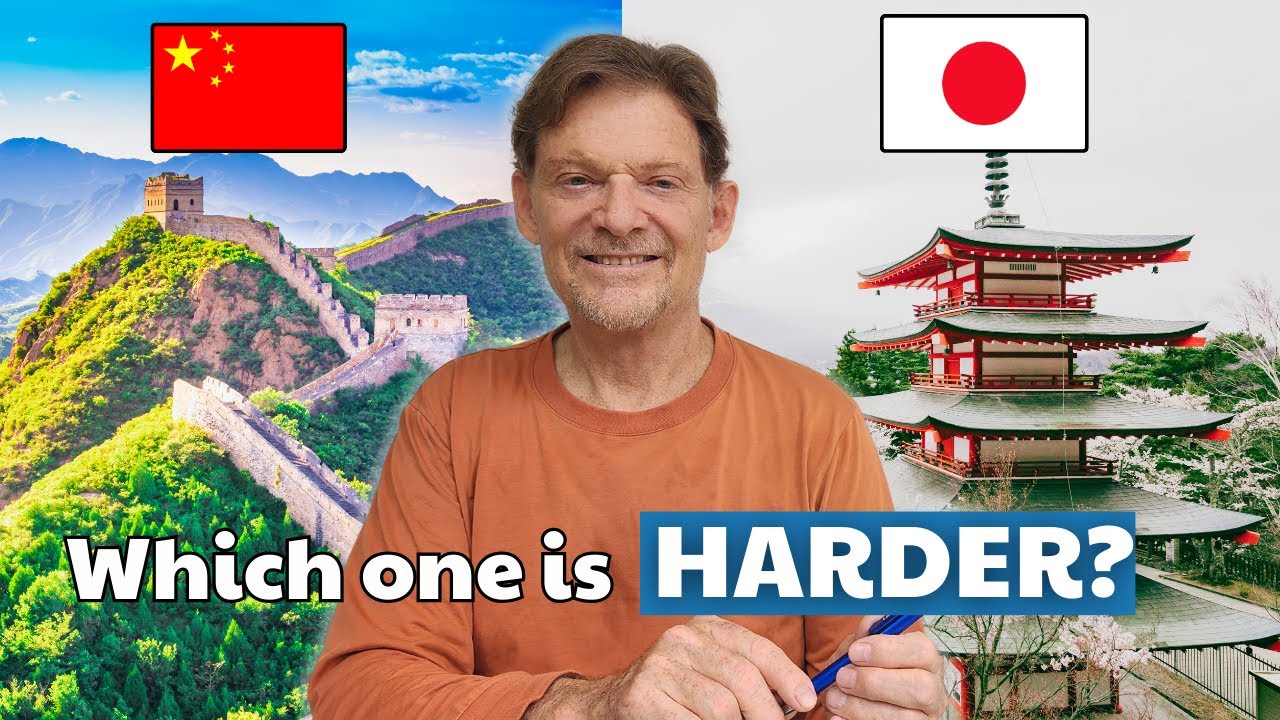
Writing Systems Compared: Chinese vs Japanese Language
Here’s where the Chinese vs Japanese language confusion really explodes.
Chinese: One Script, All Characters
- Uses Hanzi (Chinese characters) only
- Each character = one syllable + one core meaning
- Modern literacy: roughly 2,500–3,500 characters
- Simplified characters in Mainland China, Traditional in Taiwan/HK
- Written horizontally left-to-right in modern usage
Example:
- 火 = fire
- 山 = mountain
Japanese: Hybrid Frankenstein System
Japanese use three scripts at the same time:
- Kanji – logographic characters borrowed and adapted from Chinese
- Hiragana – syllabary for grammar, endings, native words
- Katakana – syllabary for loanwords, emphasis, technical stuff
- Written horizontally and also vertically top to bottom in modern usage
Modern Japanese text is roughly:
- 54% Kanji
- 38% Hiragana
- 8% Katakana
Shared Characters… but Not Shared Meaning
Yes, you’ll see the same character in both languages. No, that does not mean you’re bilingual.
- 火 = “fire” in both
- 走 = “walk” in Chinese, “run” in Japanese
- 手紙 = “toilet paper” in Chinese, “letter” in Japanese
- 勉強 = “to force/compel” in Chinese, “study” in Japanese
Grammar Rules in the Chinese vs Japanese Language
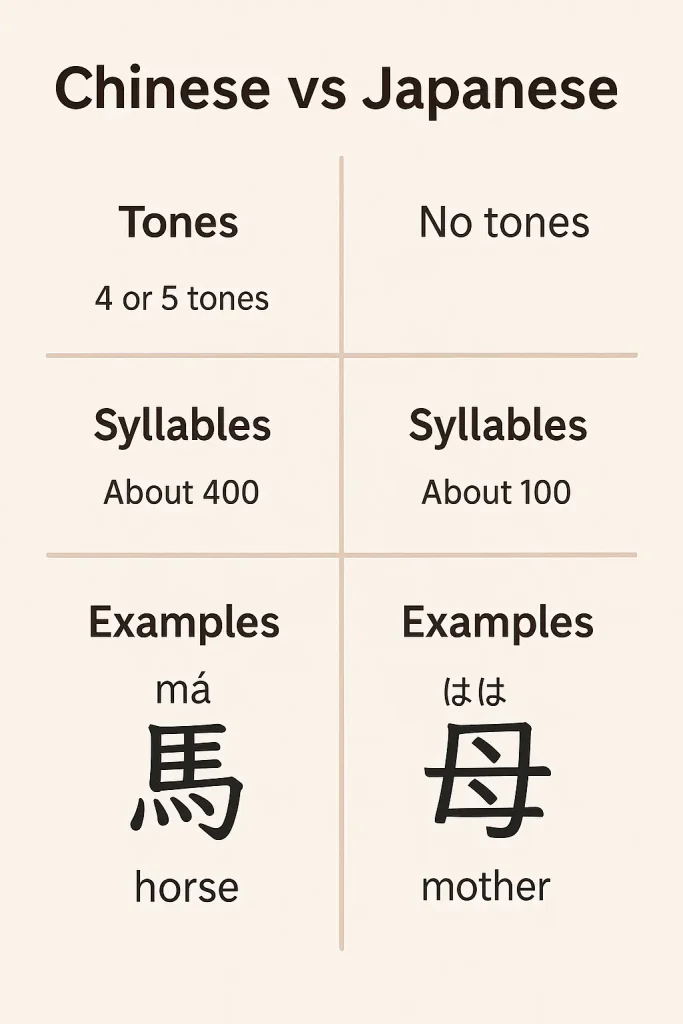
Chinese and Japanese share common roots in written characters. But their grammar differs a lot in word order and morphology.
Chinese Grammar: Simple Structure, Sneaky Particles
Chinese is SVO (subject-verb-object) like English:
我吃苹果
wǒ chī píngguǒ
I eat apple.
Key traits:
- No verb conjugations
- No grammatical gender
- Plurals are mostly optional/contextual
- Tense is handled with aspect particles and time words
Examples:
- 了 (le) → completed action
- 过 (guo) → “have done at least once” experience
Grammar-wise, it’s fairly chill. The load is on tones and characters.
Japanese Grammar: Verb-Heavy, Particle-Heavy, Politeness-Heavy
Japanese is SOV (Subject-Object-Verb):
私はリンゴを食べる
Watashi wa ringo o taberu
I + topic marker + apple + object marker + eat.
The fun extras:
- Verbs change for tense, mood, formality, and politeness
- Tons of particles:
- は (wa) – topic
- が (ga) – subject
- を (o) – object
- の (no) – possession
- Flexible word order because particles mark roles
- Keigo (honorific speech) changes entire verb forms
- する (do) → なさる (respectful) / いたす (humble)
Chinese grammar is “what you see is what you say.”
Japanese grammar is “what’s your relationship, context, and power dynamic… then maybe you can speak.”
Pronunciation Differences in Chinese vs Japanese Language
Mandarin uses four tones. It also has a neutral tone. It has around 400 base syllables. With tones, the total number becomes 1,200. This shows that a single tone change can completely change the meaning of a word.
Japanese is not tonal. It uses a pitch-accent system and is based on mora timing. It has about 100 morae. Pitch changes can alter meaning, but mistakes are usually still understood.
Vocabulary Similarities and False Friends
Japanese has been stealing Chinese vocabulary for centuries:
- Roughly 60% of dictionary entries in Japanese are Sino-Japanese (kango).
- These dominate academic, political, and technical vocabulary.
Then, in the late 19th–20th centuries, Japan sent a bunch of modern terms back into Chinese:
- 哲学 (tetsugaku / zhéxué) – philosophy
- 文化 (bunka / wénhuà) – culture
- 科学 (kagaku / kēxué) – science
The relationship is messy and circular. It is not simply “Chinese came first, Japanese copied, the end.”
Why do people choose one over the other?
People pick Chinese because:
- Career & economy – second-largest economy, massive trade and tech presence
- 1.1B speakers – serious ROI if you want reach
- Grammar that feels more logical to English speakers
Main pain points: tones, characters, homophones.
People pick Japanese:
- Anime, manga, J-pop, gaming. Let’s not pretend otherwise.
- Love of Japanese culture, etiquette, and design
- Pronunciation feels more predictable if you’re terrified of tones
Main pain points: grammar, keigo, three scripts, kanji death wall.
Which Language is Harder to Learn in 2025?
As per U.S. Foreign Service Institute, both Mandarin and Japanese are Category V for English speakers:
- About 2,200 class hours
- Roughly 88 weeks of full-time, high-intensity study
But the difficulty profile is different:
- Chinese = simpler grammar, brutal tones + character memorization
- Japanese = nicer pronunciation, savage grammar + script juggling
Pro fact: AI tools like Jolli, ELSA Speak boost Chinese tone accuracy. AR/VR sharpens Japanese writing and pronunciation.
FAQs
Are Chinese and Japanese mutually intelligible?
No. Same characters don’t mean shared meaning. Spoken forms are completely different.
Can you learn Chinese and Japanese at the same time?
Not recommended. It’s much better to master one sound system before blending two.
Do Japanese people understand Chinese characters?
Chinese open business doors; Japanese open creative worlds. Depends on your goal.
Final Verdict
Both Chinese and Japanese sit in the same FSI “super-hard” bucket, but for opposite reasons.
- Chinese simplifies grammar and wrecks you with tones + character volume.
- Japanese keep pronunciation simple. Then it hits you hard with grammar, particles, honorifics, and multi-script chaos.
Pick whatever you find interesting and fun to learn. And if you need any help? Try Jolii.ai.