Introduction: Understanding Imparfait vs Passé Composé
French learners often describe the pair imparfait vs passé composé as one of the most confusing aspects of the language (I understand why. English at that level is much simpler). Both tenses refer to past actions, yet they convey very different meanings and emotional tones. English speakers might think of them as simple equivalents of “past continuous” and “simple past,” but the reality is richer and more nuanced.
At the heart of the distinction lies a fundamental difference in perspective.
- Passé composé tends to present actions as completed, specific, or punctual events.
- Imparfait, on the other hand, describes background, habits, ongoing states, or atmospheres.
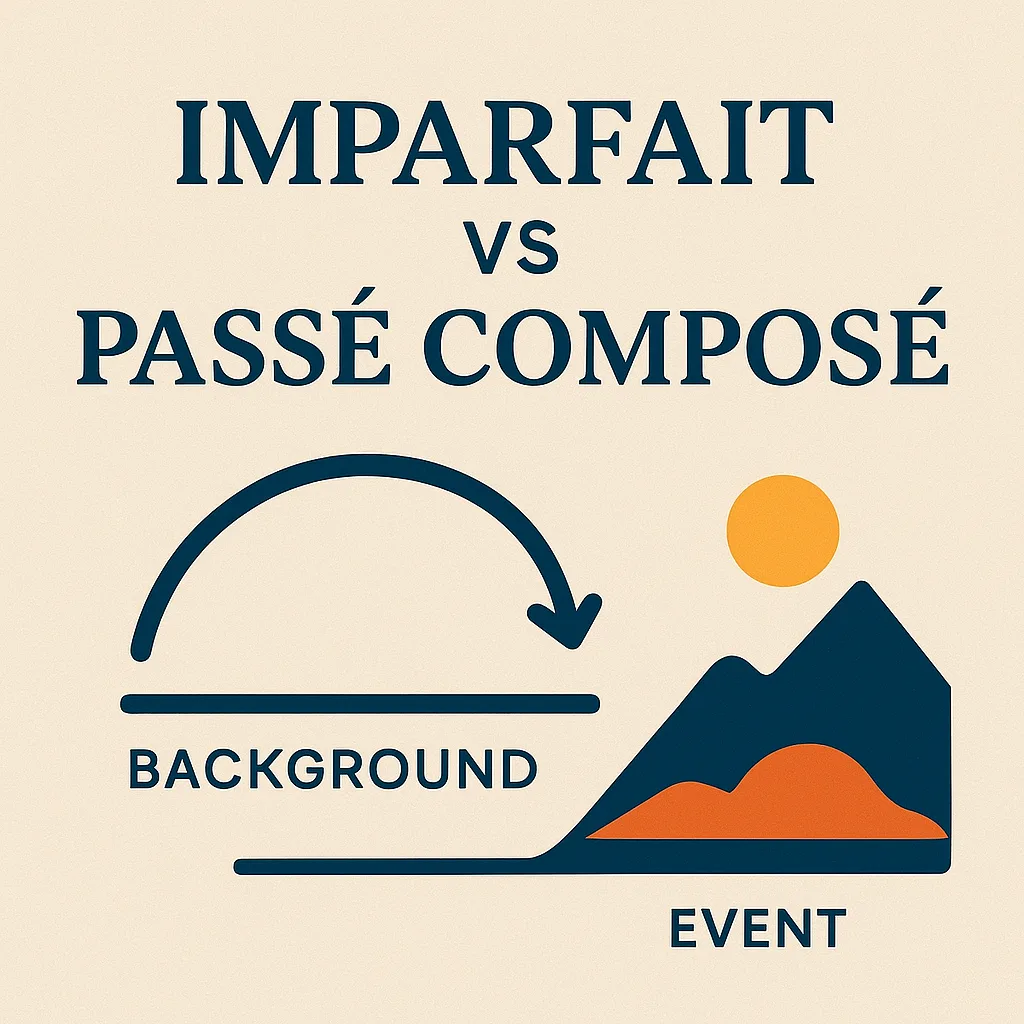
Think of passé composé as a camera shutter: it captures a moment. Imparfait is more like a wide-angle lens: it sets the scene.
French people naturally switch between the two within the same sentence or story, often without even noticing it. For learners, however, choosing the wrong tense can change the meaning or make the narrative sound unnatural. For example, saying “Je regardais la télévision quand il est entré” (“I was watching TV when he entered”) feels smoother and more idiomatic than using two passé composés.
Imparfait vs Passe Compose – Quick Guide
Passé composé = completed, single, specific past actions
Example: J’ai mangé. (I ate)
Imparfait = background, habits, ongoing past states
Example: Je mangeais. (I was eating)
Use passé composé for events.
Use imparfait for descriptions, habits, and ongoing actions.
Grammar Foundations: What Each Tense Really Means

To master imparfait vs passé composé, you first need a clear understanding of what each tense structurally expresses. Although both refer to the past, they operate on different grammatical principles and carry different narrative intentions.
1. The Passé Composé: Completed Actions and Specific Events
The passé composé is used to express actions that:
- happened once,
- are completed,
- have a clear beginning or end,
- or advance the story.
It is formed with:
- an auxiliary verb (être or avoir)
- the past participle
Example:
- J’ai mangé. – I ate.
- Elle est arrivée. – She arrived.
Because it highlights a completed event, it feels similar to the English simple past. However, it is more event-driven than the English tense, and it is often used even when English would use the present perfect.
Typical contexts:
- a single action: Il a téléphoné.
- a sequence of actions: Elle est entrée, puis elle a parlé.
- sudden events: Le téléphone a sonné.
- actions with a clear outcome: Nous avons fini le travail.
Think of passé composé as the “plot-moving” tense.
2. The Imparfait: Background, Habits, and Ongoing States
The imparfait, by contrast, sets the scene. It describes:
- habits: Je jouais tous les jours.
- descriptions: Il faisait froid.
- ongoing states: Nous étions fatigués.
- background conditions: La ville était silencieuse.
- actions in progress interrupted by another event.
Its formation is simpler:
- take the nous present tense
- remove –ons
- add the endings: –ais, -ais, -ait, -ions, -iez, -aient
Example:
- Je regardais. – I was watching.
- Nous étions en vacances. – We were on vacation.
Imparfait has a durative, descriptive, or habitual feel, and it does not focus on the beginning or ending of the action.
3. A Key Concept: Viewpoint (Perspective)
The difference between the two tenses comes down to how the speaker views the past action:
| Tense | Viewpoint |
| Passé composé | Action seen as a single completed event |
| Imparfait | Action seen as ongoing, habitual, or descriptive |
French storytelling often alternates between the two:
- imparfait → sets the atmosphere
- passé composé → delivers the event
Example:
Il faisait beau et les oiseaux chantaient quand soudain le téléphone a sonné.
“It was sunny and the birds were singing when suddenly the phone rang.”
Here, faisait and chantaient create the background, while a sonné introduces the event.
4. Imparfait vs Passe Compose – Key Differences
Now that you understand the basic perspective behind each tense, it helps to see the contrast side-by-side. The table below summarizes the essential differences between imparfait vs passé composé, with clear examples. Click on the audio icon for listen to the pronunciation!
Imparfait vs Passe Compose – Key Differences
| Imparfait | Passé Composé |
|---|---|
| Background Il faisait beau. (It was nice weather.) | Completed action Il a commencé à pleuvoir. (It started raining.) |
| Habitual action Je jouais souvent. (I used to play often.) | One-time event J’ai joué hier. (I played yesterday.) |
| Ongoing past Je marchais dans la rue. (I was walking in the street.) | Sudden change Il est arrivé soudainement. (He suddenly arrived.) |
| Description Elle avait les cheveux longs. (She had long hair.) | Action that moves story forward Elle a ouvert la fenêtre. (She opened the window.) |
| Weather, emotions, age J’avais 10 ans. (I was 10 years old.) | Clear result or outcome J’ai fini le travail. (I finished the work.) |
| “Was …ing / used to …” Je lisais. (I was reading.) | “Did / has done” J’ai lu. (I read / I have read.) |
5. When Both Are Used Together
French speakers frequently mix the tenses within a single sentence. A classic structure is:
Imparfait + quand + passé composé
Because the imparfait sets a continuous context and the passé composé interrupts it.
Example:
- Je lisais quand il est entré.
“I was reading when he entered.”
This combination is so common that it almost feels like a storytelling formula.
5. French Narrative Style
French narration tends to be more descriptive and atmosphere-driven than English. Native speakers often linger on background details using the imparfait before introducing the key event with the passé composé.
This creates a natural rhythm:
- describe the setting → imparfait
- announce the event → passé composé
Understanding this rhythm helps learners sound more natural and less “translated.”
Contrast Through Examples and Storytelling

The best way to understand imparfait vs passé composé in French is to see how native speakers actually use them in real stories. Grammar rules explain the mechanics, but examples reveal the logic, the feel, and the narrative flow behind the two tenses.
Example 1 : Setting the Scene vs. Triggering an Event
Using the imparfait to describe the background:
Il faisait froid et le vent soufflait fort.
“It was cold and the wind was blowing hard.”
These verbs describe a state or background condition. No beginning or ending is emphasized.
Using passé composé for the event:
Soudain, la porte a claqué.
“Suddenly, the door slammed.”
The action is sudden, completed, and interrupts the background.
Together:
Il faisait froid et le vent soufflait fort quand la porte a claqué.
This sentence feels natural because the tenses follow the rhythm of French storytelling: background → event.
Example 2 : Habit vs. One-Time Action
Habit (imparfait):
Quand j’étais enfant, je jouais dans le parc tous les jours.
“When I was a child, I used to play in the park every day.”
Here, jouais expresses a repeated action, not a specific event.
Single event (passé composé):
Hier, j’ai joué dans le parc.
“Yesterday, I played in the park.”
Same verb, different meaning.
Same action, different narrative function.
Example 3 : Ongoing Action Interrupted
A very common storytelling structure:
Je regardais la télévision quand le téléphone a sonné.
“I was watching TV when the phone rang.”
If you replaced the imparfait with passé composé, the sentence would sound abrupt or unnatural:
J’ai regardé la télévision quand le téléphone a sonné.
(Sounds like you finished watching TV before the phone rang, which is not the intended meaning.)
Example 4 : Descriptions vs. Actions
Description (imparfait):
Elle avait les cheveux longs et portait une robe bleue.
“She had long hair and was wearing a blue dress.”
Action (passé composé):
Elle a ouvert la fenêtre.
“She opened the window.”
Descriptions create visual imagery, actions move the story.
Example 5 : Emotion and State
Imparfait often expresses inner states, emotions, or thoughts:
Je me sentais triste.
“I felt sad.”
Nous étions stressés.
“We were stressed.”
These expressions do not describe a punctual event, they describe a condition.
If you use passé composé here, the meaning shifts toward a momentary emotional burst:
Je me suis senti triste.
“I suddenly felt sad.”
Both are grammatically correct, but the nuance is different.
Example 6 : Narrative Flow in a Short Story
Let’s combine everything in a natural storytelling example:
Breakdown:
- était, éclairaient, marchais → background, atmosphere
- a freiné → the key event
This pattern mirrors how French speakers tell anecdotes or recount past events.
French narratives often build atmosphere before introducing the action. Where English might jump straight to the event, French prefers:
- setting
- description
- mood
- event
This gives French storytelling a more cinematic or descriptive feel.
Because of this, students who translate directly from English often overuse passé composé and underuse imparfait. Understanding the narrative rhythm helps avoid this common mistake.
Common Mistakes and Practical Rules for Mastery

Even intermediate learners struggle with imparfait vs passé composé because the difference is subtle and often intuitive rather than purely grammatical.
1. Mistake: Using passé composé for everything in the past
Example (incorrect in many contexts):
Je suis allé au café et j’ai parlé avec mon ami, et j’ai bu un café.
This sounds like a list rather than a story. French prefers a mix of tenses to create flow.
Correct narrative style:
2. Mistake: Forgetting that imparfait describes states, not events
Incorrect:
Correct:
Je m’ennuyais.
(You were bored a state)
Passé composé is possible, but it shifts meaning:
Je me suis ennuyé.
→ “I got bored at a specific moment.”
3. Mistake: Mixing the tenses when the story does not require interruption
Sometimes students write:
When they actually mean two sequential events.
Correct:
Je lisais et il est venu. (if interruption)
J’ai lu et il est venu. (if sequence)
The difference is subtle but meaningful.
4. Rule: Use imparfait for:
- background
- description
- habitual actions
- emotions
- ongoing states
- time, weather, age
- repeated actions
- circumstances
Examples:
5. Rule: Use passé composé for:
- single completed action
- sudden event
- action with a beginning or end
- sequence of events
- change of state
Examples:
6. Rule: Use both together when telling a story
Structure:
(Background) imparfait + quand + (Event) passé composé
Examples:
7. Mistake: Confusing ongoing past actions with habitual past actions
Habitual (imparfait):
Je prenais le bus tous les matins.
Ongoing (imparfait):
Je prenais le bus quand il a commencé à pleuvoir.
Completed (passé composé):
Same verb, different narrative intentions.
8. Rule: If you can add “always / often / every day,” use imparfait
Because it expresses habits.
Je regardais la télévision tous les soirs.
Il allait à la plage chaque été.
9. Rule: If the action is isolated or punctual, use passé composé
Ask yourself:
- Does it happen once?
- Can I add “yesterday,” “suddenly,” or “then”?
- Does the story move forward because of this action?
If yes → passé composé.
10. Tip: Think in pictures, not rules
Imparfait → background image
Passé composé → snapshot/event
When you narrate:
- Paint the environment (imparfait)
- Show the action (passé composé)
This visual strategy helps learners internalize the distinction far more effectively than memorizing charts.
Summary
In French storytelling, the imparfait and the passé composé work together to create a natural flow. People often begin by painting the atmosphere with the imparfait, a mood, a setting, a feeling, before introducing a specific event with the passé composé. This reflects how memories are experienced: a background that slowly forms and a moment that suddenly stands out. Because of this cultural rhythm, French stories feel descriptive and immersive, and the tension between the two tenses becomes an essential part of communication rather than a grammatical exercise.
For you, learners, the key is to think in terms of perspective. If you are describing something ongoing or habitual, the imparfait feels right. If you are presenting a clear, completed action, the passé composé carries the narrative forward. With practice, this distinction becomes intuitive, simple so practice.
Takeaway:
Imparfait sets the scene; passé composé delivers the event. Mastering both means understanding the story you want to tell.
Accelerate your process with Jolii AI. It helps you practice these tenses in context, generate examples, and receive instant feedback so your intuition develops faster and more reliably.