First published: December 2025. Last updated: May 2026
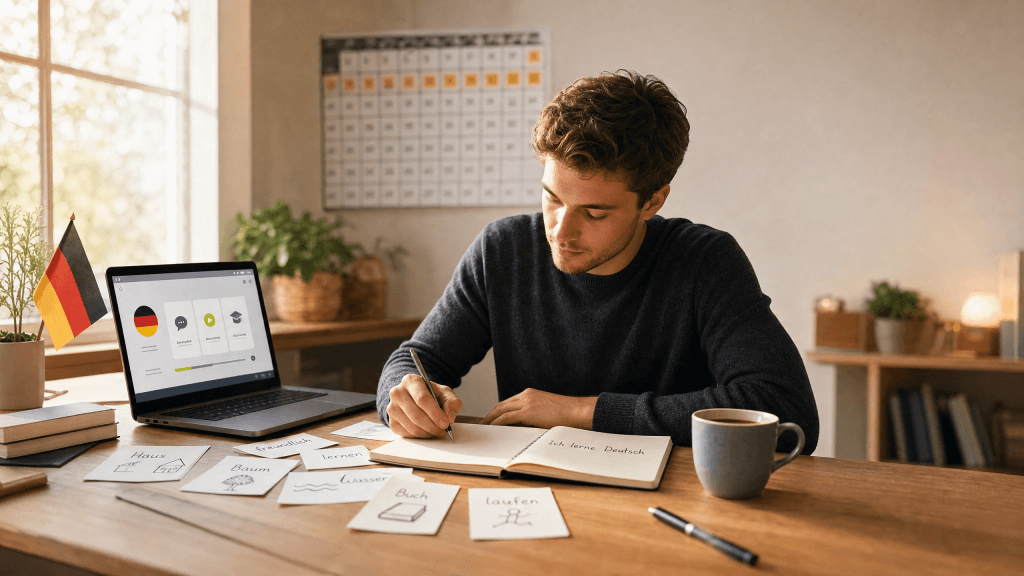
The question isn’t whether you can learn German fast. It’s what “fast” actually means and what it requires.
This guide focuses on reaching conversational A2 in your first 100 days — the level where you can handle basic everyday situations, follow simple conversations, and start feeling the language become automatic rather than constructed. The accelerator plan that follows takes you toward B1, where German stops being something you study and starts being something you use.
One hour a day. One hundred days. Here’s exactly how to spend them.
The Best Way to Learn German Fast in 2026 (What Actually Works)
To learn German quickly in 2026, you need a combination of structured approaches.
You need to adapt to the following daily German learning structure.
- 30 min/day AI tutor
- 10 min/day speech shadowing
- 15 min/day SRS vocabulary
- Watch something in German while eating.
- Speak for 5 minutes in the evening.
That’s roughly 60–75 minutes per day — manageable as a daily habit if you stack it onto existing routines like commuting, eating, or your morning coffee.
Stop Cramming German: Why Immersion, Output, and Spaced Repetition System (SRS) Are the Secret
Immersion allows you to absorb German through context rather than translation. It makes vocabulary and sentence patterns stick naturally. Output keeps you actively involved in the language in the form of writing or speaking. Spaced Repetition System involves actively reviewing the material at certain intervals.
If you want to go deeper into immersion-based learning, you can explore our full guide on learning German through immersion at home.
How Contextual Video-Based Learning Accelerates Your German Learning
Video-based learning lets you immerse yourself in the language. To get started with micro-lessons today, learn how to learn German at a fast pace with YouTube short videos.
You can find varied apps that let you upload videos of your choice and use them as customized lessons for you.
Video-based learning works because it combines three elements that research in second language acquisition consistently identifies as essential: comprehensible input in context, opportunities for active output, and spaced repetition to move vocabulary from short-term exposure into long-term memory. Each element reinforces the others — which is why watching German content actively produces stronger results than passive viewing alone.
How to Learn German Quickly: Your First 100 Days as a Complete Beginner
So, you are all set to learn German in less time, and there you have your first 100 days as a complete beginner.
- You are going to learn a language that is notorious for long words.
- Article (der, die, das) usage is not simple.
In your first 100 days, you are going to concentrate only on three main concepts.
- Learning 800 Core German Words
- Working on German pronunciation
- Getting the flow of the German sentence structure
The 80/20 Rule: Mastering the 800 Core German Words To Reach A2
Forget that you have to cram all of the German words in the dictionary. The Pareto principle states that you get 80% of the results from 20% of your efforts.
Following the Pareto principle, you will not learn each German dictionary word.
What can you do instead?
Learn 800-1000 core words to speak 80% of conversational German.
Tip: Don’t just learn Haus (house). Learn the whole phrase: Das ist mein Haus (That is my house). This contextual learning sticks better and gives you immediate output practice.
Build Pronunciation Early (Umlauts, ß, Stress patterns)
Learn pronunciation along with learning vocabulary. Don’t leave it for later.
The German language has some dots and symbols that seem unimportant, but they actually are critical if you want to learn the right pronunciation.
Umlauts (ä, ö, ü)
Umlauts are diacritical marks(two dots over vowels ä, ö, ü).
Why are umlauts important?
They represent that the vowel sound is changing. They aren’t just an ‘e’ sound; they distinguish words like schon (already) from schön (beautiful).
The Sharp S (ß) is a double “s” sound, not a “b”.
Why learn the sharp S sound?
Knowing where the stress falls in a German word (usually the first syllable) makes you instantly more comprehensible to a native speaker.
What is the best way to learn German pronunciation?
You can mimic the pronunciation through speech shadowing. Practice listening to the audio first, and later speaking the same word. You can use AI tools or a teacher to get feedback on your pronunciation skills and tips for improvement.
Tip: Correct your pronunciation on the go.
Master Simple German Sentence Structure
For beginner-level conversations, you don’t need to learn the “complex part of German grammar.
Just remember:
Subject+Verb+Rest of the sentence
Tip: Focus entirely on the V2 rule: the main verb must occupy the second position in a simple main clause.
Ich kaufe Brot. (I buy bread)
Er wohnt in Berlin. (He lives in Berlin)
By following these three steps consistently across your first 100 days, you build the vocabulary, pronunciation, and sentence structure needed to move from A1 to A2.
Learn German Grammar (German Rules to Achieve Fluency)
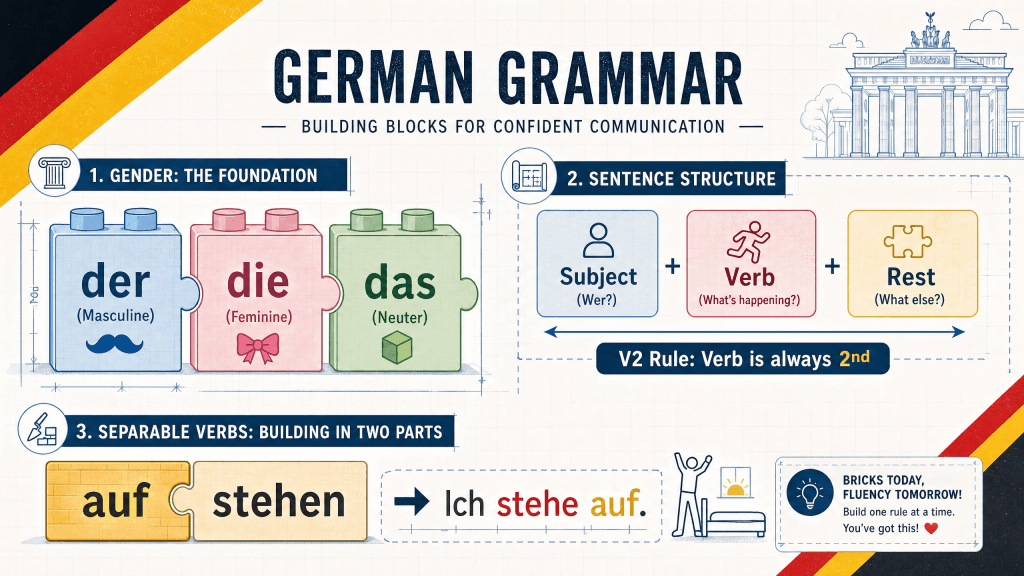
Let’s talk about the elephant in the room, “the German grammar”.
There’s no need to cram the grammar rules. However, to avoid pitfalls, be aware of the most common German grammar mistakes learners make.
You will learn German grammar easily if you understand common patterns to achieve a basic conversational level of German.
German Noun Genders & Articles (der/die/das) Simplified
For English speakers, German genders and articles are not as simple as they are in English.
But you will learn German noun genders and article patterns here.
| der | Masculine | Nouns ending in -er, -ling, -ismus (e.g., der Computer) |
| die | Feminine | Nouns ending in -e, -ung, -heit, -keit (e.g., die Wohnung) |
| das | Neuter | Diminutives -chen, -lein, many loanwords (e.g., das Hotel) |
The 4 German Cases Explained Fast (A1–A2 Level)
The German case system tells you what role each noun plays in a sentence. Think of it less as a grammar rule and more as a labeling system — each case answers a different question.
| Case | Question it answers | Example |
|---|---|---|
| Nominative | Who is doing the action? | Der Mann kauft Brot. (The man buys bread.) |
| Accusative | What is receiving the action? | Der Mann kauft den Apfel. (The man buys the apple.) |
| Dative | To/for whom is something done? | Er gibt dem Kind den Apfel. (He gives the apple to the child.) |
| Genitive | Whose is it? | Das ist das Auto des Mannes. (That is the man’s car.) |
What actually changes:
| Masculine | Feminine | Neuter | Plural | |
|---|---|---|---|---|
| Nominative | der | die | das | die |
| Accusative | den | die | das | die |
| Dative | dem | der | dem | den |
| Genitive | des | der | des | der |
The practical approach for A1–A2:
Focus on nominative and accusative first — they cover the majority of everyday German. The only article that changes between the two is the masculine: der becomes den. Everything else stays the same.
Add dative at A2–B1 when you start using verbs like geben (to give), helfen (to help), and prepositions like mit, nach, seit, von, and zu — all of which always take dative.
Leave genitive for later. Native speakers increasingly use dative constructions in casual speech anyway — “dem Mann sein Auto” instead of “des Mannes Auto” — so avoiding genitive at early stages won’t make you sound unnatural.
Word Order & Separable Verbs (Quick Patterns to Memorize)
You will find two types of verbs.
The ones you have already learned in the first 100 days.
Subject+Verb+Rest of the sentence
Rule 1: The Verb Must Be Second (V2): We covered this. Ich gehe jetzt nach Hause. (I go now home.)
Rule 2: The End-of-Sentence Verb (Subordinate Clause): This happens when you start a sentence with a connector like weil (because) or dass (that).
Main Clause+Connector+Subject+…..+Verb(final)
Example: Ich lerne Deutsch, weil ich in Deutschland wohne. (I learn German, because I in Germany live.)
Separable verbs are another thing you must learn; here, the verb has a prefix that separates it. The prefix goes at the end, while the main verb stays on its own.
The most commonly found prefixes are ab-, an-, auf-, aus-, ein-, mit-, nach-, weg-, and zu-.
Example: Ich stehe um 7 Uhr auf. (I get up at 7 o’clock.)
Here the verb is “aufstehen,” which means “to get up,” and it is split into the main verb “stehe” and the prefix “auf” goes at the end.
The 100 Days: Your Daily Plan to Reach Conversational (B1)
After completing the initial 100-Hour Conversational Base, you are now ready for the accelerator plan.
It is structured to take your functional A2 conversation skills and rapidly push them toward true B1 Fluency.
If you follow a 1-hour plan each day, the 100-day plan will steadily build conversational fluency.
Alternative Timeframe. Or, if you want a faster start, try our 30-day German learning challenge.
Here is a daily plan to reach the B1 level of fluent German.
Days (1-30) Foundations A1
| Focus Area | Daily Action | Why This Works |
| Input | 10 min Speech Shadowing | Trains pronunciation and umlauts |
| Vocabulary | 15 min SRS Vocabulary | Builds core 800 words efficiently |
| Output | 30 min AI Tutor Dialogue | Builds speaking confidence |
Days (31-60): German Grammar & Real Phrases
Okay, time to tackle the German rules, but we’re doing it the smart way—through context!
You’ll be applying grammar in conversation, not just reading charts.
| Focus Area | Daily Action | Why This Works |
| Grammar | Video immersion with transcripts | You’ll analyze video clips to see the Accusative and Dative cases in action. Context makes it click. |
| Phrases | 5 min evening speech | Practice building longer sentences using simple conjunctions. You’re linking ideas now! |
| Output | 30 min AI Tutor Roleplay | Practice high-value, functional dialogues: booking trains, asking for directions. |
Days(61-100): Fluency Drills & B1 Power-Up
You need to practice this to achieve fluency. You’re moving from correct speaking to fast speaking.
Here, your focus will shift to speed and mastering those complex structures that make you sound truly fluent.
| Focus Area | Daily Action | Why This Works |
| Fluency | Speech shadowing + speed drills | Try to match the speed of the native speaker. As per CEFR, this is the fastest way to feel natural. |
| Complexity | AI dialogue feedback | The tutor pushes you to use separable verbs and subordinate clauses correctly in conversation. |
| Output | 30 min AI tutor debate | Discuss opinions, plans, and abstract ideas. This confirms you’re at B1. |
How to Practice Speaking German Every Day (Even Alone)
You can practice German speaking alone every day, even if you have no German friends.
Learning vocabulary and memorizing grammar rules is only part of the process. When it comes to speaking, you have to actually use the language out loud.
I have observed that language comes through speaking, and when you are alone, you can use language learning apps. Jolii has a chatbot that analyzes your speech and lets you correct the mistakes instantly.
You can memorize all the vocabulary and grammar rules in the world, but if you don’t use your mouth, you won’t speak German fast.
But what if you don’t have a German friend, a conversation partner, or the budget for a daily private tutor? No problem! Modern tools and smart routines mean you can get powerful, effective speaking practice every single day, even if you’re sitting in your living room alone.
Self-Talk + Shadowing Routines: Your Secret Weapon
This combination is one of the most effective techniques for building fluency and automaticity quickly.
German Self-Talk:
Narrate your day out loud in German.
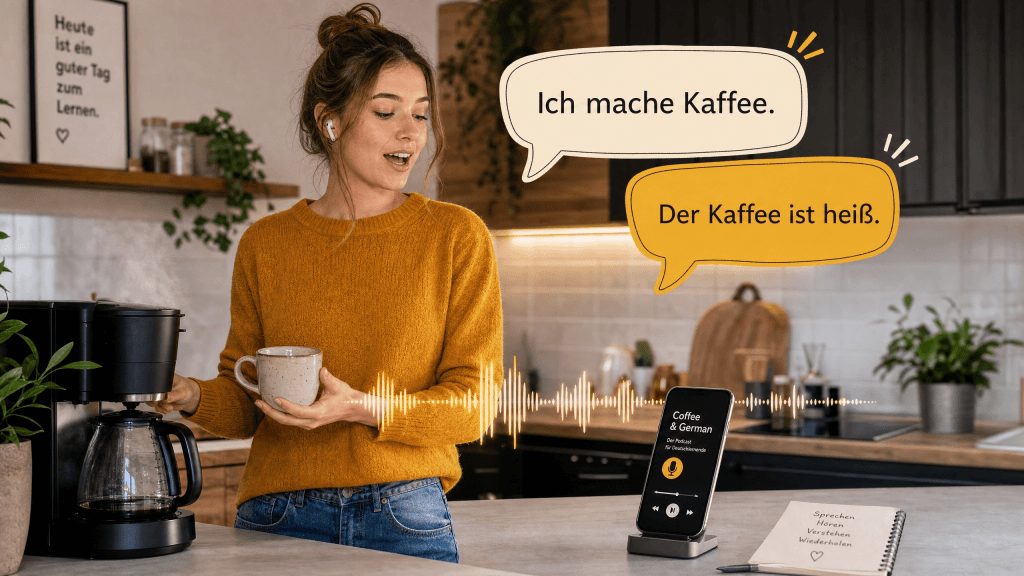
When you’re making coffee, describe the process: “Ich mache Kaffee. Der Kaffee ist heiß.“ (I am making coffee. The coffee is hot.)
Results: It lets you think about applying correct German sentence structure under pressure—just like in a real conversation.
The Shadowing Technique:
Listen to a short segment of native German audio (from a podcast or a Jolii video) and immediately repeat the words back.
Mimic the speaker’s intonation, pace, and rhythm.
Results:
It builds your auditory input and trains your mouth muscles faster than any other drill.
You can discuss opinions, plans, and abstract ideas. This confirms you’re at B1—you might even be ready to share some German jokes!
The journey to speaking fluency takes you from an aspiring to a confident German speaker.
FAQs
How long does it realistically take to learn German?
The Foreign Service Institute (FSI), which trains US diplomats in foreign languages, estimates approximately 900 study hours to reach professional working proficiency in German. If conversational fluency at B1–B2 is your goal rather than full professional proficiency, most learners get there in significantly fewer hours — especially with structured daily practice.
Can you learn German fast using only apps?
Apps alone are rarely sufficient because they tend to focus on recognition rather than production — you can answer multiple choice questions correctly without being able to construct a sentence spontaneously. The most effective approach uses apps for vocabulary and grammar drilling, video content for immersive input, and AI conversation practice for speaking output. Jolii combines all three in a single workflow, which removes the friction of switching between multiple tools.
What German CEFR level can you reach in 2–3 months?
A dedicated learner putting in one hour a day from scratch can realistically reach A2 in two to three months — solid basic comprehension and simple conversation on familiar topics. B1 requires significantly more time, typically four to six months beyond A2 with consistent daily practice. Attempting to reach B1 from zero in two to three months would require three to four hours of daily study in a structured environment, like a full-immersion language learning course in Germany.
What’s the best way to practise German speaking without a native speaker?
Three methods work well in combination. Self-talk — narrating your daily activities out loud in German — builds the habit of thinking in the language rather than translating. Shadowing — repeating native audio immediately after hearing it — trains pronunciation and rhythm faster than any other technique. AI conversation practice provides the back-and-forth of real dialogue with immediate correction, available any time without scheduling. Jolii’s AI tutor combines shadowing with conversation practice built around real German video content.
Is German grammar really as hard as people say?
For English speakers, yes — but not uniformly. The case system and adjective endings are genuinely complex and take months to internalise. Verb conjugation and basic sentence structure click relatively quickly. The key is not trying to master everything at once. The approach in this guide — focusing on nominative and accusative cases first, adding dative later, and leaving genitive until B1 — mirrors how German children actually acquire the language and is more effective than trying to learn all four cases simultaneously from the start.