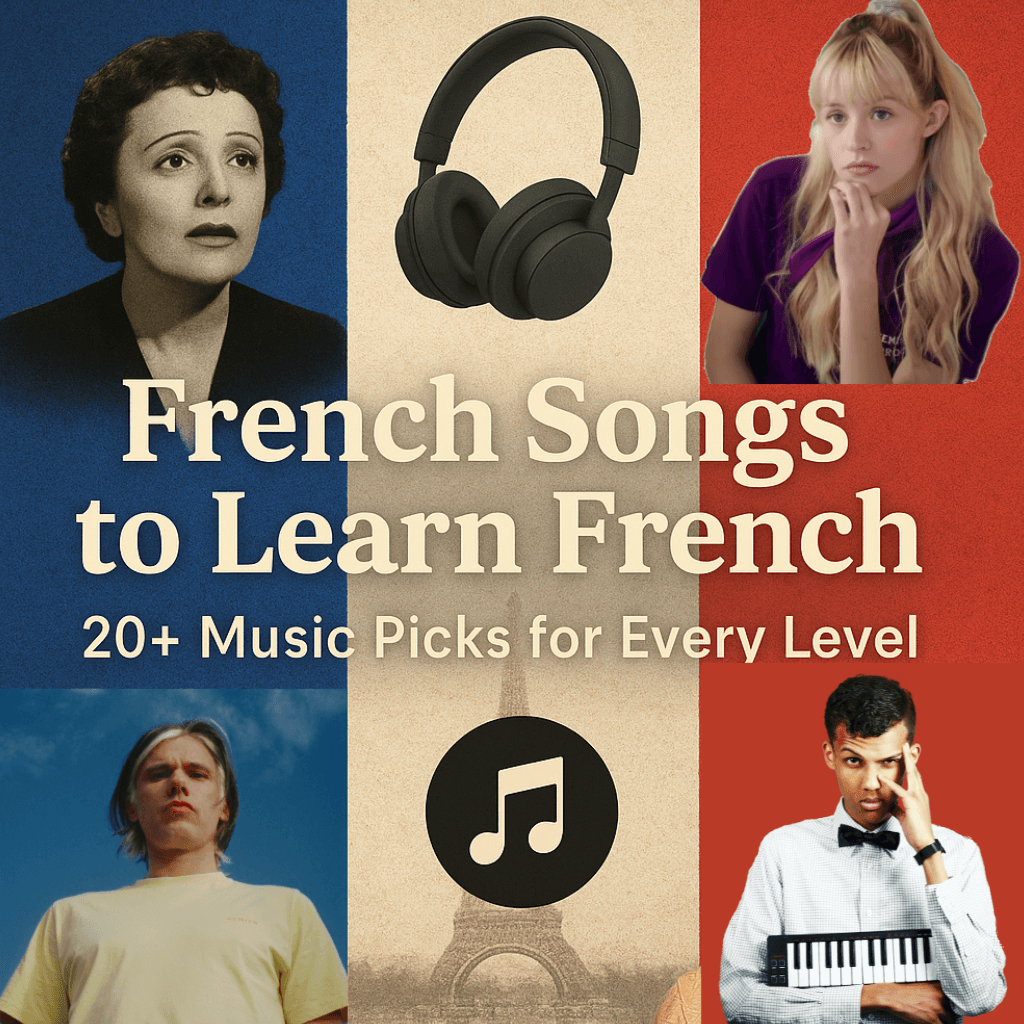
It’s well known that music is an excellent way to learn a language, and in this case, the one we’re interested in here: French. Songs help learners absorb vocabulary naturally, memorize expressions thanks to rhythm, and take in the melody of the French accent. If you’re looking for the best French songs to learn French, look no further, you’re in the right place. We’re offering you more than 20 carefully selected tracks, sorted by level, accompanied by audio clips, cultural notes, and practical study tips.
According to several language-learning studies, songs significantly improve long-term vocabulary retention thanks to melody-based memory. Using music strategically can turn passive listening into a powerful learning routine. Let’s put that into practice.
Why Learn French With Music?
Learning through music is one of the most natural ways to absorb a language. French songs offer a mix of authentic pronunciation, cultural context, and memorable repetition, making them ideal for learners at any level.
The Benefits of Learning French With Songs
1. Better Listening Comprehension
Songs expose you to real, everyday pronunciation, liaisons, contractions, rhythm, and even regional accents. This helps you understand spoken French beyond textbook phrases.
2. Improved Pronunciation & Accent
Melody trains your ear to recognize intonation patterns. Repeating lyrics helps you internalize the unique musicality of French.
3. Natural Vocabulary Acquisition
Words learned through songs stick longer because they’re tied to rhythm, emotion, and imagery.
4. Exposure to Idioms & Real Expressions
Many popular French songs contain idiomatic phrases you won’t find in beginner textbooks.
5. Strong Emotional Connection
Emotion boosts memory. When a song moves you, the vocabulary becomes easier to recall.
6. Cultural Immersion
From Piaf to Stromae to modern alt-pop, each song teaches a piece of French identity.
Because songs repeat key structures (like verb forms, useful phrases, and connectors), they act as natural spaced repetition systems, a proven method for long-term retention.
Beginner-Friendly French Songs to Learn French (A1-A2)
Beginner songs should be slow, clear, and built around repetitive structures. These tracks help learners distinguish sounds, build basic vocabulary, and gain confidence.
Top Beginner-Friendly French Songs
1. “Je te laisserai des mots” – Patrick Watson
A soft, poetic song with very clear articulation. Perfect for romantic vocabulary, simple nouns, easy sentence structures.
2. “On écrit sur les murs” – Kids United
A positive, uplifting song sung by children, perfect for beginners. You can learn present tense verbs, simple imagery, inclusive vocabulary (“on”, “nous”).
3. “Moi… Lolita” – Alizée
Catchy, repetitive, and easy to follow. You find informal expressions, pronunciation of oi, li, ti, and musical rhythm of French.
4. “Je Vole” – Louane
Slow and emotional, ideal for learners discovering French past tenses. Learn past narration, personal emotions, everyday vocabulary.
5. “C’est la vie” – Khaled
Although originally in a Franco-Arabic style, the chorus is extremely accessible. Simple exclamations, repeated vocabulary, a first contact with Maghreb-influenced French.
Start by focusing on choruses, they’re repetitive, easier to memorize, and often contain the key vocabulary of the song. Listening to the chorus first builds instant confidence before tackling full verses.
Intermediate French Songs (B1-B2)
At this stage, learners can handle longer sentences, idioms, and a variety of tenses. Intermediate songs are perfect for building expressive vocabulary, improving rhythm, and discovering cultural nuances.
Top Intermediate French Songs
6. “La Vie en Rose” – Édith Piaf
A timeless classic with poetic, emotional vocabulary. Figurative expressions, love-related vocabulary, pronunciation clarity.
7. “Dernière danse” – Indila
Beautiful vocals with precise diction. Learn patterns like je remue, je danse, je cours with Derniére danse
8. “Formidable” – Stromae
A must-listen for any French learner. Cheers with informal spoken French, Belgian pronunciation, contractions (t’es, j’suis, y’a).
9. “Paris” – Pomme
Soft indie pop with accessible lyrics. Daily life vocabulary, emotional expressions, simple metaphors.
10. “Le Festin” – Camille
Famous from Ratatouille, very clear and melodic. Learn: adjectives, descriptions, food vocabulary, useful verbs (laisser, sorter, régaler).
This is the perfect moment to begin shadowing, repeating lines out loud as the singer sings them. It improves your accent, timing, and connection between written and spoken forms.
Advanced French Songs (C1-C2)
Advanced learners can finally explore the full richness of French music: faster flow, slang, idioms, cultural references, poetic writing, and layered meaning. These songs challenge comprehension while sharpening spoken fluency.
Top Advanced French Songs to Learn French
11. “Basique” – Orelsan
A track built around fast, repetitive lines with modern slang.
12. “Ne me quitte pas” – Jacques Brel
One of the most powerful songs in the Francophone world. Poetic language, emotional nuance, conditional forms, elevated vocabulary.
13. “Christine / Tilted” – Christine and the Queens
Blends French and English with intricate phrasing. You can learn subjunctive structures, self-reflective vocabulary, fluid transitions between languages.
14. “J’suis pas dupe” – Lomepal
Clean rap with personal, introspective themes. See modern vocabulary, relationship-related expressions, advanced pronunciation patterns.
15. “Balance ton quoi” – Angèle
A cultural phenomenon in the French-speaking world. Belgian French nuances, modern slang and social commentary.
At C1-C2, switch to a lyrics-first approach: Read the full lyrics before listening, underline unknown words, then listen twice, once normally, once while following the text. This mirrors how advanced learners train for real-life speed conversations.
Trending French Songs (2024-2025)
French learners often want to understand the current French they hear on TikTok, YouTube, or in cafés. These recent hits introduce you to modern slang, youth expressions, and cultural references that don’t usually appear in textbooks.
Popular & Trending Songs to Learn Contemporary French
16. “Jolie demoiselle” – Ninho
A melodic rap hit mixing smooth flow and clear phrasing. There, you can find urban vocabulary, expressions of attraction, common contractions.
17. “Mercredi soir” – Pierre de Maere
Distinct voice and impeccable diction, trending heavily in francophone pop. A song with everyday vocabulary, Belgian French musicality.
18. “Soleil” – Yoa
Soft pop with very clear pronunciation and modern themes, with metaphorical vocabulary, poetic adjectives, contemporary tone.
19. “Dépassé” – Zaho de Sagazan
One of the breakout artists of recent years, known for expressive delivery. Emotional lexicon, advanced descriptions, storytelling.
20. “Casanova” – Soolking & Gazo
Danceable, catchy, and language-rich. What you learn: fast-paced expressions, slang, modern rhythm of spoken French.
Trending French songs are a goldmine for learners wanting to sound more natural. They reflect how people actually speak today, especially young adults, making them ideal for anyone aiming for conversational fluency.
How to Use French Songs to Learn Effectively

Listening to French songs is great, but listening strategically is where real progress happens. Here are practical, learner-tested methods to transform your playlist into a powerful learning routine.
1. Listen → Read → Listen Again
Start by listening naturally. Then read the lyrics to catch missed words. Finally, listen again with new understanding. This reinforces the link between spelling, pronunciation, and meaning.
2. Try Shadowing (Repeating Out Loud)
Repeat lyrics in real time as the singer performs them :
- accent
- rhythm
- breath control
- natural connected speech
Great for intermediate and advanced learners.
3. Chunk the Vocabulary
Instead of memorizing isolated words, learn short expressions (chunks):
- avoir envie de…🔊 → want to
- je n’en peux plus🔊 → I can’t take it anymore
- c’est pas grave🔊 → it’s okay / it’s all right / it doesn’t matter
Songs are full of perfect chunks that native speakers use daily.
4. Focus on Choruses First
Choruses are repetitive and usually clearer than verses.
By mastering them first, you build immediate confidence and comprehension.
5. Use Slow Playback
Listening at 0.75x or 0.9x helps you catch contractions and subtle sounds. It’s especially useful for:
- rap
- fast pop
- artists known for fluid diction (Orelsan, Angèle)
6. Learn With Audio Clips
Short audio excerpts allow you to isolate difficult lines or practice pronunciation on specific segments. They make it easier to catch nuances you’d miss in full-speed listening.
Music naturally creates a form of spaced repetition: each time a chorus repeats, your brain strengthens connections between sound and meaning. This makes learning through songs more efficient than passive study.
Cultural Insight: Music as a Window Into French Identity

Learning French fast through songs gives you more than vocabulary, it offers a direct connection to French identity, emotions, and artistic traditions. Each era, region, and genre reflects a different facet of the francophone world.
1. Emotional Expression & Poetic Tradition
French music has always embraced lyricism. From Piaf’s dramatic vibrato to contemporary indie artists like Pomme, emotions play a central role. You learn metaphors, imagery, cultural references to love, nostalgia, and melancholy.
2. Social Commentary Through Music
Artists such as Stromae, Angèle, and Orelsan use music to discuss society, politics, inequality, and modern identity.
3. A Multicultural Francophone World
French music isn’t limited to France. It includes Belgium, Switzerland, Canada, and the Maghreb.
- Stromae (Belgium)
- Angèle (Belgium)
- Soolking (Algeria)
- Pierre de Maere (Belgium)
Accents, regional expressions, and cultural diversity.
4. From Chanson to Rap: A Century of Styles
French music spans classic chanson, 80s pop, electro, indie, slam, and rap/trap, now the most popular genre among young people.
By exploring different eras and regions, learners naturally absorb a broader cultural awareness. This enriches comprehension, boosts motivation, and builds a deeper connection with the language, something textbooks rarely provide.
Summary & Takeaway

Now that we’ve looked at over 20 French songs to learn French, you now know that through music, it offers you a path that is both fun, efficient, and culturally rich. From songs suitable for beginners to more advanced tracks with complex vocabulary and slang, each level provides carefully selected options:
- Beginners (A1–A2): slow, repetitive songs to build confidence and basic vocabulary.
- Intermediate (B1–B2): songs with idioms, varied tenses, and expressive phrases.
- Advanced (C1–C2): fast-flow rap, poetic lyrics, and slang for authentic fluency.
- Trending Songs: modern hits that reflect current youth culture, everyday expressions, and contemporary accents.
Takeaways:
- Music enhances listening comprehension, pronunciation, and memory retention.
- Repetition through choruses and shadowing strengthens natural recall.
- Cultural context enriches learning and understanding of idioms, slang, and regional variations.
- Audio clips and slow playback accelerate mastery of tricky phrases.
To get even more out of your French music practice, try using Jolii AI, the app designed for language learners. It provides audio support, interactive exercises, and smart tools to turn your favorite songs into effective learning sessions. Boost your French skills while enjoying the music you love, a perfect blend of fun and learning.