TL;DR
Words are easier to remember when they appear inside emotionally meaningful moments. When a phrase is spoken by a character you like, the brain stores not just the word but the entire scene—voice, emotion, and context—creating a powerful memory anchor that makes the language easier to recall later.
Words from movies often stay in your memory longer than words from a vocabulary list.
Especially when they’re said by a character you like.
Sometimes you remember a word from a movie without ever trying to memorize it.
Maybe it was a line your favorite character said.
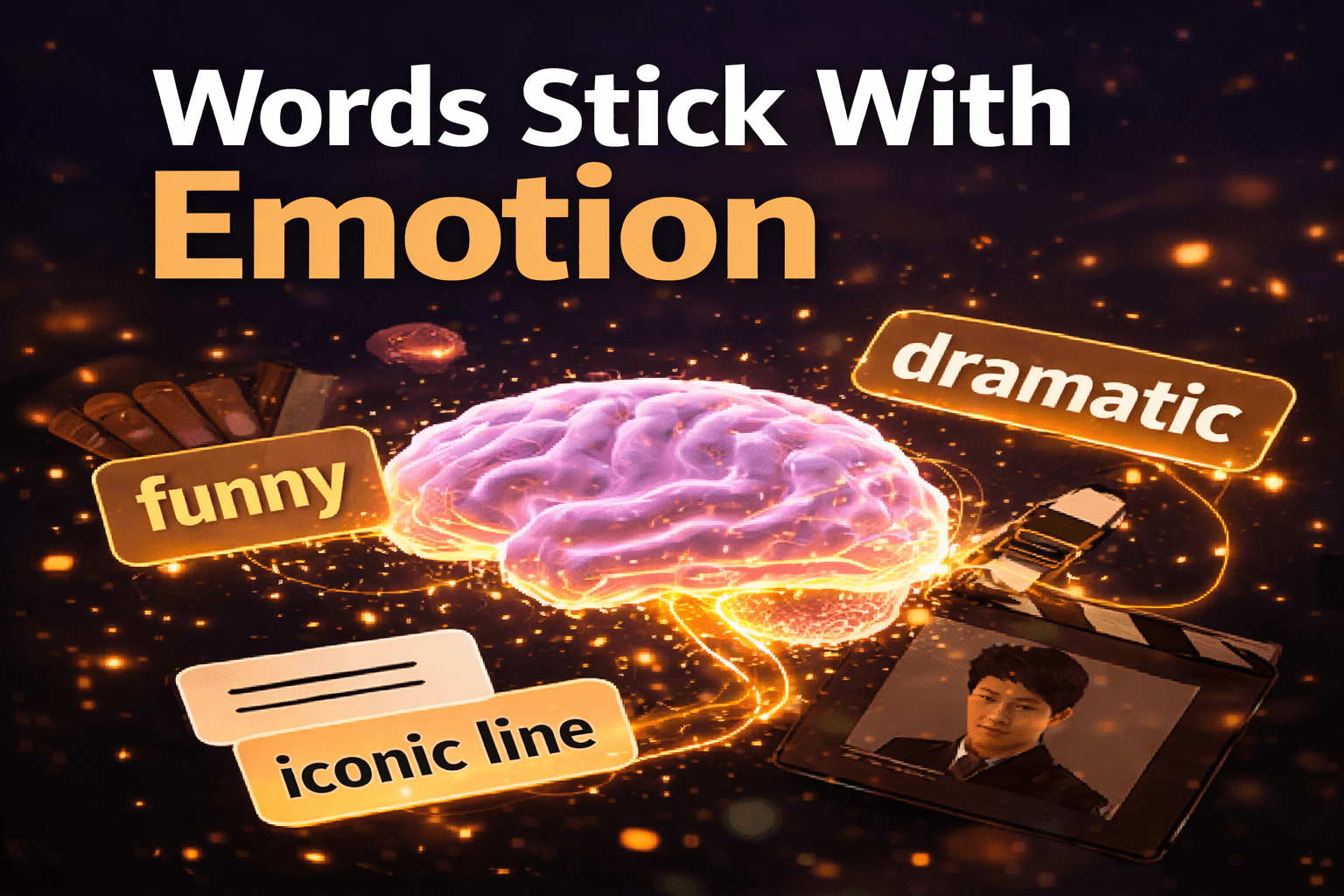
Maybe the scene was funny.
Or a little dramatic.
And somehow that sentence just stayed in your head.
This happens because the brain remembers language differently when it is connected to emotion.
When a word appears inside a meaningful moment, it becomes easier to recall later.
The scene, the voice, the feeling — they all become part of the memory.
In a way, emotion becomes a kind of memory anchor that helps the brain hold on to the language.
Why Vocabulary From Movies Feels Easier to Remember
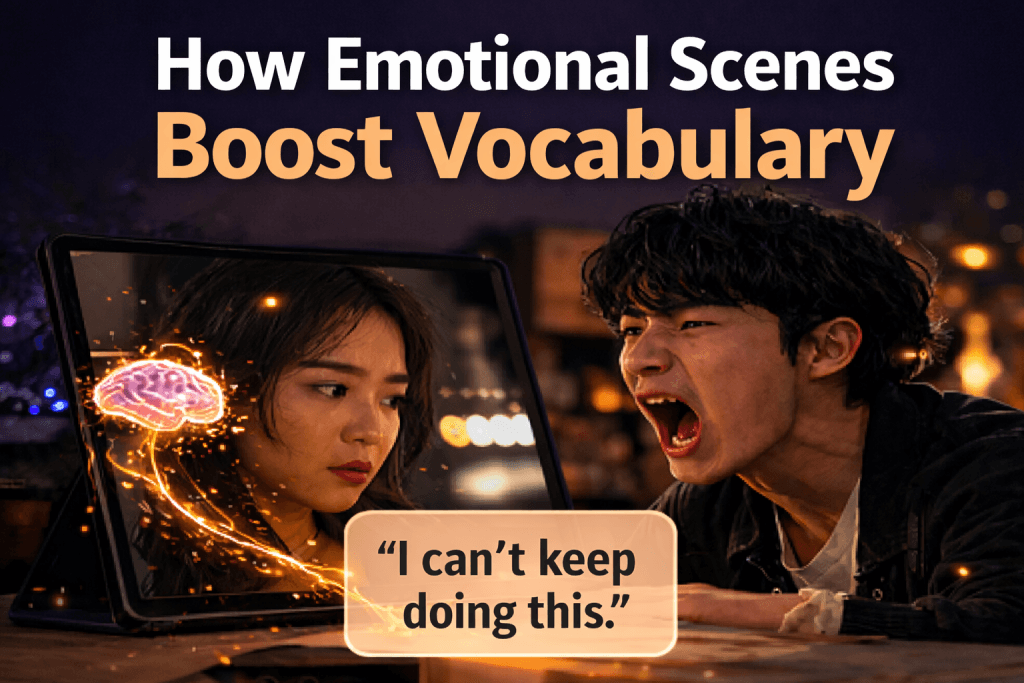
Many language learners notice something curious after watching shows in their target language.
Words from textbooks often fade surprisingly quickly.
You might memorize twenty new words in a study session.
A few days later, many of them feel unfamiliar again.
But phrases from movies or TV shows behave differently.
A short line from a character can stay in your memory for weeks—or even months.
Sometimes learners remember an entire sentence without ever intentionally studying it.
Why does that happen?
The difference is not the word itself.
The difference is how the word entered your memory.
Vocabulary lists present language as isolated information.
But when language appears in a story, the brain experiences much more than just words.
It processes:
- The character speaking
- The emotional tone
- The situation
- The visual scene
- The reaction of other characters
Instead of remembering a word alone, the brain remembers an event.
And that event becomes a powerful retrieval cue later.
The Cognitive Mechanism: Emotion and Memory
One thing I started noticing while learning languages is this.
Words connected to a strong moment are strangely hard to forget.
A line from a dramatic scene.
A sarcastic comment from a character.
Even a short reaction in an argument.
Those lines tend to stay in your memory much longer than vocabulary from a study list.
It turns out the brain treats emotional experiences differently from ordinary information.
Neuroscience research shows that emotionally meaningful events activate brain systems that strengthen memory consolidation. One structure involved in this process is the amygdala, which interacts with the hippocampus to reinforce memories connected to emotional experiences.
Other studies have also found that emotionally charged words and images are remembered more easily than neutral information because emotional processing strengthens how memories are encoded and later retrieved.
In language learning, this leads to an interesting effect.
When a word appears inside a memorable scene, the brain doesn’t store only the word.
It stores the moment.
The tone of voice.
The character’s expression.
The situation in the story.
Later, when you try to recall the phrase, the brain often retrieves the scene first.
And the words come back with it.
That’s essentially what an emotional anchor is.
Why Emotional Context Creates Stronger Vocabulary Memory
There is another reason emotional scenes improve memory.
Emotion increases attention.
When a scene is funny, dramatic, or surprising, the brain becomes more alert.
Attention increases how deeply information is processed.
Language heard during those moments therefore receives stronger encoding in memory.
Emotion also helps create distinctive memories.
A vocabulary list often looks similar from one page to the next.
But a scene from a movie is unique.
It has its own:
- Tone
- Voice
- Setting
- Emotional meaning
These elements make the memory easier to retrieve later.
A Moment I Realized This Myself
I noticed this while watching a Korean drama.
There was a scene where one of the characters said a short sentence during a tense conversation.
The phrase itself wasn’t complicated.
But the moment was memorable.
The character’s expression changed.
The tone of voice was slightly emotional.
The situation made the line feel important.
At the time, I didn’t think much about it.
I was simply watching the show.
But weeks later, I noticed something interesting.
I could still recall that exact sentence instantly.
Not because I had studied it.
Not because I had written it down.
But because I remembered the scene.
The phrase was attached to a moment.
And the moment made the language easy to remember.
Emotional Anchors in Language Learning
| Learning Situation | What Happens in the Brain | Result |
| Vocabulary list | Isolated information | Easier to forget |
| Emotionally meaningful scene | Context + emotion + voice | Stronger memory |
| Repeated emotional exposure | Reinforced episodic memory | Faster recall |
Emotion does not replace repetition.
But it makes repetition more powerful and more memorable.
How to Use the Emotional Anchor Method

1. Learn Language Through Characters
Characters in shows often repeat certain phrases.
These include:
- Reactions
- Emotional expressions
- Short conversational responses
For example:
“That makes sense.”
“No way.”
“Are you serious?”
Because these phrases appear in real interactions, they are easier to remember than isolated vocabulary.
2. Replay Memorable Lines
When a line from a show stands out, replay it several times.
Pay attention to:
- Tone of voice
- Rhythm of the sentence
- Emotional context
These elements strengthen the memory. Over time, the phrase becomes familiar enough to appear naturally in conversation
3. Connect Words With Scenes
When trying to recall a phrase, think about the scene where you heard it.
Often the brain retrieves the visual moment first.
Then the words follow automatically.
This is an example of episodic memory helping language recall.
Why Emotional Learning Feels More Natural
Language is not just a collection of words.
It is communication between people.
In real conversations, words always appear together with:
- Emotion
- Facial expressions
- Tone
- Social context
Learning through emotionally meaningful input simply mirrors how language normally exists in real life.
That is why phrases learned from movies or conversations often feel more natural than vocabulary learned from flashcards. The brain recognizes language as part of human interaction, not just information
FAQs
1. Why do I remember movie quotes more easily than vocabulary lists?
Because the words are connected to emotional scenes, which strengthens memory formation.
2. Do emotions really affect language learning?
Yes. Emotional experiences activate brain systems involved in memory consolidation, making information easier to remember.
3. Should I stop studying vocabulary lists?
No.
Structured study helps introduce new words.
However, combining structured learning with emotionally meaningful input improves long-term retention.
A Simple Way to Create Emotional Anchors
One challenge with learning through videos is that learners often watch passively.
Passive exposure increases recognition but does not always strengthen recall.
Interactive learning can make emotional moments more useful.
For example, Jolii turns short video segments into interactive learning sessions using dual subtitles and guided exercises.
This encourages learners to notice memorable phrases and actively repeat them.
As a result, emotional moments in a show become powerful language memory anchors.
If you are interested in how short bursts of authentic input improve language learning, you might also enjoy this article:
Why Repetition Alone Doesn’t Build Fluency (But Variation Does)
It explains why short segments of real conversation can sometimes produce stronger learning signals than longer study sessions.
Final Thoughts
Words are easier to remember when they are connected to experiences.
A vocabulary list may introduce a word.
But a meaningful scene gives that word a place in your memory.
Emotion transforms language from simple information into a memorable moment.
And the brain rarely forgets moments that felt meaningful.