First published: November 2025. Last modified: May 2026
German immersion sounds glamorous until reality hits.
Here’s the twist. You don’t need a single native speaker to build an immersive German world at home.
Most people learn at home with nothing but Wi-Fi and a normal schedule.
Immersion works when the language surrounds you daily, not when you relocate your entire life. Daily exposure beats weekend study binges, and simulated immersion can match classroom outcomes.
You can wrap your life in German without ever leaving your couch.
Can you really learn German via Immersion?
The short answer is. Yes!
Research consistently shows that immersion learners develop stronger listening comprehension and vocabulary retention than learners using traditional methods alone — particularly when exposure is daily rather than periodic. For dedicated learners putting in an hour or more a day, B1 is realistically achievable within six to twelve months. B2 takes longer — most estimates put it at 500 to 600 hours of quality input and output combined, which at one hour a day means roughly eighteen months to two years. The timeline varies significantly depending on your starting level and how actively you use the time.
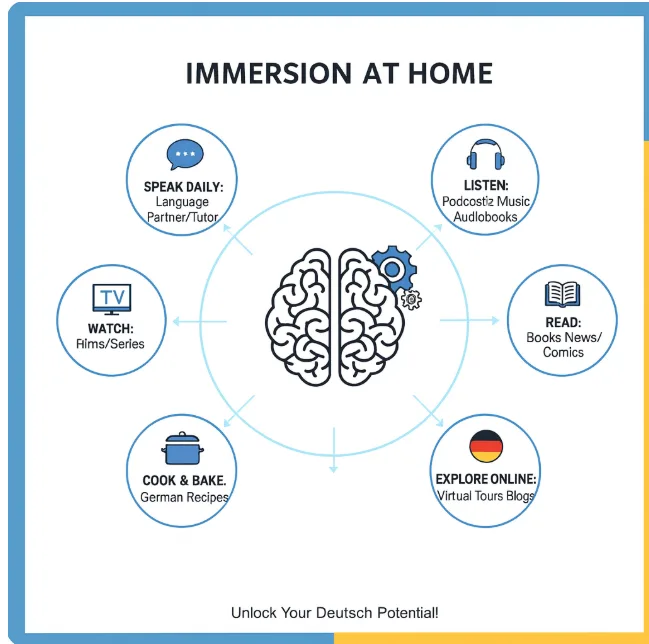
Top 6 Methods for learning German at home:
Here are the six methods that actually move the needle when you’re learning German at home.
1. Create a German-Only Environment at Home
Immersion is environmental before it’s conversational.
Label anything you use daily. Kühlschrank, Tasse, Tür, Tastatur.
Set your phone, laptop, Netflix, YouTube, and Instagram to German so every tap becomes exposure.
Neurolinguistics shows 5-10 secs of German notifications strengthen memory pathways. The repetition compounds into real fluency.
2. Daily German Input Through Media
You need input flooding your brain all day.
- Chores become podcast time.
- Commuting becomes audio immersion.
- Cooking becomes German YouTube.
Shows with strong clarity include Dark and Der Tatortreiniger. Youth speech and slang show up in How to Sell Drugs Online Fast.
Research confirms passive listening builds phoneme recognition even when comprehension is low. Active listening sharpens it later. Rotate both.
3. Simulate Conversations Using AI and Scripts
If you don’t have native speakers, you create them.
AI conversation tools give you scenarios that feel like real role plays — ordering coffee, asking for help, handling workplace small talk. These build the automatic responses you need for genuine fluency rather than rehearsed phrases.
The key is making conversations specific rather than generic. A prompt like “you are a Berlin café owner and I am a customer who doesn’t speak much German” produces far more useful practice than open-ended chat. The more constrained and realistic the scenario, the more transferable the language you practise becomes.
AI corrects mistakes instantly and adapts to your level in real time. For learners without access to native speakers, this kind of simulated interaction is the closest available substitute — and for building confidence before real conversations, it’s arguably more effective because the stakes are lower.
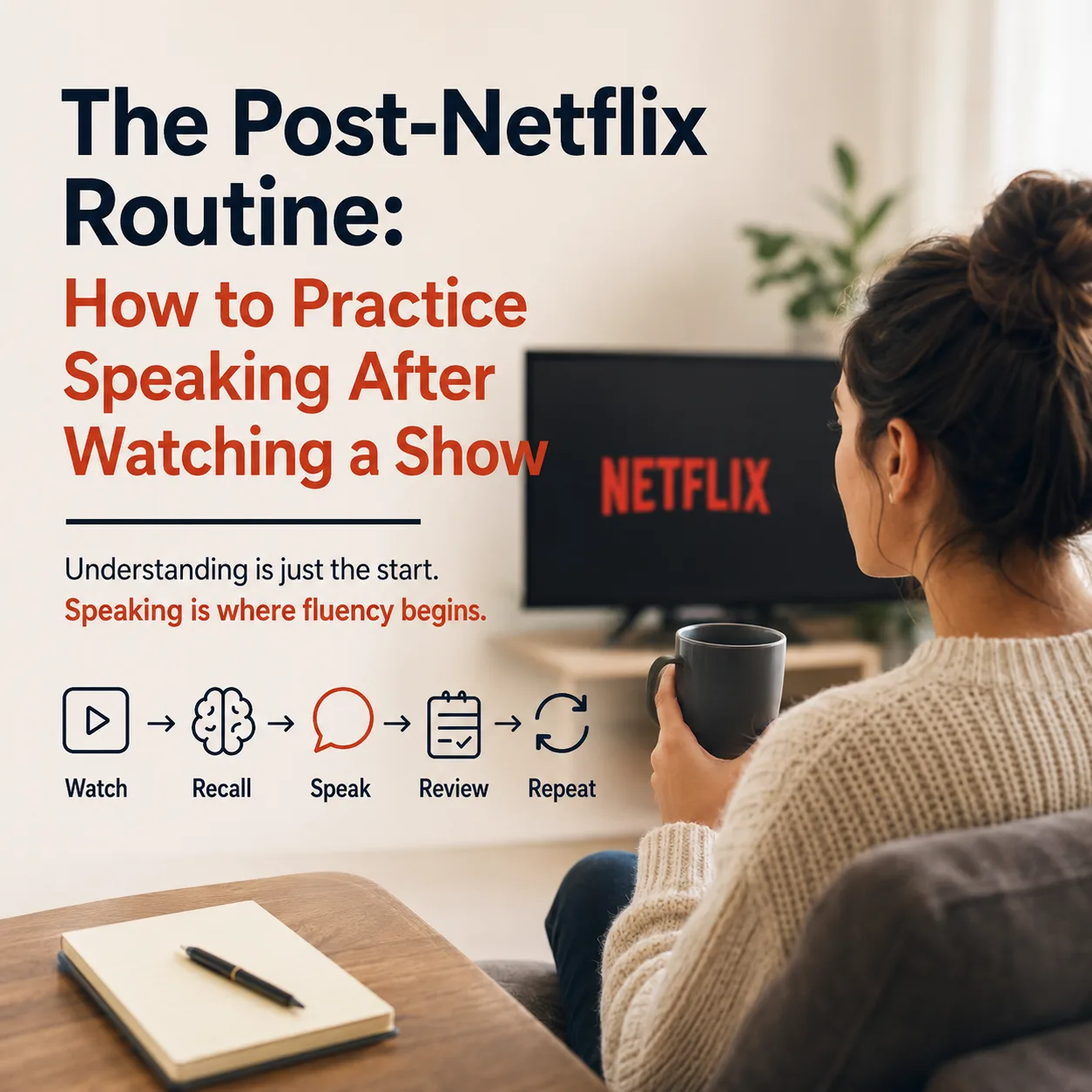
In Jolii: the AI tutor is built around real German video content rather than abstract scenarios — you watch a clip, then practise speaking about what you just heard. This connects conversation practice directly to the immersive input from Method 2, so the vocabulary and structures you’re drilling are ones you’ve already encountered in context rather than ones chosen at random.
For broader conversation simulation outside Jolii, tools like TalkPal or even ChatGpt with the right prompts offer additional scenario-based practice worth supplementing your routine with.
4. Think in German
Learning accelerates when you stop translating.
Start by naming actions. Ich gehe, ich koche, ich warte. Then narrate short thoughts. Then short monologues. Immersion learners internalize grammar through repeated patterns.
Thinking in German pushes you into that natural acquisition zone faster than memorizing rules.
5. Use Immersive Learning Apps Strategically
Learning apps become powerful when paired with passive listening, conversation simulation, and sentence mining.
- Jolii converts real German videos into personalized lessons.
- LingQ lets you read and listen to native content with instant lookups.
- FluentU gives interactive subtitles.
- Clozemaster reinforces patterns through contextual sentences.
Duolingo and Babbel are fine, but they rely heavily on translation. Translation keeps you dependent on English. Immersion requires direct processing.
6. Create a German Routine You Can Stick To:
Habit stacking turns German into a lifestyle.
Research shows consistent daily routines outperform long weekly study blocks.
Pair your coffee with Anki, shower with vocabulary audio, and your workout with German rap.
A simple immersion schedule under sixty minutes per day works.
- Ten minutes of recall.
- Fifteen minutes of passive listening.
- Ten minutes of reading.
- Fifteen minutes of AI conversation.
- Ten minutes of writing.
- Repeat until fluent.
AI’s Impact on Immersive Learning
AI has become the most significant shift in language learning in recent years. According to the Digital Education Council’s Global AI Student Survey 2024 — which surveyed over 3,800 students across 16 countries — 86% of students globally are now regularly using AI in their studies, with 54% doing so on a weekly basis.
For language learners specifically, this matters because AI changes the feedback loop in ways traditional immersion couldn’t. Living abroad gave learners constant exposure but unpredictable correction. Classrooms gave structure but limited speaking time. AI at home gives you both — unlimited speaking practice with instant, specific feedback — available at any point in your daily routine.
Concretely, AI tools now enable three things that directly accelerate home immersion:
Personalised input at the right level. Rather than consuming content that’s too easy or too difficult, AI adapts to your current comprehension level and pushes you just beyond it — which is where acquisition happens fastest.
Real-time pronunciation feedback. Accent and rhythm errors that would go unnoticed for months in passive listening get corrected immediately, preventing them from becoming ingrained habits.
Simulated conversation without anxiety. Speaking anxiety is one of the most consistent barriers to fluency. AI removes the social stakes entirely — you can sound terrible, restart, and try again with no consequence, which is exactly the condition under which speaking habits form fastest.
Jolii integrates all three into a single workflow — real German video input, adaptive lessons built from that content, and AI conversation practice that responds to your specific output rather than a generic script.
FAQs
Q. What if I don’t understand anything at first?
A. That is immersion doing its job. Comprehensible input starts around seventy percent understanding. Repetition raises it naturally.
Q. Do I need to speak German out loud?
A. Yes. Speaking builds muscle memory and reduces anxiety. Mirror talk counts. Reading aloud counts. Narrating chores counts.
Q. How long does it take to get fluent this way?
A. Expect B1 around three hundred fifty to four hundred hours. Expect B2 around five hundred to six hundred. Immersion learners often hit the same levels faster.
Q. Do I need to study grammar separately
A. Only as needed. Immersion teaches most structures through repeated patterns. Use grammar explanations to clarify, not to lead.
Q. How long until immersion at home feels natural?
A. Usually a few weeks. Once your devices, media, and routines switch to German, the language becomes part of your daily rhythm.
Final Thoughts
Immersion at home is a kind of approach that delivers because it’s sustainable.
Daily cycles of input, thinking, speaking, and environmental exposure build fluency quietly and quickly.
Always remember that fluency comes from steady exposure, not a passport stamp.
Want a smarter immersion workflow? Jolii.ai app turns real German videos and articles into adaptive lessons that feel like living inside the language.