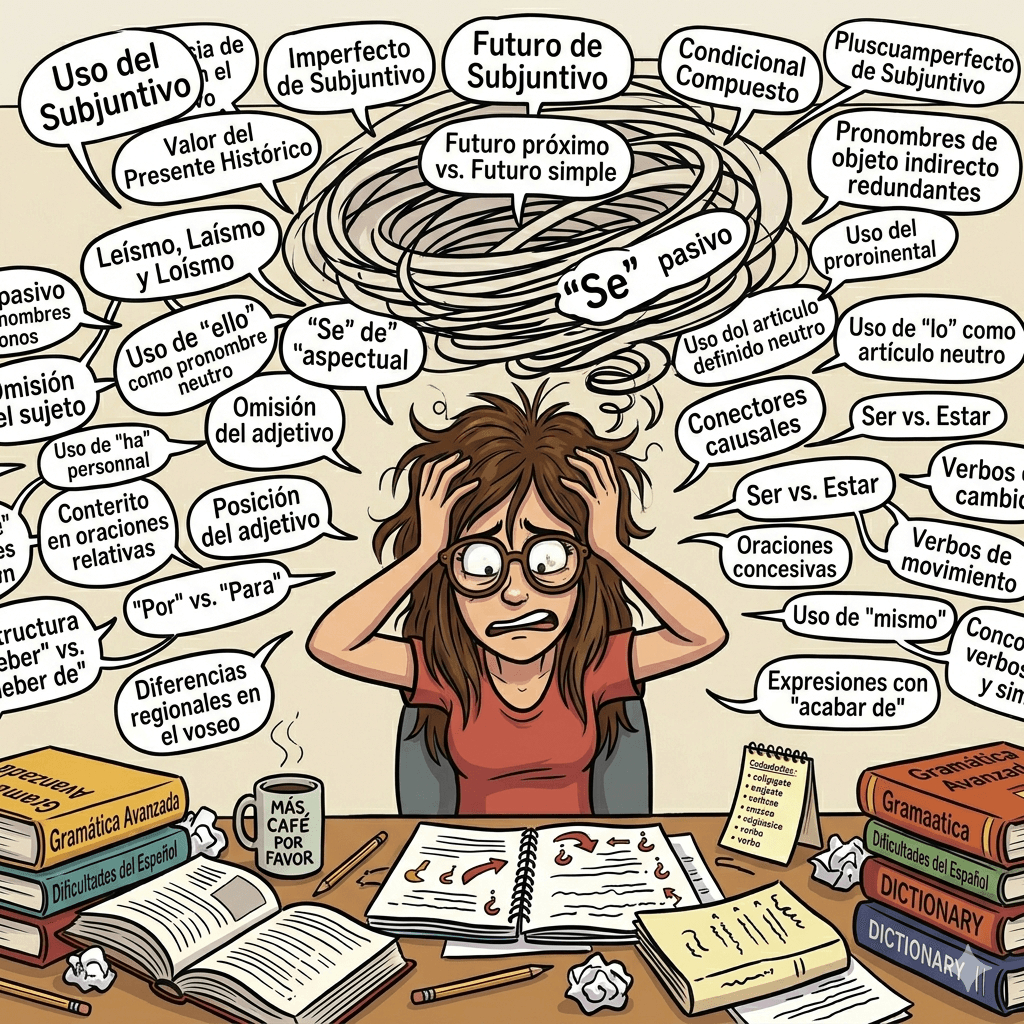
Learning a language is no joke.
If you genuinely want to learn a language, let’s assume Spanish here, it will take you anywhere between 80-92 weeks to learn “Superior Level” Spanish.
If you are learning a language to upgrade your professional life or want to travel to Spanish-speaking places, the perspective of learning a language depends heavily on what level of language you aim to achieve.
A traveler needs just basic Spanish, precisely beginner-level Spanish vocabulary. The advanced Spanish learner needs to have a complete understanding of grammar, vocabulary, comprehension, and writing. Whoever learns for professional purposes needs to master Spanish words and phrases for business.
Here we have the high-frequency word lists that are the backbone of any Spanish-speaking lessons. Mastering these words can make up the majority of your day-to-day communications.
Why Learn High-Frequency Words First?
High-frequency words appear constantly in everyday communication, making them essential for learning to speak and understand the language.
Pareto-Principle Of Language Learning
According to the famous 80/20 rule by Pareto, we can assume that 80% of communication comes from 20% of the whole Spanish vocabulary.
Learning high-frequency Spanish words (which approximately make up around 20% of the whole vocabulary) is required if you want to understand the language.
Benefits Of Learning High-Frequency Spanish Words
Effective communication is based on understanding a language. You need to understand the language to benefit from getting along and easily building up conversations. Here, you must know that high-frequency words build a strong platform for you to build a strong foundation for speaking and understanding the language.
How about getting along with the Jolii language learning app, which helps you focus on learning Spanish on the basis of a high-frequency word list? You upload videos you like and focus on the context to learn the language; here the high-frequency Spanish words will let you understand the language better.
Download Jolii today to polish your Spanish speaking and comprehension.
The Core Categories of Spanish High-Frequency Words
Spanish Personal Pronouns
Our list of high-frequency words begins with personal pronouns. These constitute the fundamental building blocks of the language and are essential to learning for anyone starting to learn Spanish.
| Pronoun | Meaning | Example Sentence |
| yo | I | Yo tengo un perro. – I have a dog. |
| tú | You | Tú estás feliz. – You are happy. |
| él / ella / usted | He / She / You (formal) | Él es médico. – He is a doctor. Ella cocina muy bien. – She cooks very well. |
| nosotros / nosotras | We (masculine /feminine) | Nosotros estamos en casa. – We are at home. |
| vosotros / vosotras | You all (masculine / feminine) | Vosotros sois estudiantes. – You all are students. |
| ellos / ellas / ustedes | They (masculine/ feminine / formal) | Ellos viajan mucho. – They travel a lot. |
Please note that vosotros/vosotras is specific to Spain, while ustedes is used in Latin America for all plural “you.”
To learn more about the Spanish pronouns you can check demonstrative, personal and interrogative pronouns.
Common Spanish Verbs
Next are common Spanish verbs, which can be divided into three groups depending on their infinitive form: -ar, -er, and -ir. It is important to know to which group a verb belongs because verbs conjugate differently depending on their group. Here is a table with example conjugations for the present tense.
| Person | -ar Verb (Hablar – to speak) | -er Verb (Comer – to eat) | -ir Verb (Vivir – to live) |
| yo | hablo | como | vivo |
| tú | hablas | comes | vives |
| él/ella/usted | habla | come | vive |
| nosotros/as | hablamos | comemos | vivimos |
| vosotros/as | habláis | coméis | vivís |
| ellos/ellas/ustedes | hablan | comen | viven |
Note: Each verb is conjugated by adding the appropriate ending to its stem (habl-, com-, viv-).
Most verbs follow the conjugation above in their main form. However, some of the most common Spanish verbs have irregular conjugations in the present, and we recommend that you practice them and learn their conjugations by heart.
7 High-Usage Irregular Spanish Verbs That You Need to Know
| Person | Ser (to be – permanent) | Estar (to be – temporary) | Tener (to have) | Hacer (to do) | Ir (to go) | Poder (to can) | Querer (to want) |
| yo | soy | estoy | tengo | hago | voy | puedo | quiero |
| tú | eres | estás | tienes | haces | vas | puedes | quieres |
| él/ella/usted | es | está | tiene | hace | va | puede | quiere |
| nosotros/as | somos | estamos | tenemos | hacemos | vamos | podemos | queremos |
| vosotros/as | sois | estáis | tenéis | hacéis | vais | podéis | queréis |
| ellos/ellas/ustedes | son | están | tienen | hacen | van | pueden | quieren |
You may be wondering why there are two “to be” verbs in Spanish? Ser is used for permanent conditions such as identity and origin, estar for temporary ones like location and condition. The image below breaks down their uses with the acronyms DOCTOR and PLACE to help you better remember which one to use.
Ser vs. Estar In Spanish

Articles and Prepositions
Articles in Spanish change in gender (masculine and feminine) and number (singular and plural) and are:
- Definite articles (the): el, la, los, las.
- Indefinite articles (a, an, some): un, una, unos, unas
| Articles | Singular | Plural |
| Masculine | el libro (the book)un coche (a car) | los libros (the books)unos coches (some cars) |
| Feminine | la mesa (the table)una manzana (an apple) | las mesas (the tables)unas manzanas (some apples) |
Spanish Prepositions:
Prepositions can be tricky to learn because they are little words and mostly because there is no 1-to-1 translation in English. Depending on the context, they can be translated differently.
| Preposition | Meaning | Example Sentence |
| de | of, from | El libro de Juan. – Juan’s book. |
| a | to, at | Voy a la tienda. – I’m going to the store. |
| con | with | Estoy con mis amigos. – I’m with my friends. |
| en | in, on | Está en la mesa. – It’s on the table. |
| por | by, through, for (cause) | Paso por el parque. – I pass through the park.Lo hice por amor. – I did it for love. |
| para | for (purpose), in order to | Esto es para ti. – This is for you.Trabajo para ganar dinero. – I work to earn money. |
Two prepositions that are particularly tricky to distinguish for Spanish speakers are por and para.
In general, por focuses on cause, means, or motion, and para on goal, purpose, or destination.
| Por | Para |
| Lo hice por ti. – I did it because of you. | Lo hice para ti. – I did it for you (as a gift). |
| Pasé por el parque. – I passed through the park. | Voy para el parque. – I’m going to the park. |
The image below breaks down the uses of por and para using the acronyms DREAM and PERFECT to help you avoid confusing them again.

Frequently Used Spanish Adjectives
When learning the adjectives, we recommend learning them in pairs with their opposite.
| Adjective | Meaning | Example Sentence |
| bueno – malo | good – bad | Es un día bueno. – It’s a good day.Tuvo un día malo. – He had a bad day. |
| grande – pequeño | big – small | La casa es grande. – The house is big.Tengo un perro pequeño. – I have a small dog. |
| feliz – triste | happy – sad | Ella está feliz. – She is happy.Está muy triste hoy. – She is very sad today. |
| nuevo – viejo | new | Compré un coche nuevo. – I bought a new car.Es un libro viejo. – It’s an old book. |
| rápido – lento | fast – slow | Es un coche rápido. – It’s a fast car.El servicio fue lento. – The service was slow. |
| bonito – feo | pretty – ugly | Tiene una casa bonita. – She has a pretty house.El edificio es feo. – The building is ugly. |
Conclusion
Learning Spanish vocabulary words aids in enhancing your experience of learning the language. In a broader vision, the Spanish high-frequency word list can be a great advantage in building up strong foundations for learning the Spanish language.
For working your way to increase vocabulary, you can use the Jolii app, which easily makes a connection between learning a language and getting entertainment. The true Netflix integration with the app helps you learn Spanish high-frequency words better.
FAQs
Q: How many high-frequency words do I need to know to start speaking?
A: You need to have around 1000 to 2000 Spanish high-frequency words to start speaking it. These high-frequency words make up nouns, pronouns, adjectives, adverbs, prepositions, verbs, and numbers.
Q: Do high-frequency words help in understanding spoken Spanish?
A: High-frequency words build up our Spanish vocabulary. The more words you have in your vocabulary, the better you will understand the language.
Q: Can I achieve fluency with just high-frequency words?
A: Building vocabulary sharpens your fluency. The more high-frequency words you learn, the better you get at understanding the language. By just learning high-frequency words, you are pretty much at a good pace in speaking and understanding the language. Practice speaking regularly to improve your speaking skills!