Practice speaking by yourself using “self-talk” or narrating your activities to help strengthen the neural muscles without a partner. Doing this regularly turns your reading vocabulary into active vocabulary. Plus, the simulation of low-pressure conversations keeps your brain ready for real-life dialogue.
Why Your Brain “Freezes” (And How to Unblock It)
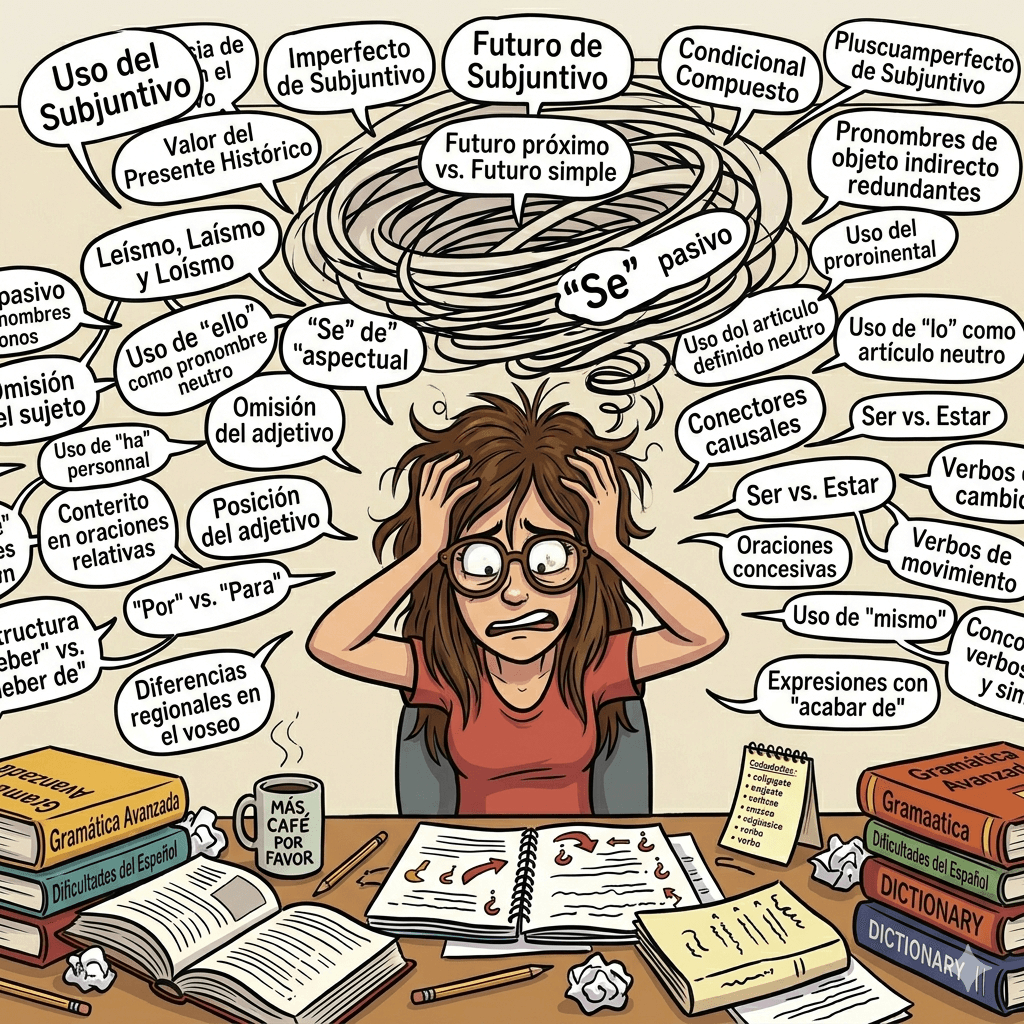
It’s normal that most adult learners hit a plateau where comprehension far outpaces speaking. This happens because listening is a passive skill, while speaking is an active motor and cognitive task.
According to Merrill Swain’s Output Hypothesis, we only truly notice the “holes” in our grammar when we attempt to speak. Similarly, Robert DeKeyser’s Skill Acquisition Theory suggests that fluency is essentially “procedural memory”—the same type of muscle memory used for driving or playing an instrument. To get better, you have to do the reps to automate those neural pathways.
5 Solo Drills for High-Speed Fluency
If you want to stop translating in your head and start speaking instinctively, try these five techniques:
| Technique | The “How-To” | Why It Works |
| Self-Shadowing | Listen to a native speaker and repeat exactly what they say with a 1-second delay. | Forces your mouth to mimic native rhythm and intonation. |
| The “Mirror” Recording | Record yourself speaking for 60 seconds, listen back, and transcribe your errors. | You become your own tutor, identifying “fossilized” mistakes. |
| Simulated Scenarios | Role-play both sides of a conversation (e.g., a job interview or a debate). | Builds flexibility by forcing the brain to switch between roles. |
| Active Narration | Describe your day as you do it: “I’m grinding the coffee now.” | Bridges the gap between abstract vocabulary and real-world use. |
| Scripted Reading | Read a dialogue or article aloud with exaggerated emotion. | Combines visual recognition with physical muscle production. |
Real Learner Example: How Liam Found His Voice
Let’s look at Liam, 29, an engineer. He knew that his Spanish wasn’t where he wanted it to be. Sure, he could watch Netflix without subtitles and read complex work emails, but when a colleague posed him a question, his brain would totally freeze. He was caught in a trap, with the material knowledge of the language without the vocal muscles how to deploy it.
To break through, Liam stopped studying and started “performing.” He began using Jolii.ai to bridge the gap between his silent thoughts and spoken words. He needed a strategy that treated language as a physical habit rather than a history lesson.
The platform acted as a flight simulator for his Spanish, allowing him to practice:
- Contextual Role-play: He practiced the exact project updates he had to give at work.
- Low-Pressure Repetition: He could fail, restart, and refine his phrasing without the social anxiety of a live partner.
- Neural Automation: By repeating these scenarios, he moved Spanish from his notebook (short-term memory) to his nervous system” (procedural memory).
After six weeks of consistent solo work, the physical mental lag Liam felt began to vanish. Because he had already navigated these conversations repeatedly in his solo sessions, his brain no longer had to work overtime to find the right words.
His transition was:
- Passive observer → Active learner → Confident speaker
Eventually, Liam was able to deliver project updates in Spanish with the same confidence he had in his native tongue.
5 Fluency Killers to Avoid
- The “Passive Trap”: Watching 3 hours of TV without saying a word. (Fix: Pause and summarize what happened aloud).
- Isolated Grammar: Memorizing conjugations in a book without using them. (Fix: Build 3 sentences using a new rule immediately).
- Mental Translation: Translating from your native tongue. (Fix: Focus on “thinking” in images or actions).
- The Perfectionist Lean: Being afraid to make a mistake when nobody is listening. (Fix: Embrace the “ugly” phase of learning).
- Inconsistency: Cramming 5 hours on Monday and no practice for the rest of the week.
The Plateau-Breaker Checklist
Shift your focus from “studying” to “performing” with these high-impact strategies:
- Implement Structured Drills: Build complex sentences and interview yourself to create neural shortcuts.
- Audit Your Audio: Use your phone to record and detect errors in your pronunciation and syntax.
- Merge Input with Output: Use shadowing to turn passive listening into an active workout.
- Scale Complexity: Gradually integrate advanced tenses and idioms into your solo drills.
- Quantify Your Output: Measure progress by sentences produced rather than hours of content consumed.
Take the Pressure Off Your Practice
Consider solo practice as a high-efficiency test lab in which you can stumble over your thoughts, experiment and self-critique without the crushing anxiety of a live audience. By taking away the fear of being judged, you offer your brain the conditions it requires to overcome just understanding a sentence. Now, you will say it.
If you need a personalized routine for those drills, Jolii.ai provides a structured environment for independent work. We provide the prompts, role-play scenarios, and instant feedback loops that turn “talking to yourself” into a professional training session for adult learners.

FAQs
Can I actually get fluent by talking to myself?
Yes. Solo practice builds the “muscle memory” of language. Even if you will eventually need native interaction to learn social nuances, practicing alone handles 80% of the heavy lifting.
How do I know if my pronunciation is right if I’m alone?
Use recording and comparison. Record yourself saying a phrase, then play a native speaker saying the same phrase. Your ears are much better at detecting differences than your brain is while you speak.
How long does it take to see results?
Learners usually notice a significant drop in “mental lag” within 4 to 6 weeks of consistent daily output practice, so don’t give up!