TL;DR
No, speaking from day one is not required for fluency. Waiting is allowed when listening and reading input are strong. A silent period lets the brain build correct grammar and sounds first.
- Early speaking can cause fossilized errors that are hard to fix.
- A silent period is a normal stage in language learning.
- Input-first learners often reach stronger long-term fluency.
- AI tools now make low-pressure speaking safer for blocked speakers.
Why Do Learners Feel Stuck on the “Speak From Day One” Advice?
Many learners feel pressured to speak from day one. This advice is repeated by apps, influencers, and polyglot videos. But most “block speakers” freeze when forced to talk early. The fear of mistakes is real, and understanding is often ahead of speaking ability.
Your frustration is not a weakness. It is a signal. Speaking failure is usually caused by anxiety and retrieval load, not lack of knowledge. Waiting is often the smarter move.
What Does “Speak From Day One” Actually Mean?
The phrase was popularized by Benny Lewis via TEDx talk and the Fluent in 3 Months platform. It was designed to push learners out of silent classrooms and into real-time conversations early.
The real intent is simple. Basic chunks like “I want,” “I like,” and “How do you say…?” are used from day one. Perfect grammar is not expected. Communication is prioritized over correctness.
The method is often misread. Learners assume full fluency is expected on day one. That is not the original claim. The method is a mindset shift, not a fluency promise.
Why Does the “Speak From Day One” Myth Still Spread?
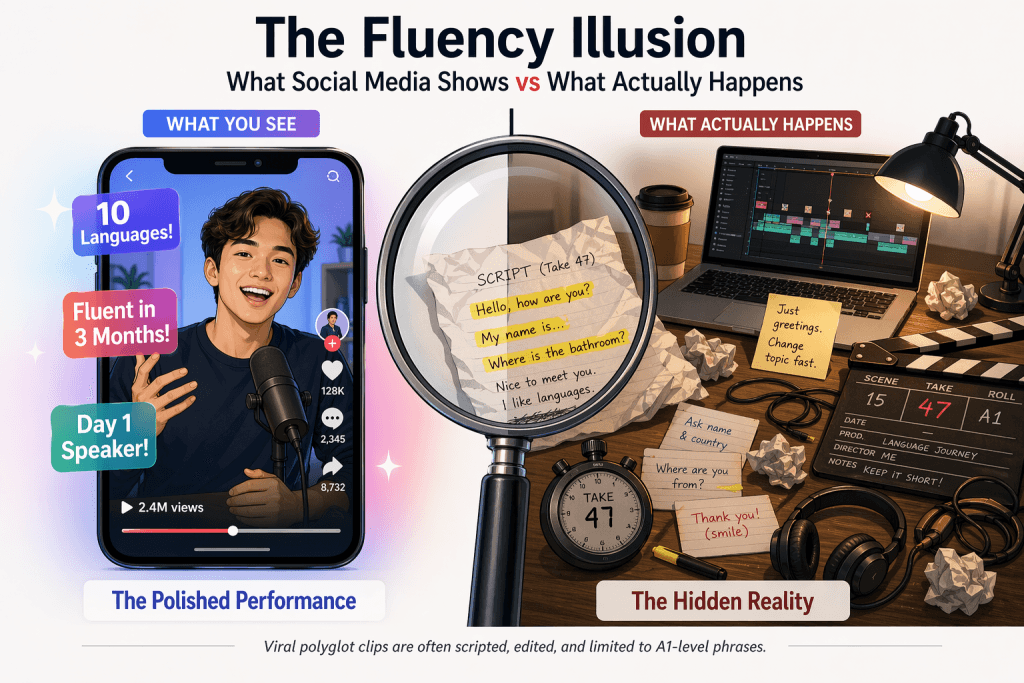
The myth is kept alive by marketing and social media. Apps reward daily streaks, not real fluency. Viral polyglot videos are often scripted, edited, or limited to greetings.
A fluency illusion is created. Learners compare rough practice to polished clips and feel behind. The pressure to “just speak” grows, even when input is still weak.
Loss aversion is used in many apps. Streak systems feel like progress, but engagement is not the same as acquisition.
What Is the Silent Period in Language Learning?
The silent period is a stage where learners understand a lot but speak little. Input is absorbed. Internal grammar is built. Output is delayed until the brain is ready.
This idea was shaped by Stephen Krashen’s Input Hypothesis.
Language is acquired through comprehensible input, slightly above the current level (called i+1). Forced output is not required for acquisition to occur.
A high Affective Filter blocks learning. Anxiety, fear, and pressure reduce how much input is absorbed. A calm, silent period keeps the filter low.
Why Can Waiting Improve Fluency?
Waiting allows sound patterns to be mapped first.
Pronunciation is shaped by the ear before the mouth takes over. Vocabulary is stored with context, not in isolation. Anxiety is kept lower because output is not forced.
Fossilization is also avoided. This is when wrong patterns become permanent through repetition. Early speaking without strong input is a main cause.
Delayed, supported speaking reduces this risk.
Input vs. Output: A Quick Comparison
The table below shows what each approach gives you.
| Factor | Output-First (Speak Day 1) | Input-First (Silent Period) |
| Anxiety level | High | Low |
| Fossilization risk | High | Low |
| Pronunciation accuracy | Weaker early | Stronger long-term |
| Vocabulary depth | Shallow | Deep and contextual |
| Speaking speed start | Fast | Slower but cleaner |
| Long-term fluency ceiling | Mixed | High |
Neither is wrong. The balance between them matters most.
How Long Should the Silent Period Last?
There is no fixed timeline. Readiness depends on exposure, not the calendar. Most learners feel ready after strong comprehension is built.
According to FSI language learning benchmarks, Category I languages like Spanish and French need about 600–750 hours for professional proficiency.
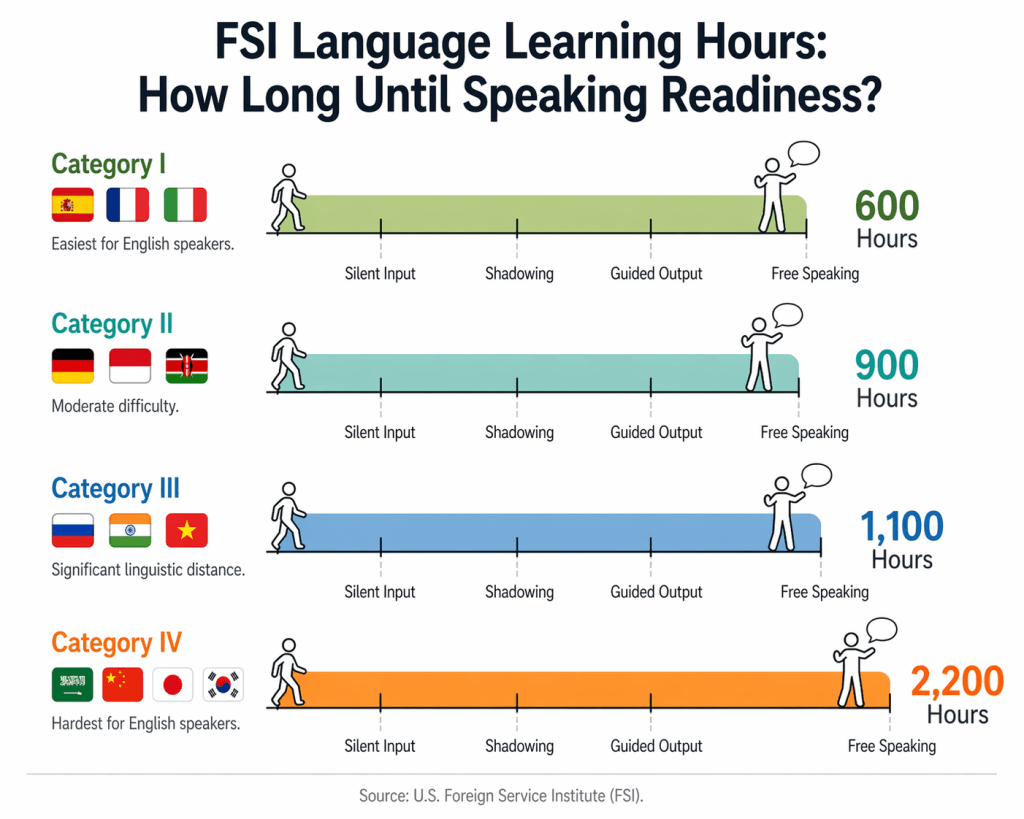
Category IV languages like Arabic or Japanese need about 2,200 hours. Speaking emerges naturally inside these ranges.
Common vocabulary thresholds:
| Word Families Known | Speaking Ability Unlocked |
| 500–1,000 | Very basic chunks and greetings |
| 1,000–2,000 | Short sentences and simple talk |
| 2,000–3,000 | Around 80–90% text comprehension |
| 3,000–4,000 | Natural recombination and fluent talk |
Signs of readiness include fewer mental translations, easier listening, and chunks that form without effort.
What Should Be Done Instead of Forcing Early Speech?
Listening and reading should be prioritized. Narrow listening is powerful. One topic is repeated across many episodes, podcasts, or videos. Repetition builds depth faster than variety.
Shadowing is also useful. Audio is repeated immediately as it is heard.
Rhythm and intonation are trained without pressure to invent speech. This acts as a bridge between silent input and real output.
For example, a learner working through a German series like Dark with dual subtitles can build strong comprehension within weeks of consistent watching — and phrases like “Was ist passiert?” start coming out naturally once speaking resumes.
Real Example: The Block Speaker Pattern
A learner studies Japanese for two years. Grammar is known. JLPT content is understood. But in a café, the words freeze. This is not a knowledge gap. It is an amygdala response.
Under stress, the prefrontal cortex is suppressed. Word retrieval fails.
The “freeze” is neurological, not a lack of effort. A supported silent period reduces this loop before speaking is reintroduced.
When Does Speaking Early Actually Work?
Early speaking is not always wrong. In some cases, it is the right move.
- Survival situations, like refugee relocation or emergency travel.
- Immersion environments with daily real-world interaction.
- Guided practice with a patient tutor or AI partner.
- Extroverted learners who gain confidence from social risk.
The key is control. Structured early output is helpful. Forced, unsupported output is harmful.
2026 and Beyond: The Future of the “Speak From Day One” Debate
The debate is being reshaped by AI.
The old binary of “speak early” vs. “stay silent” is fading. A hybrid model is replacing it. Multimodal AI tutors now combine voice, text, and visuals in real time.
AI-powered conversation practice is increasingly used for low-pressure speaking — removing the social stakes that make early output feel risky.
Speaking is being separated from human pressure. Predicted shifts for the next two years:
| Trend | Impact on Learners |
| Multimodal AI tutors | Input and output are blended with images and context |
| Emotion-aware AI | Sessions shift to passive input when stress is detected |
| Async remote work | Real-time verbal fluency is less urgent at work |
| Translanguaging tools | Native language is used as scaffolding for new ones |
The silent period is not being removed. It is being personalized. Output is being added earlier, but in safer, lower-pressure settings.
Common Mistakes to Avoid
- Speaking is forced before enough input is built.
- Random vocabulary lists are memorized without context.
- Listening is skipped in favor of drills and apps.
- Progress is compared to scripted polyglot videos.
- Daily streaks are mistaken for real fluency gains.
FAQs
Should I speak from day one when learning a language?
Not necessarily. Speaking is not required for fluency to be built. Strong input must be developed first to avoid fossilized errors and burnout.
What is the silent period in language learning?
The silent period is a stage where input is absorbed, but speaking is minimal. Grammar and sounds are built internally before output begins.
Will waiting too long hurt my speaking skills?
No, if input is kept active. Waiting only becomes harmful when speaking is avoided forever, even after readiness signs appear.
How do I know when I am ready to speak?
Readiness is shown by easier listening, less mental translation, and automatic chunks forming in your head.
Is speaking early better for confidence?
It depends on personality. Extroverts often benefit from early speaking. Introverts and anxious learners often gain more from input-first routines with AI.
Does speaking early cause a permanent accent?
It can. Early output without enough listening locks in L1 sound habits. Listening first improves phoneme mapping and pronunciation accuracy.
Can AI replace a human tutor during the silent period?
For early stages, often yes. AI removes social pressure, allows infinite repetition, and lowers the Affective Filter. Human tutors remain useful for advanced stages.
Final Word: It Is Okay to Wait Before Speaking
Fluency is not earned by speaking on day one. It is earned by listening well, building strong input, and speaking when the brain is ready. The silent period is not a failure. It is a foundation.
Speaking should be entered gradually, not forced. With the right input and safe tools, block speakers can move from understanding to speaking without fear.
How Jolii Supports Block Speakers
Jolii is built for learners who understand but cannot yet speak. Content from Netflix, YouTube, and music is turned into learning material.
AI-generated exercises are created from what is already watched. A low-pressure speaking partner is also included.
The “Affective Filter” is kept low, and the silent period is honored before real output is pushed.