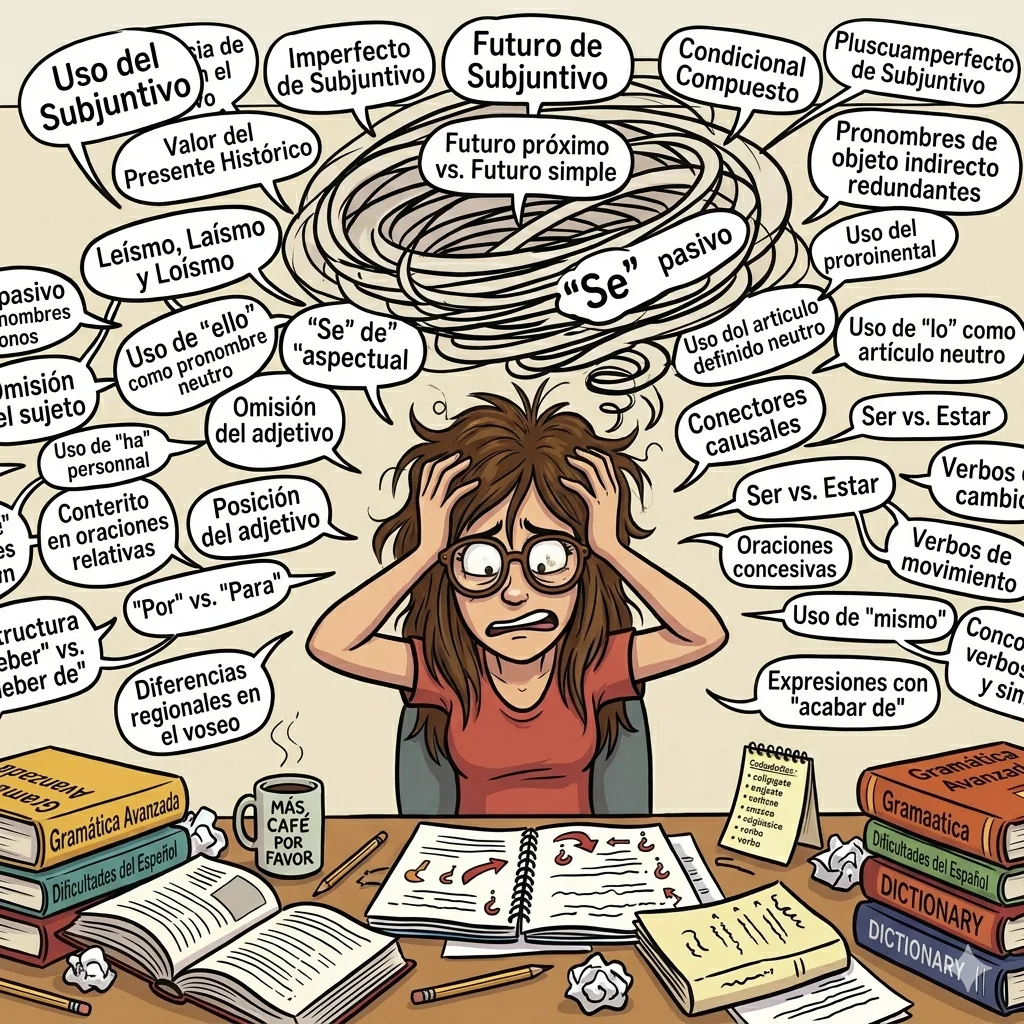
Adults don’t learn languages the way kids do. They’re just operating on different neurological hardware.
Kids acquire language implicitly. They learn via games, repetition, and immersion. They do not use conscious analysis.
Adults process language explicitly. They rely on grammar, rules, and structured systems.
The gap isn’t about talent. It’s about brain maturation, memory architecture, and emotional conditioning.
Neither system is superior in absolute terms. Each has leverage points.
Why Does Learning Feel So Different Now?
A common frustration is felt by adult learners.
Netflix shows are understood at 70%. Songs are partially followed.
But speaking still feels impossible. Words are known. Grammar rules are memorized. Yet real conversations are frozen by hesitation.
This is not a personal failure. It is a predictable result of how the adult brain is wired. The science behind this gap is well understood.
What Is the Critical Period for Language Learning?
In 1967, Eric Lenneberg introduced the Critical Period Hypothesis. He claimed that here’s a biological window where language acquisition is frictionless.
For decades, people assumed that the window slammed shut at puberty. That model is now outdated.
A 2018 large-scale study tracking ~670,000 learners showed something tighter. Grammar acquisition remains highly efficient until roughly age 17.4.
After that, performance declines gradually, not catastrophically.
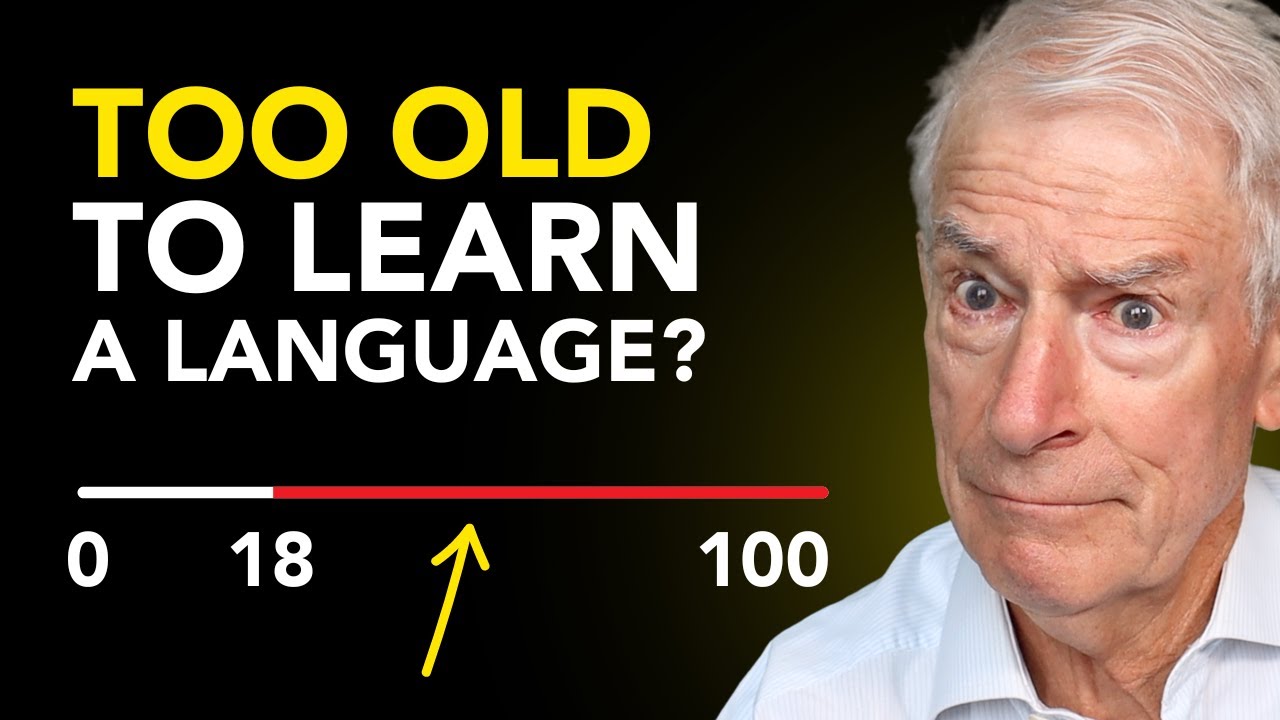
Is It Too Late to Learn Languages After 30?
No. The sharpest decline hits 17–18.
After 18, the decline becomes gradual. The curve flattens into a slow taper.
Adults in their thirties reach fluency. Forties and beyond still progress. About 5% reach near-native mastery. The other 95% communicate effectively.
How Brain Plasticity Impacts the Ability to Learn Languages
Neuroplasticity is the brain’s ability to form new connections. In children, this ability is at its peak. New language pathways are built automatically through exposure.
Adult brains work differently. Strong networks for the first language already exist.
New information must be routed through these existing pathways. This creates what researchers call a “bottleneck.”
A surprising finding supports this. When the analytical part of the adult brain was temporarily disrupted using magnetic stimulation (TMS), implicit language learning improved significantly.
The adult brain was essentially returned to a more child-like learning state.
Why Kids Learn Languages Naturally Through Immersion
Children learn by doing, not by studying. Words are picked up through play, repetition, and social interaction.
Mistakes are made freely. No embarrassment is felt. This low-stress exposure feeds the brain’s implicit learning system.
Why Do Kids Develop Native-Like Pronunciation?
Babies are born hearing all human speech sounds. By 12 months, the ear begins tuning only to native language sounds.
This early sensitivity is why children mimic accents so easily.
Adults have already lost this universal hearing ability. Their articulatory muscles have also been trained for decades in one language.
Recent 2025–2026 research found that speech muscles retain “epigenetic memory.” Old motor patterns are stored at the molecular level.
This makes accent change physically difficult, not just mentally.
Why Adults Learn Languages Through Logic and Rules
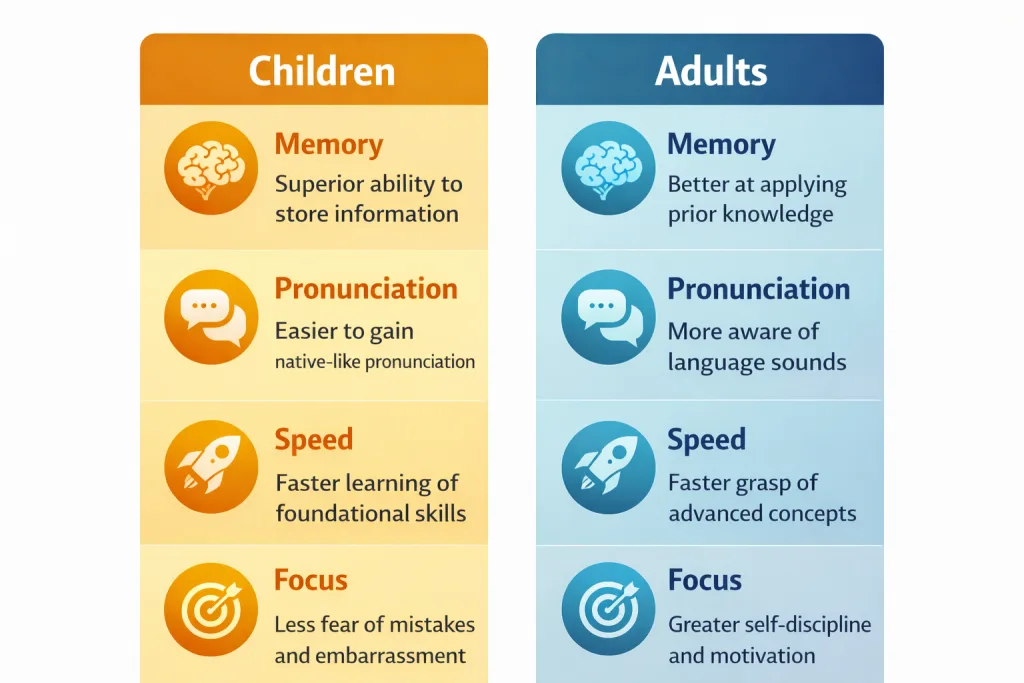
Adults rely on a different memory system.
Kids employ “doing” memory. Like a habit, this type of memory is automatic. Like learning to ride a bike, it helps them pick up new skills without even realizing it.
Adults employ “Fact” memory. This type of memory is active and conscious. By following guidelines and retaining particular facts, it aids in their learning.
A verb conjugation can be memorized in minutes by an adult.
But using it naturally in conversation takes much longer. The knowledge is stored as a fact, not as an automatic skill.
Transferring information from “knowing” to “doing” is the core adult challenge.
How Children and Adults Learn Languages: A Comparison
| Feature | Children | Adults |
| Memory System | Procedural (unconscious) | Declarative (conscious) |
| Learning Style | Implicit, through immersion | Explicit, through rules and study |
| Pronunciation | Native-like accent is common | Foreign accent is typical |
| Grammar Speed | Slower start, higher ceiling | Faster start, lower ceiling |
| Vocabulary | Learned through context | Learned faster through reading |
| Emotional Filter | Low anxiety, fearless | High anxiety, self-conscious |
| Motivation | Environmental (must learn) | Goal-driven (career, travel) |
How Do Anxiety and Motivation Change Language Learning?
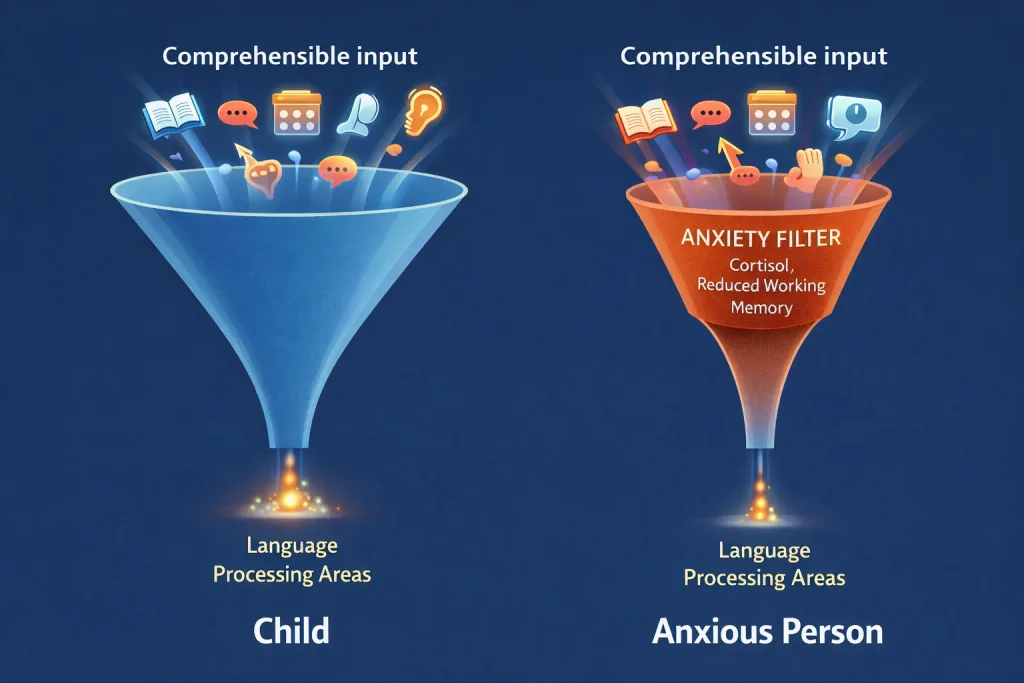
Adults feel more stress while learning. Social evaluation triggers the brain’s alarm. As a result, cortisol spikes while focus levels drop. Language areas like Broca’s slow down.
Children don’t overthink mistakes. They babble, guess, and experiment freely. This relaxed state boosts learning depth.
Motivation differs between adults and kids. Adults chase career goals. Instrumental drive fuels early progress. Emotional connection drives lasting fluency.
What Advantages Do Adults Have When They Learn Languages?
Adults bring tools kids lack. Metalinguistic awareness spots patterns fast. Cognates and grammar parallels pop immediately. Mnemonics boost word retention up to 50%.
Metacognition is another edge. Adults track progress and adjust strategies. Weak areas are fixed consciously. Children rarely self-regulate this way.
Reading speed gives adults an advantage. Daily 30-minute reading expands vocabulary fast. Technical terms can grow 300% yearly.
Real Example: Steve Kaufmann, 20 Languages After 60
Steve Kaufmann is a Canadian polyglot born in 1945. He spoke only English until age 17. Today, he speaks 20 languages. The key detail: most were learned after he turned 60.
His method relies entirely on adult strengths. Massive reading and listening are prioritized over grammar drills. Content is chosen based on personal interest, not textbook sequences. Mistakes are treated as part of the process, not as failures.
Kaufmann’s approach maps directly onto the science in this article. He uses metacognition to self-direct his learning. He lowers his affective filter by rejecting perfectionism.
And he floods his brain with input, which is the very same strategy that helps adults bypass the declarative-to-procedural bottleneck. His case disproves the myth that language learning belongs to the young. Age 60 was not a barrier. Motivation, volume of input, and consistent low-pressure practice were the deciding factors.
How Can Adults Learn Languages More Like Children?
The research points to a clear strategy. The goal is to combine adult analytical strengths with child-like input conditions.
- Increase passive exposure. Podcasts, music, and shows in the target language should be consumed daily. Even without full understanding, the brain is trained on patterns.
- Speak early and imperfectly. Hesitation is reduced by practicing output from day one. Mistakes are data, not failures.
- Stop translating mentally. Scenes and actions should be described directly in the new language. This trains the brain to bypass the first language.
- Lower the emotional stakes. Low-pressure practice environments are essential. Anxiety physically shuts down the language areas of the brain.
FAQs
Q. Are adults as capable of learning languages as children?
Indeed, but in a different way. High fluency in adults is attained through disciplined work.
Although native-like pronunciation is uncommon, general communication abilities can be comparable.
Q. Why do children pick up languages more quickly?
Children are less anxious and use unconscious procedural memory. Before the age of 17, their brains are more malleable. Implicit learning is accelerated by these factors taken together.
Q. Is learning a language more difficult after the age of forty?
Although more work is required, success is still quite possible. Learning a language after the age of forty has neuroprotective advantages as well.
Q: What’s the optimal path for adults to learn a new language?
Flood the brain with input. Listen and read daily. Force consistent output through regular practice in both speaking and writing.
Q: Do adults have advantages over kids?
Yes. Adults come pre-loaded. They already command literacy. They understand abstraction. They’ve built learning frameworks through experience.
Final Verdict:
Children absorb language unconsciously. Adults process it through logic and rules.
The critical period is real but gradual.
Adults compensate with metacognition, reading speed, and disciplined goal-setting.
Understanding isn’t the problem. Activation is.
Jolii fills that gap. Its AI-driven drills convert passive recognition into active recall. Knowledge stops sitting in your head and starts coming out of your mouth.