Quick Answer: How Japanese Numbers 1–100 Work
Japanese numbers follow a simple additive system. Once you learn numbers 1–10 and the word for ten (juu), you can build any number up to 99 by combining tens and units. Japanese mainly uses Sino-Japanese (onyomi) readings for combined numbers, with predictable pronunciation changes for hundreds.
Examples:
- 11 = juu-ichi (10 + 1)
- 23 = ni-juu-san (2×10 + 3)
- 47 = yon-juu-shichi
- 300 = san-byaku (phonetic change)
The first time I tried to pay for coffee in Tokyo, I froze. Not because the barista spoke too fast, and not because the menu was complicated. It was the number. Just the price. A few digits, spoken out loud, and suddenly my brain went blank.
If you’ve ever felt that moment — when you know you’ve studied something, but real life refuses to wait for your memory to catch up — then you already understand why Japanese numbers matter more than people often admit.
Numbers show up everywhere: prices, train platforms, room numbers, time, age, dates. You can avoid advanced grammar for a while, but you can’t avoid numbers. And when I first started learning Japanese (and later Korean), I treated numbers like a checklist item. Memorize them, move on. That was a mistake.
In this guide, we’ll walk through Japanese numbers from 1 to 100 with one principle in mind: Japanese numbers follow a rule-based system. They don’t change because of personal preference or habit — they change because the language requires them to.
How Japanese Numbers Work at a Glance (1–100)
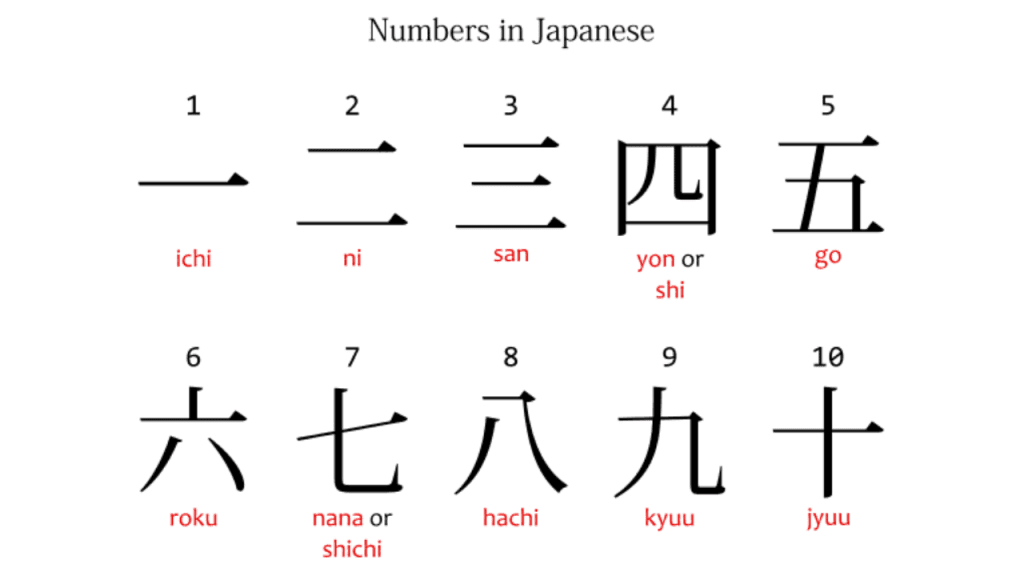
Here’s the short, accurate answer: Japanese numbers are systematic, but the rules aren’t always obvious to beginners.
Once you learn numbers from 1 to 10, you already have the foundation for almost everything up to 99. Japanese uses an additive structure: ten plus one becomes eleven, two tens plus three becomes twenty-three, and so on. There are no irregular “teen” forms like in English.
What trips learners up isn’t the math — it’s the reading system. Japanese numbers are governed by Kanji readings and grammatical rules. Understanding those rules matters more than memorizing sound variants.
1. Japanese Numbers Use Two Reading Systems (Kunyomi & Onyomi)
Japanese numbers are built on two parallel reading systems: kunyomi (native Japanese readings) and onyomi (Sino-Japanese readings derived from Chinese).
This distinction explains most of the confusion learners experience.
Why this matters
Kunyomi readings are native Japanese and are used primarily for numbers up to ten, usually in isolation or in fixed expressions. Onyomi readings dominate once numbers are combined, expanded, or used in calculations.
This isn’t optional or stylistic. It’s structural.
If you misunderstand this early on, Japanese numbers can feel unpredictable when they’re actually following a consistent rule.
Core reference: numbers 1–10
| Number | Kanji | Kunyomi (Native) | Romaji | Onyomi (Sino-Japanese) | Romaji |
| 1 | 一 | ひとつ | hitotsu | いち | ichi |
| 2 | 二 | ふたつ | futatsu | に | ni |
| 3 | 三 | みっつ | mittsu | さん | san |
| 4 | 四 | よっつ | yottsu | し / よん | shi / yon |
| 5 | 五 | いつつ | itsutsu | ご | go |
| 6 | 六 | むっつ | muttsu | ろく | roku |
| 7 | 七 | ななつ | nanatsu | しち / なな | shichi / nana |
| 8 | 八 | やっつ | yattsu | はち | hachi |
| 9 | 九 | ここのつ | kokonotsu | く / きゅう | ku / kyuu |
| 10 | 十 | とお | too | じゅう | juu |
Practical takeaway
Once numbers go beyond ten, onyomi becomes the default reading system. Kunyomi survives mainly in fixed forms such as hitotsu, futatsu, and certain counter expressions.
2. How Numbers Are Built Beyond 10 (Rule-Based, Not Optional)
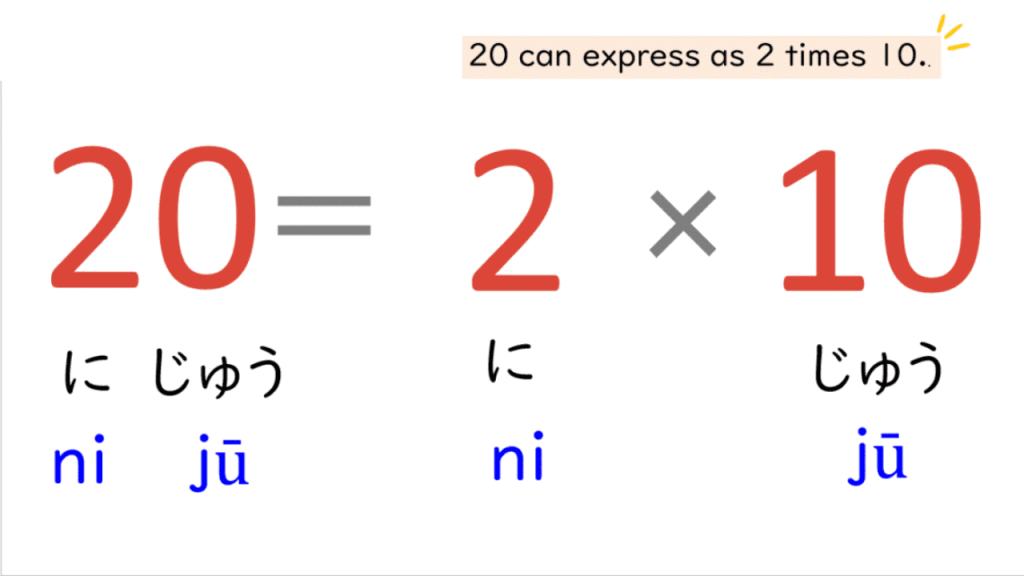
Once you move past ten, Japanese numbers rely almost entirely on onyomi and a clean additive structure.
This is where the system becomes predictable.
Examples
- 11 (十一) → juu-ichi
- 15 (十五) → juu-go
- 20 (二十) → ni-juu
- 47 (四十七) → yon-juu-shichi
Notice that kunyomi disappears completely here. This shift is systematic, not a matter of preference.
Zero in Japanese
The Kanji for zero is 零 (rei), but in everyday usage:
- ゼロ (zero) is common in modern contexts
- マル (maru) is used when reading individual digits (similar to “oh” in English)
Which form appears depends on context, not personal choice.
3. Counters: Why Numbers Change When They Meet Real Life
Counting in isolation is simple. Counting things is where Japanese enforces rules.
Japanese uses counters — grammatical units that attach to numbers depending on what you’re counting. These counters require specific readings.
Required readings (not preferences)
| Context | Required reading | Why |
| 4 animals | yon-hiki | shi-hiki is not used with this counter |
| 7 people | nana-nin | Fixed reading with 人 counter |
| 1 person | hitori | Irregular but grammatically fixed form |
| 2 people | futari | Irregular but grammatically fixed form |
These forms exist because of grammatical rules, not because speakers “prefer” them.
4. Hundreds, Thousands, and Phonetic Changes
Pronunciation shifts in Japanese numbers follow phonetic rules, often to make speech smoother.
Common phonetic exceptions
| Number | Kanji | Reading | Romaji |
| 300 | 三百 | さんびゃく | san-byaku |
| 600 | 六百 | ろっぴゃく | rop-pyaku |
| 800 | 八百 | はっぴゃく | hap-pyaku |
| 3000 | 三千 | さんぜん | san-zen |
These are examples of euphonic change, not irregular memorization traps.
5. Big Numbers and Why Kanji Actually Helps
Japanese groups large numbers by ten-thousands (man), not thousands. This makes Kanji numerals more readable for large figures.
| Number | Kanji | Reading | Romaji |
| 10,000 | 一万 | いちまん | ichi-man |
| 100,000 | 十万 | じゅうまん | juu-man |
| 1,000,000 | 百万 | ひゃくまん | hyaku-man |
| 100,000,000 | 一億 | いちおく | ichi-oku |
For large numbers, Arabic numerals are common — but understanding Kanji lets you actually interpret what you’re seeing.
Pro Insight: Why Rule-Based Practice Beats Memorization for Japanese Numbers
Here’s something I only understood after spending years actually using Japanese numbers, not just studying them: the difficulty isn’t the numbers themselves. It’s the speed at which the rules have to be applied.
In real situations — paying, checking train times, hearing room numbers — you don’t have time to consciously choose a reading. Your brain has to apply kunyomi vs onyomi, counter rules, and phonetic changes automatically.
Research in second language acquisition consistently shows that this kind of skill relies on procedural knowledge, not declarative knowledge. Segalowitz (2010) describes this as automaticity: the ability to apply rules without conscious effort. Similarly, studies on retrieval practice (Karpicke & Roediger, 2008) demonstrate that actively recalling information in short bursts builds faster, more reliable access than rereading or memorizing lists.
This explains why learners who “know” Japanese numbers on paper still freeze in real life. They’ve memorized forms, but haven’t practiced applying rules under time pressure.
The practical takeaway is simple but important: Japanese numbers stick when you practice them as rules in motion — reading prices, saying times, reacting to quantities — not when you treat them as isolated vocabulary items.
FAQs About Japanese Numbers
Do Japanese people use kanji or Arabic numerals?
Both. Arabic numerals are common in modern contexts like prices and technology. Kanji appear more often in traditional or formal writing.
Is it okay to avoid kanji numbers as a beginner?
Yes, temporarily. But long-term reading fluency requires recognizing basic kanji numbers.
Why do some numbers sound different in conversation?
Because Japanese numbers follow counter-based and grammatical rules. When numbers combine with people, animals, objects, or units, specific readings are required by the counting system. These are rules, not choice
Japanese Numbers in Real Life: What Actually Sticks
Learning Japanese numbers from 1 to 100 isn’t about memorizing charts — it’s about internalizing a few rules until your brain stops translating. And honestly, that process can feel just as tricky as telling hiragana, katakana, and kanji apart. It’s like levelling up in a game: each stage feels tough at first, but once you beat it, something clicks.
You’ll mishear prices. You’ll repeat numbers to buy time. That’s normal. But gradually, numbers stop being obstacles and start becoming background knowledge — reliable, quiet, and useful.
If Japanese numbers still feel slippery — fine on paper, but unreliable in real life — that’s part of the process.
Having something like Jolii around can help keep numbers active in your day-to-day routine through short, rule-focused practice. Over time, those repetitions add up — and numbers start showing up when you need them, without asking permission.