The first time I searched Korean alphabet Hangul for beginners, I wasn’t sure where to start. The shapes were so tidy—circles, straight lines, sharp angles—that it felt like I was missing a rule.
I remember staring at a sign and thinking, “No way I’ll learn this quickly. But the more Korean I noticed in real life—shop signs, menus, subtitles—the more curious I got. It looked unfamiliar, yet it kept repeating in a way that felt consistent. That curiosity finally got me to sit down and learn it properly. And Hangul surprised me. Once you notice the pattern, it stops looking like random symbols and starts looking like a system built to help you read.
Quick Answer:
- The Korean alphabet is called Hangul.
- It uses 14 basic consonants and 10 basic vowels.
- Letters form syllable blocks, and that structure is what makes reading in Korean easier once it “clicks.”
- Many learners can memorize Hangul in a single day and start reading simple words within a week.
What Makes the Korean Alphabet Hangul for Beginners So Easy to Learn?
Hangul looks unfamiliar at first, but it’s built from a small set of repeatable pieces. You’re not memorizing endless symbols—you’re learning a limited set of letters, then practicing how they combine. Once you start reading syllable blocks (instead of single letters), Korean feels a lot less intimidating.

1. Korean Consonants (자음) in the Korean Alphabet Hangul for Beginners
When I learned the consonants, what helped most was realizing the shapes aren’t random. Many are meant to match how your mouth moves when you make the sound. Once I linked shape → mouth position → sound, the whole set felt much more manageable.
Why Consonants Matter First
- They carry the main sound of each syllable
- They shape pronunciation and rhythm
- They help you recognize syllable blocks quickly
- They make listening and reading easier from the start
Instead of focusing on memorization, it helps to see consonants as functional sound anchors that hold each word together.
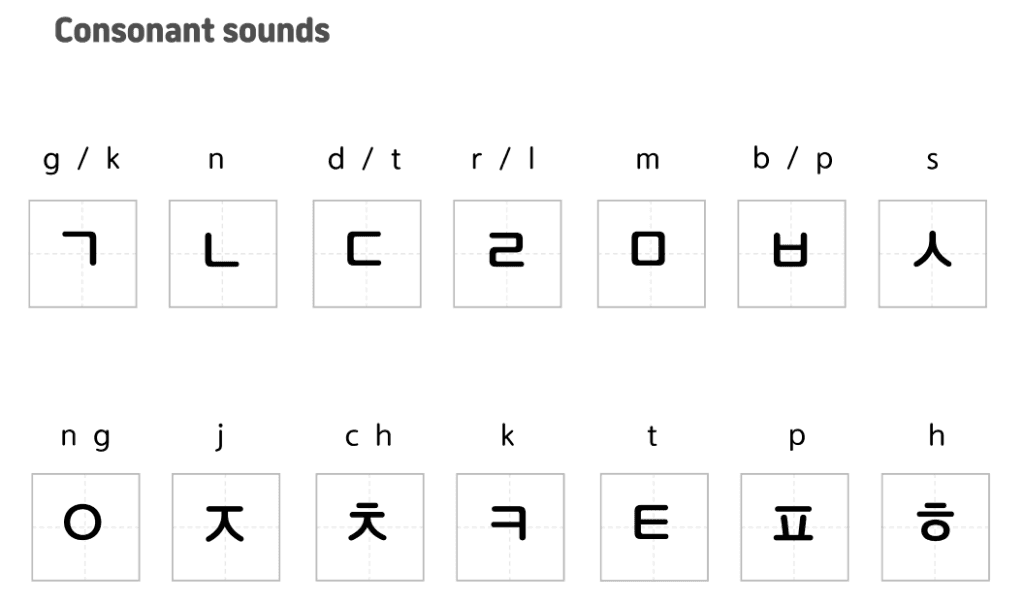
The 14 Basic Consonants
- ㄱ (g/k) — giyeok
- ㄴ (n) — nieun
- ㄷ (d/t) — digeut
- ㄹ (r/l) — rieul
- ㅁ (m) — mieum
- ㅂ (b/p) — bieup
- ㅅ (s) — siot
- ㅇ (silent/ng) — ieung
- ㅈ (j) — jieut
- ㅊ (ch) — chieut
- ㅋ (k) — kieuk
- ㅌ (t) — tieut
- ㅍ (p) — pieup
- ㅎ (h) — hieut
Double Consonants (쌍자음): The 5 Tense Sounds in Korean alphabet Hangul
Once you’re comfortable with the basic consonants, there’s one more group you’ll encounter very early in Korean: double consonants, also called tense consonants (쌍자음). These letters often confuse beginners—not because they’re complicated, but because they don’t exist in English.
- ㄲ (kk) — ssang-giyeok
- ㄸ (tt) — ssang-digeut
- ㅃ (pp) — ssang-bieup
- ㅆ (ss) — ssang-siot
- ㅉ (jj) — ssang-jieut
You’ll see them frequently in everyday Korean words, so it’s important to recognize them early.
How They Sound (Beginner-Friendly Explanation)
Double consonants are not pronounced with extra air and not stretched longer.
Instead, they sound tight, tense, and sharp.
Think of them as sounds made with more muscle tension, not more breath.
Simple comparisons:
- ㄱ vs ㄲ → 가 (ga) vs 까 (kka)
- ㅂ vs ㅃ → 발 (bal) vs 빨 (ppal)
- ㅅ vs ㅆ → 사 (sa) vs 싸 (ssa)
At first, the difference may feel subtle — but in Korean, it completely changes meaning.
Quick Comparison: Basic vs Double Consonants
The table below shows the key differences between basic consonants and double consonants (쌍자음) in the Korean alphabet Hangul. Understanding this distinction early helps improve pronunciation, listening accuracy, and overall confidence.
| Basic Consonant | Pronunciation Type | Double Consonant | Pronunciation Type | Meaning Difference Example |
| ㄱ (g/k) | Soft, relaxed | ㄲ (kk) | Tense, tight | 가 (ga) / 까 (kka) |
| ㄷ (d/t) | Light, relaxed | ㄸ (tt) | Tense | 달 (dal) / 딸 (ttal) |
| ㅂ (b/p) | Light airflow | ㅃ (pp) | Strong, tight | 발 (bal) / 빨 (ppal) |
| ㅅ (s) | Soft sound | ㅆ (ss) | Sharp, tense | 사 (sa) / 싸 (ssa) |
| ㅈ (j) | Light | ㅉ (jj) | Tense | 자 (ja) / 짜 (jja) |
2. Korean Vowels (모음) in Korean alphabet Hangul for Beginners: 10 Simple Building Blocks
Vowels were what tripped me up most at the start—especially ㅗ and ㅜ. What changed everything was learning the simple visual idea behind them. Hangul vowels follow a consistent pattern, so you can actually “see” the logic instead of memorizing blindly.
Why Vowels Make Korean Alphabet Hangul Feel Predictable
Unlike many writing systems, Hangul vowels follow a small set of visual rules. These patterns repeat across words, which means you’re rarely guessing how something should sound.
This predictability helps beginners:
- Read new words without hesitation
- Improve pronunciation naturally
- Hear sound patterns more clearly when listening
Instead of learning words one by one, you start noticing the same vowel shapes show up again and again—and your brain begins to predict the sound automatically.
How Vowels Work Together With Consonants
In Korean alphabet Hangul, vowels aren’t just add-ons. They shape how the consonants connect inside each syllable block. Once you see that relationship, blocks stop feeling messy or confusing.
Then reading Hangul becomes less about “figuring it out” and more about rhythm—moving from one sound to the next without stopping.
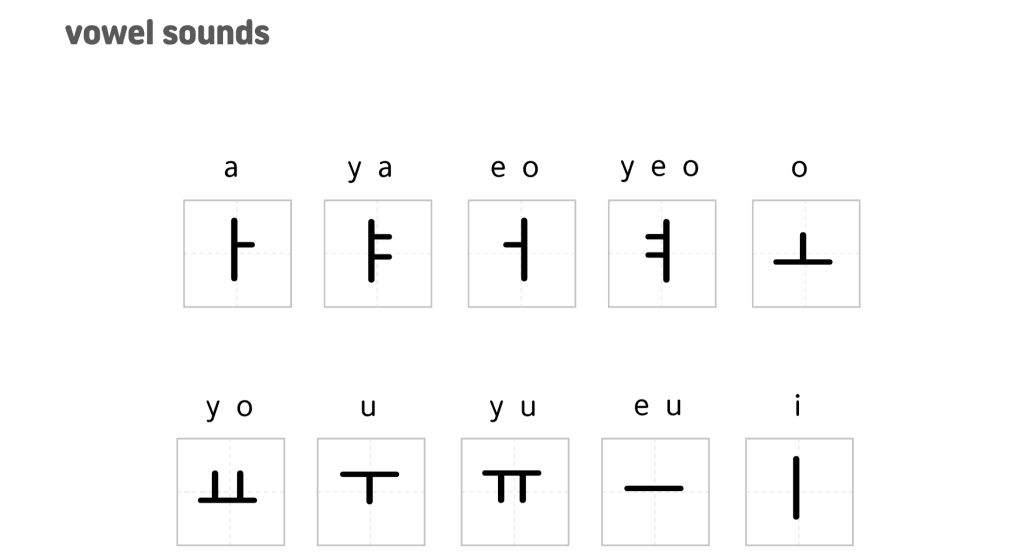
Basic Vowels
- ㅏ (a)
- ㅑ (ya)
- ㅓ (eo)
- ㅕ (yeo)
- ㅗ (o)
- ㅛ (yo)
- ㅜ (u)
- ㅠ (yu)
- ㅡ (eu)
- ㅣ (i)
The Logic Behind the Shapes
- Vertical line (ㅣ) → narrow mouth shape
- Horizontal line (ㅡ) → wider mouth shape
- Extra strokes indicate front vs. back vowel position
Once you see the pattern, vowels stop feeling like a random list and start feeling connected.
Try Reading These
아 (a), 오 (o), 우 (u), 이 (i), 여 (yeo)
3. Korean Alphabet Hangul Syllable Blocks for Beginners: How Korean Letters Combine
Korean alphabet Hangul isn’t written letter-by-letter like English. Letters are grouped into syllable blocks, and each block represents one spoken unit. This is where reading starts to feel real—because you’re reading sounds, not isolated letters.
Block Formula
Every syllable follows one of these patterns:
Consonant + Vowel → 가 (ga)
Consonant + Vowel + Consonant → 강 (gang)
Vowel + Consonant → 안 (an)
Always read blocks from top-left → bottom-right.
Examples
- 가 = ㄱ + ㅏ → ga
- 걸 = ㄱ + ㅓ + ㄹ → geol
- 밥 = ㅂ + ㅏ + ㅂ → bap
- 한 = ㅎ + ㅏ + ㄴ → han
Learn Korean Alphabet Hangul in 1 Day: A Practice Plan for Beginners
If you’re following this Korean alphabet Hangul for beginners plan, don’t rush—focus on reading the blocks clearly.
Step 1 — Learn consonants by shape (10 min)
Write each consonant while saying it aloud: ㄱ(g/k), ㄴ(n), ㄷ(d/t), ㄹ(r/l)…
Step 2 — Learn vowels by pattern (10 min)
Practice the visual rule: ㅣ → narrow, ㅡ → wide.
Step 3 — Build syllables (10 min)
Start with:
가 (ga), 나 (na), 다 (da), 라 (ra)
Then try simple nouns:
- 오리 (ori, duck)
- 바다 (bada, sea)
- 아빠 (appa, dad)
Step 4 — Read simple words (10 min)
사과 (sagwa), 학교 (hakgyo), 커피 (keopi)
How I trained my brain to remember Korean alphabet Hangul faster?
The habit that helped me most was simple: write a little, then read out loud. Saying the syllable as you write it ties the sound to the shape, and that connection sticks. It’s basic, but it works.
What I finally understood about Korean alphabet Hangul’s design
Hangul feels “logical” for a reason. It’s often described as a featural alphabet, meaning parts of the letter shapes reflect how the sound is produced. Encyclopaedia Britannica notes that the consonant letters were designed to show the position of speech organs, and the vowel letters were built from symbolic strokes.
Some scholars also point out that Hangul is unusual because it combines this featural logic with a syllable-block writing style.
Once I understood that, Hangul stopped feeling like a code I had to crack. It started to feel like a tool meant to be used—something you learn through practice, not pure memorization.
1-Day Summary: Reinforcing the “Learn in 1 Day” Promise
If your goal is to learn Korean alphabet Hangul in one day, aim for readability—not perfection. By the end of day one, you should be able to:
- Recognize the 14 basic consonants and 10 basic vowels
- Combine letters into syllable blocks using the patterns above
- Read a short list of simple words slowly, using the practice plan steps
- Know what to practice next: more syllable blocks, more short words, and a little daily reading out loud
FAQs
1. How long does it take to learn the Korean alphabet Hangul ?
Many learners can memorize Hangul in a single day and start reading simple words within a week.
2. Should I learn Hangul before learning Korean words?
Yes. Romanization can get confusing, while Hangul stays consistent and phonetic.
3. Is handwriting necessary?
Handwriting helps memory. Typing helps speed. Both are useful.
Final Thoughts

Learning Korean alphabet Hangul was the moment Korean started to feel closer. It’s clean, consistent, and genuinely satisfying once the pieces fall into place. And when you can sound out a sign or a menu on your own, the language stops feeling “far away”—it starts showing up in your daily life.
If you want daily Korean alphabet Hangul drills, quick reading tests, or personalized micro-lessons, Jolii AI is one of my favorite tools. Tiny, consistent practice is what turns Hangul from “new” into “natural.” After you finish this Korean alphabet Hangul for beginners guide, you can practice with my post on How to Say Hello in Korean.