Quick Answer (TL;DR)
You don’t learn Korean effectively by memorizing lyrics alone.
Songs like I Will Go to You Like the First Snow help because they connect language to emotion, story, and cultural meaning—making expressions easier to understand and remember.
This is why OSTs are often more useful than K-pop for real language learning.
You don’t learn Korean effectively just by memorizing song lyrics.
However, when a song is deeply tied to emotion, story, and cultural meaning—like “I Will Go to You Like the First Snow”—your brain starts absorbing language in a completely different way.
As a result, this OST became one of the most iconic Korean drama soundtrack, topping charts in South Korea and gaining global recognition through Goblin.
Even years later, it is still remembered for how deeply it resonates emotionally.

And for Korean learners, this reveals something important.
Most people start with K-pop—especially idol music, which is catchy but often stylized.
Here, “K-pop” mainly refers to idol songs designed for performance and global appeal, while OSTs are created to support story and emotion.
However, OSTs—especially emotional ballads—can often help you learn more than you expect.
Because they don’t just give you words.
They show you how language feels inside real situations.
Why Listening to K-pop Alone Is Not Enough
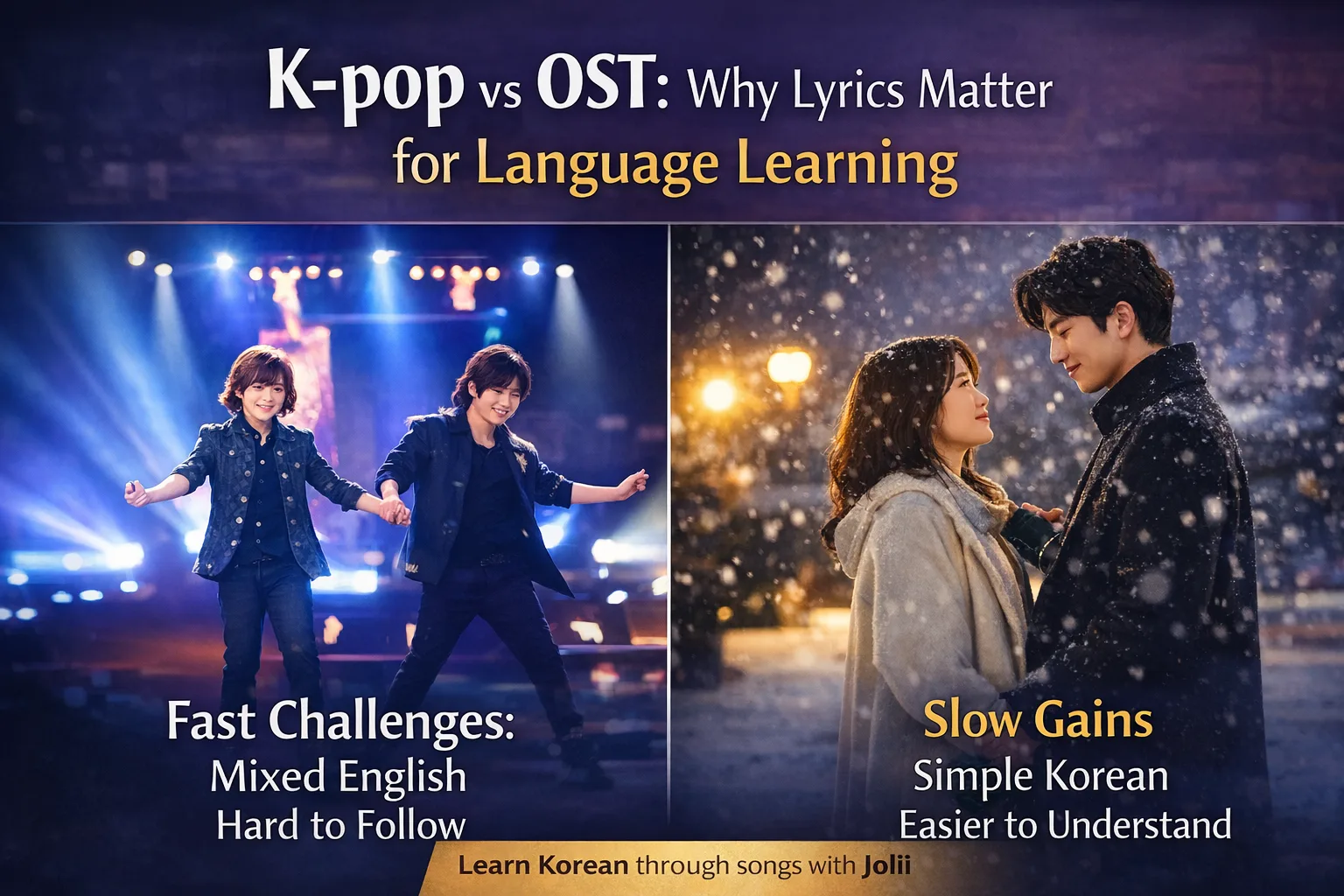
K-pop is often the first entry point.
It’s catchy.
It’s memorable.
And it makes learning feel easier.
However, there is a hidden limitation.
Most K-pop lyrics are:
- Short and stylized
- Repetitive
- Mixed with English
Because of that, they don’t always reflect natural usage, and as a result, learners may struggle to apply them in real conversations.
A Common Problem Learners Don’t Notice
You might hear lines like:
👉 「이 사랑이 너무 아파」 (this love hurts so much)
👉 「넌 나의 전부야」 (you are my everything)
And naturally, you remember them.
However, when you try to use similar expressions in real conversations, something starts to feel off.
Because in many songs, the original Korean structure may:
- Be simplified
- Be emotionally exaggerated
- Or shaped by rhythm rather than natural speech
So while these lines sound powerful in music, in reality, they don’t always reflect how Korean is actually used.
Another Hidden Issue: Speed and Pronunciation
K-pop songs are often fast.
Because of that:
- Sounds blend together
- Syllables are reduced
- Rhythm overrides clarity
For beginners, this makes it difficult to:
- Hear word boundaries
- Understand structure
- Reproduce pronunciation accurately
Why OSTs Work Differently (And More Effectively)
This is where OSTs—especially ballads—become powerful.
1. Slower Pace, Clearer Pronunciation
In “I Will Go to You Like the First Snow”:
- The tempo is slower
- Each syllable is clear
- Pauses carry emotional meaning
As a result, your brain can process language more accurately.
2. Language Is Tied to Story and Emotion
OSTs are not standalone.
They exist inside:
- Scenes
- Relationships
- Emotional turning points
So when you hear a line, you understand:
👉 When it is used
👉 Why it is said
3. Repetition Within Context
The same song appears across different moments.
However, each time:
- The emotional weight changes
- The meaning deepens
As a result, this builds a more flexible and context-based understanding.
The Cognitive Insight: Emotion Changes How You Learn
One reason this song feels so powerful is how it expresses emotion indirectly.
For example:
👉 「널 품기 전 알지 못했다
내 머문 세상 이토록 찬란한 것을」
(Before I held you, I didn’t know the world I lived in was this bright)
This is not just a statement.
Instead of saying:
👉 “You changed my life”
It shows:
- Contrast (before vs after)
- Realization
- Emotional awareness
As a result, your brain processes this as experience—not just vocabulary.
Cultural Meaning: Language Is Not Literal
To understand this song, you need to understand how Korean expresses emotion.
For example:
👉 「고운 꽃이 피고 진 이 곳
다시는 없을 너라는 계절」
(Pretty flowers bloomed and faded here—
the season that is you will never come again)
Here, a person is described as a season.
This reflects a deeper cultural pattern:
- People are tied to time
- Relationships are experienced as phases
- Emotions are expressed through nature
As a result, meaning becomes symbolic rather than direct.
✅ Language Insight
Now look at the most iconic line:
👉 「첫눈처럼 내가 가겠다」
(I will go to you like the first snow)
Grammatically, it is simple.
But emotionally, it is layered.
Why does “first snow” carry so much meaning?
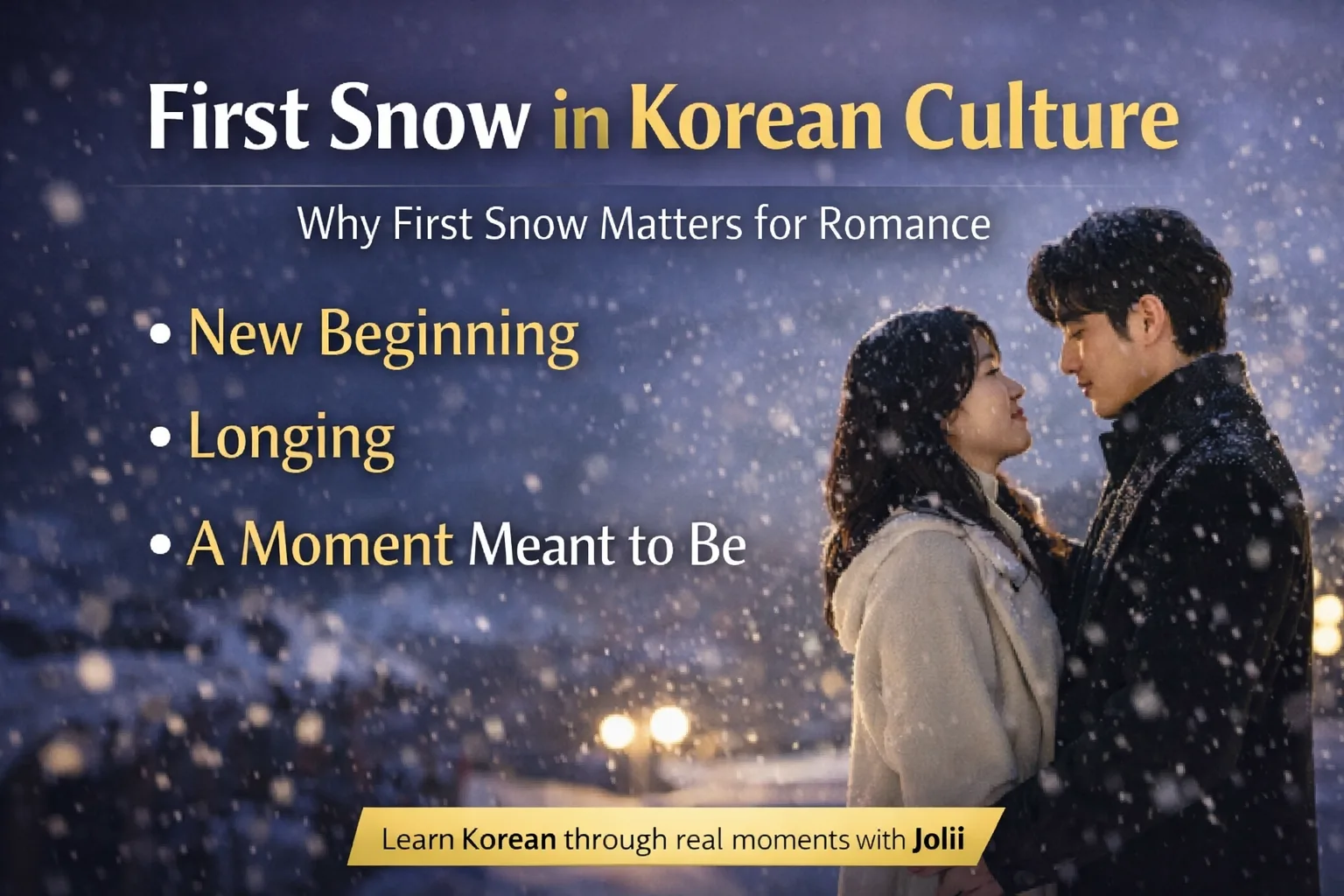
In Korean culture, 첫눈 (first snow) is not just a seasonal event.
It marks a shared moment.
The first snowfall often comes unexpectedly,
and when it does, people:
- Stop what they are doing
- Look outside
- Sometimes even think of someone
There is a common feeling attached to it:
👉 “I wish I could experience this moment with someone important.”
Because of that, first snow becomes associated with:
- New beginnings → it signals the start of winter
- Longing → it makes people think of someone they miss
- Fate → because it feels like a moment you are meant to share
In many Korean dramas, the first snow is used as:
- A turning point
- A reunion
- Or a silent promise
So when the lyric says:
👉 「첫눈처럼」
It is not describing weather. It is referencing a cultural moment loaded with emotion.
What about 「가겠다」(I will go to)?
👉 가겠다 (I will go) is also more than a future action.
It carries a sense of intention and willingness, yet without pressure.
Rather than sounding forceful, it feels soft and non-imposing.
Instead of demanding, it gently suggests.
Put together, what does the sentence really mean?
This is not a direct promise like:
👉 “I will come back to you.”
Instead, it feels like:
- “I will return to you in a moment that feels meant to happen”
- “I will come to you gently, like something you’ve been waiting for”
It is:
- Quiet
- Inevitable
Emotionally distant, yet intimate
The Deeper Insight
In Korean, meaning is not delivered directly.
It is built through:
- Shared cultural images
- Emotional timing
- Indirect expression
So to understand the sentence,
you don’t just translate it. You have to feel when it fits.
Emotional Depth: When Language Carries Time
Another powerful moment appears here:
👉 「너와 함께 살고 늙어가
주름진 손을 맞잡고」
(I wanted to live with you, grow old with you,
and hold your wrinkled hands)
This expresses:
- Time
- Aging
- Shared life
And yet, it uses simple language.
That contrast is what makes it unforgettable.
Research shows that emotional learning improves retention because meaning is tied to experience rather than isolated information.
At the same time, multimodal input (audio + visual + narrative) strengthens comprehension and memory.
In short:
Your brain remembers what it feels.
A Moment I Realized This Myself
When I first started working at the company, my Korean wasn’t strong enough for natural conversation.
So I kept to myself.
I only spoke when necessary for work.
Outside of that, I avoided conversations—not just because I was shy, but because I didn’t know how to start one.
Then one day, something small happened.
During lunch, my phone rang.
And my ringtone was “I Will Go to You Like the First Snow.”
For a moment, I noticed a reaction.
A slight spark in my colleague’s eyes.
After I finished the call, she turned to me and said:
👉 “That song… from Goblin, right?”
And just like that, a conversation started naturally.
We talked about the scene.
The feeling.
The meaning behind the song.
At one point, she mentioned a line:
👉 「첫눈처럼 내가 가겠다」
(I will go to you like the first snow)
She explained how it doesn’t just mean “I will come to you,”
but something much softer and more emotional.
That was the moment I realized:
I wasn’t just learning words.
I was learning how meaning is shaped.
And even without speaking much,
that one song became a bridge.
From Lyrics to Real Understanding
| Lyric | Literal Meaning | Cultural Meaning | What You Actually Learn |
| 찬란한 것을 | something bright | life becomes meaningful through someone | emotional contrast |
| 너라는 계절 | a season called you | people as phases in life | metaphorical thinking |
| 첫눈처럼 | like first snow | fate, longing, new beginning | cultural symbolism |
| 가겠다 | I will go | soft intention | indirect expression |
How to Use OSTs for Learning Korean
1️⃣ Listen Without Translating
Focus on emotion first.
👉 Why: feeling comes before meaning
2️⃣ Watch the Scene
Understand context.
👉 Why: meaning depends on situation
3️⃣ Replay Key Lines
Focus on repetition.
👉 Why: patterns build memory
4️⃣ Let It Click Naturally
Do not force usage.
👉 Why: language emerges with timing
Why This Connects to Context-Based Learning
At some point, you stop asking:
👉 “What does this mean?”
And start asking:
👉 “When is this used?”
That shift is everything.
Because language becomes usable only through context.
As explained here:
👉 Context is King: How Netflix & Jolii AI Rewire Your Brain for Fluency
FAQs
1. Can I learn Korean just from songs?
No. Songs help with exposure, but they are not enough on their own.
2. Why are OSTs more effective than K-pop?
Because they provide clearer pronunciation, emotional context, and real usage.
3. Should I memorize lyrics?
No. Focus on understanding how they are used.
A Simple Way to Make This Work
The key is not the song.
It’s how you use it.
That’s where Jolii helps.
Instead of passive listening,
you can:
- Replay scenes
- Focus on key lines
- Build patterns naturally
Final Thoughts
Korean is not difficult because of grammar.
It is difficult because meaning is hidden inside emotion.
Songs like this show you something deeper.
Not just what language means.
But how it feels.
And once you understand that,
language stops being something you study.
Instead, it becomes something you experience.