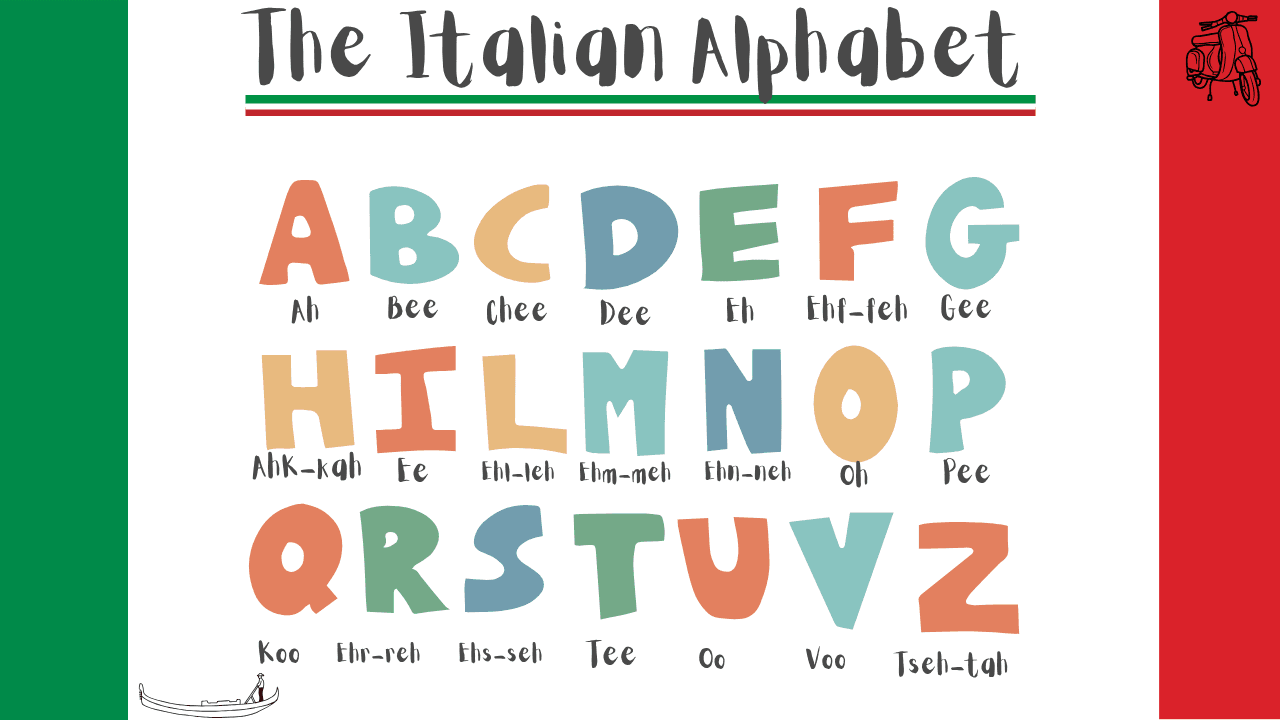
The Italian alphabet and its pronunciation rules are a natural starting point for your Italian learning journey. While foreign letters like J, K, W, X, and Y appear in loanwords, they are not part of the traditional Italian alphabet, which consists of 21 letters (16 consonants and 5 vowels).
The Italian alphabet follows highly phonetic pronunciation patterns, meaning most words are pronounced exactly as they are written, with just a few exceptions.Compared to English, this makes the Italian alphabet easier for beginners to understand and helps learners start reading Italian words correctly from day one.
But with it, you also come across situations when words totally change their meaning with a slight change in the spellings.
For example, pena (sorrow) and penna (pen) sound very similar but have completely different meanings. If you don’t emphasize the double N in penna, you might end up asking for sadness instead of a pen! How sad is that!
In this guide, you’ll learn how many letters Italian has, how to pronounce them, and the key pronunciation rules that help you avoid common beginner mistakesAndiamo!
What is Unique About the Italian Alphabet and Its Pronunciation?
Do you know what makes the Italian language sound so much like music? All the words end with vowels (a,e, i,o,u), contributing to its musicality and its melodic sound.
In this regard, it differs from other Romance languages like Spanish, French, and Portuguese, making it a unique language to learn. And speaking about music, there are so many kids’ songs about the Italian alphabet that help you memorize it faster!
How Do You Say the Alphabet in Italian?
Italian is a phonetic language, which means that once you know the alphabet and a few pronunciation rules, you will be able to pronounce most Italian words correctly. Many learners notice this early confidence and they can read Italian words aloud correctly within their first hours of lesson, something less common in languages with less predictable spelling like French. And once you know the Italian alphabet, you’re off to a good start learning Italian fast!
So, let’s start by learning the Italian alphabet. For each letter, we have included a word as an example. Click on the  icon to listen to the pronunciation, repeat the words, and memorize them for practice.
How Many Letters Are in the Italian Alphabet?
The Italian alphabet is “ristretto”, meaning that it is shorter than other alphabets, such as the English one, as it consists of only 21 letters (16 constants and 5 vowels).
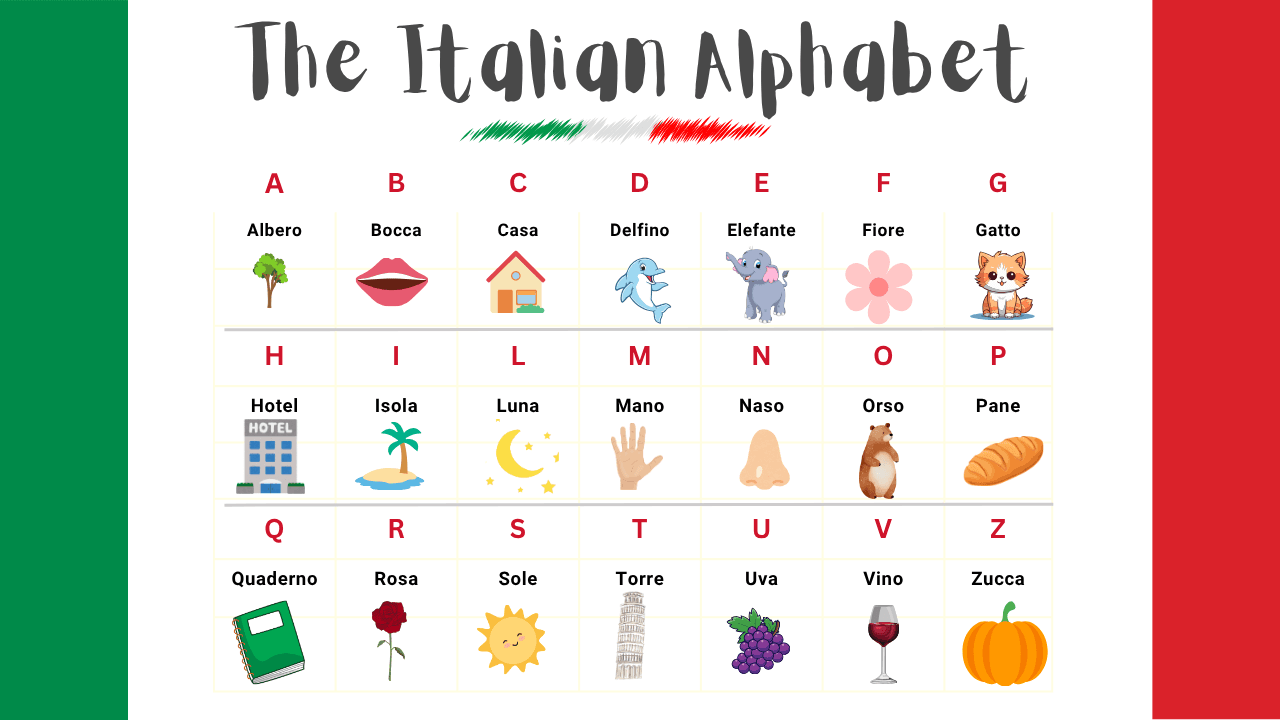
| Letter | Pronunciation | Italian Example | English Translation |
| A | a | Albero | Tree |
| B | bi | Bocca | Mouth |
| C | ci | Casa | House |
| D | di | Delfino | Dolphin |
| E | e | Elefante | Elephant |
| F | effe | Fiore | Flower |
| G | gi | Gatto | Cat |
| H | acca | Hotel | Hotel |
| I | i | Isola | Island |
| L | elle | Luna | Moon |
| M | emme | Mano | Hand |
| N | enne | Naso | Nose |
| O | o | Orso | Bear |
| P | pi | Pane | Bread |
| Q | cu | Quaderno | Notebook |
| R | erre | Rosa | Rose |
| S | esse | Sole | Sun |
| T | ti | Torre | Tower |
| U | u | Uva | Grape |
| V | vu | Vino | Wine |
| Z | zeta | Zucca | Pumpkin |
One Interesting Fact About the Italian Alphabet
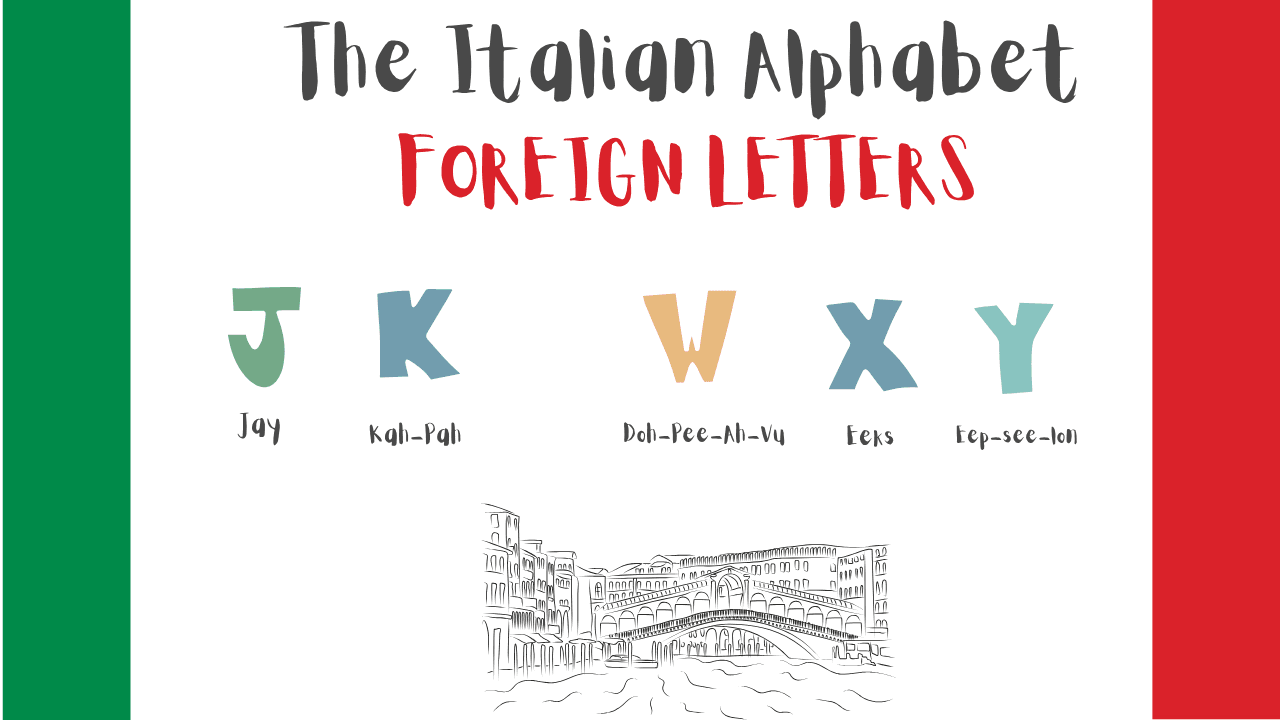
What is missing in the alphabet in comparison with English? The so-called “Lettere Straniere” (foreign letters): J (jay) K (kappa),W (doppia vu) ,X (ics),Y (ypsilon). These letters occur in some Italian words, but are only found in foreign words that are commonly used in Italian, such as ‘Jazz‘, ‘Taxi‘, ‘Kiwi, ‘Xilofono‘.
Practice: Learn How to Spell Your Name in Italian
Come si scrive il tuo nome? (How do you spell your name?) Try spelling your name using the Italian alphabet!
- Example: Emily → E – M – I – L – Y (e – emme – i – emme – ypsilon).
- David → D – A – V – I – D (di – a – vu – i – di).
Vowels and Consonants in the Italian Alphabet
Alphabets are a collection of vowels and consonants. The Italian alphabet has the following 5 vowels and 16 consonants.
How Many Vowels Are in the Italian Alphabet?
Italian has 5 vowels: A, E, I, O, U. Their sounds are quite different from English, so be careful! Especially A, E and I, which are quite different from English, and mispronouncing them can really lead to misunderstandings. A good mnemonic tip is to think:
Let’s practice! Read, listen, and repeat the following words.
| Vowel | Italian Examples |
| A | Amico, Amore, Aria, Acqua |
| E | Elefante, Estate, Elegante, Energia |
| I | Isola, Italia, Istruzione, Idea |
| O | Ombrello, Oceano, Opera, Oro |
| U | Uva, Uomo, Università, Ufficio |
How to Pronounce Tricky Letters in the Italian Alphabet
Italian alphabet has a few tricky letters, C and G both fall in the tricky category.
We recommend you memorize a few pronunciation rules. Only a few!
Most learners get confused, especially with letters C and G, because their pronunciation changes according to the following letter.
Common Pronunciation Patterns in Italian Letters
Here are some common practices for pronouncing Italian letters with some combinations.
How do you pronounce the letter “C” in Italian?
The letter C can be pronounced in three different ways depending on whether it is followed by I, E, H, or any other letter. It might sound tricky at first, but if you practice it will become clear!
| Letter Combination | Pronunciation | Examples |
| C + I, C + E | “CH” (as in “cheese”) | ciao (hello), cena (dinner), cielo (sky), cento (hundred), cioccolato (chocolate) |
| C + all the other letters (including H) | “K” | casa (house), coro (choir), cuore (heart), classe (class), credere (to believe), chiave (key), forchetta (fork), chilo (kilogram) |
How to pronounce the letter “G” in Italian.
| Letter Combination | Pronunciation | Examples |
| G + I, G + E | Soft “G” (like “J” in “jump”) | gente (people), giorno (day), gelato (icecream) |
| G + all the other letters | Hard “G” (like in “go”) | gatto (cat), gomma (rubber), grande (big), gloria (glory). |
Additionally, in Italian, when G is followed by L + I or by N, its sound changes.
| Letter Combination | Pronunciation | Examples |
| G + L + I | Silent “G”, “LI” pronounced like “lli” in “million” | figlio (son), famiglia (family), luglio (july), moglie (wife) |
| G + N | Pronounced like “NY” in “canyon” or the Spanish “ñ” | bagno (bathroom), gnocchi, giugno (june), Spagna (Spain) |
Practice: Can You Guess the Right Pronunciation?
Try saying each word aloud and guess the correct sounds of C and G. Then, click to listen and check your answer!
Words to Pronounce
How many did you guess correctly?
How to pronounce the letter “H” and more in Italian.
In the following table, you will find a few more sounds that can be tricky to learn in Italian, such as the “H” sound, the combinations with SC, and the double consonants.
| Letter Combination | Pronunciation | Examples and Translation |
| H | Silent | hotel (hotel), ho (I have), hai (you have) |
| SC + I, SC + E | “SH” sound | pesce (fish), prosciutto (ham), sciarpa (scarf) |
| SC + all other letters (including H) | “SK” sound | scarpa (shoe), scuola (school), bruschetta (bruschetta) |
| Double Consonants | Emphasized sound, longer pronunciation | pala / palla (shovel / ball), nono / nonno (ninth / grandfather) fato / fatto (fate / fact) |
Double consonants are not just longer sounds — they can change meaning entirely, making them one of the most important pronunciation details to master early.
Common Mistakes Beginners Make With the Italian Alphabet
Many learners struggle with a few recurring pronunciation patterns:
- Pronouncing C and G in the wrong way
- Forgetting that H is silent (like in “ho”)
- Ignoring double consonants (penna vs pena)
- Spelling the vowels in the wrong way, leading to confusion
Conclusion
Learning the Italian alphabet is usually straightforward, making Italian a relatively easy language to learn for English speakers. Nevertheless, a few pronunciation patterns take practice. Hearing Italian in real conversations through films, shows, or YouTube videos, helps reinforce these sounds naturally.
Platforms like Jolii allow you to pause, replay, and explore pronunciation within authentic video content, making it easier to connect written Italian with real speech.
FAQs
Silent Letters: What Letter Is Silent in Italian?
The letter H is silent in Italian. While it remains silent for historical and etymological reasons, it serves an important purpose in distinguishing between words that would otherwise sound the same, such as ho (I have) and o (or), and hanno (they have) and anno (year) . Moreover, it can be combined with the letters C or G to create different sounds, such as in chiave (key) or ghiaccio (ice).
How Do You Pronounce “Q” in Italian?
The letter Q in Italian is always followed by “U” and forms the combinations “QUA,” “QUE,” “QUI,” and “QUO.” It is pronounced like the “K” sound in English. For example: quando (when), questo (this), quindici (fifteen).
Why Does the Italian Alphabet Have Less Letters Compared to English?
The letters j,k,w,x, and y don’t exist in the Italian alphabet, and exist only in foreign words such as taxi, web, xilofono.