The only reason English is the most spoken language in the world today is that millions of non-native speakers have decided to learn it. There are 380 million native English speakers compared with 1,140 million second-language English speakers. So, if over one billion people can learn English as a second language, then you can too!
Although that is not to say that learning English is without its challenges. Over the years, the students I teach English to in Central America have told me the things that they find most difficult about learning English, including spelling, grammar rules, and more.
ersSo, is English Hard to Learn? Here is the honest truth for beginners.
Spelling vs Pronunciation

My students primarily speak Spanish as a first language, which is a phonetic language. This means that most letters are pronounced consistently, and words are generally pronounced as they are spelt. This differs from English, where pronunciation can vary significantly and English spelling can be tricky.
For beginners, this is where the language stops being “easy” and suddenly becomes a chaotic puzzle. Take, for example, the letter combination, what we typically call a diagraph, “ou”.
- through (throo)
- though (thoh)
- thought (thawt)
- tough (tuff)
Each of these words uses the same digraph “ou” but has a completely different pronunciation. Unfortunately, for beginners, there’s no simple rule to learn, just memorisation of each word.
English also has a lot of words with silent letters, making them difficult to pronounce for beginners, such as:
- k in knife
- b in debt
- w in answer
- gh in light
Again, there is no logical reason for this, and even though you don’t pronounce them, they need to learn that they exist, which can be frustrating for learners. Long English words are also a challenge for many learners.
Rules and exceptions

English has a lot of grammatical rules and just as many exceptions to each of these rules.
I before E, or is it?
One of the most well-known ones of these is the I before E except after C rule. Sounds simple, words like receive, believe, relieve, follow this rule perfectly. But then there are the exceptions. For example, weird, height, their, seize, etc. I often joke with my students about this rule, saying, “I before E except when it isn’t.”
Plural Rules
Typically, we add -s, ies, es, ves to the end of a word, depending on the word ending, to make it plural. For example:
- cat → cats (common for most nouns)
- bus → buses (when a word ends in s, ss, sh, ch, x, z)
- baby → babies (when the word ends in y)
- leaf → leaves (for words ending in f or fe)
Then again, there are the irregular plurals that completely ignore these rules. Such as:
- child → children
- person → people
- man → men
- woman → women
- goose → geese
- fish → fish (some words don’t change from singular to plural)
Irregular Past Tense Verbs
Speakers of romance languages like Spanish or French are already familiar with the concept of irregular past tense verbs in their own languages, but that doesn’t mean that learning irregular verbs in a second language is not a challenge.
Regular verbs follow the rule of ass – ed to express the past tense. This is the main pattern and one of the easiest parts of English grammar.
Examples:
- walk → walked
- play → played
- talk → talked
- wash → washed
However, there are hundreds of past tense verbs that are irregularly conjugated. These include:
- go → went
- eat → ate
- buy → bought
- take → took
- run → ran
- have → had
If you’re looking for a beginner-level guide for learning English grammar, Cambridge English is a great resource.
Psychological Barriers

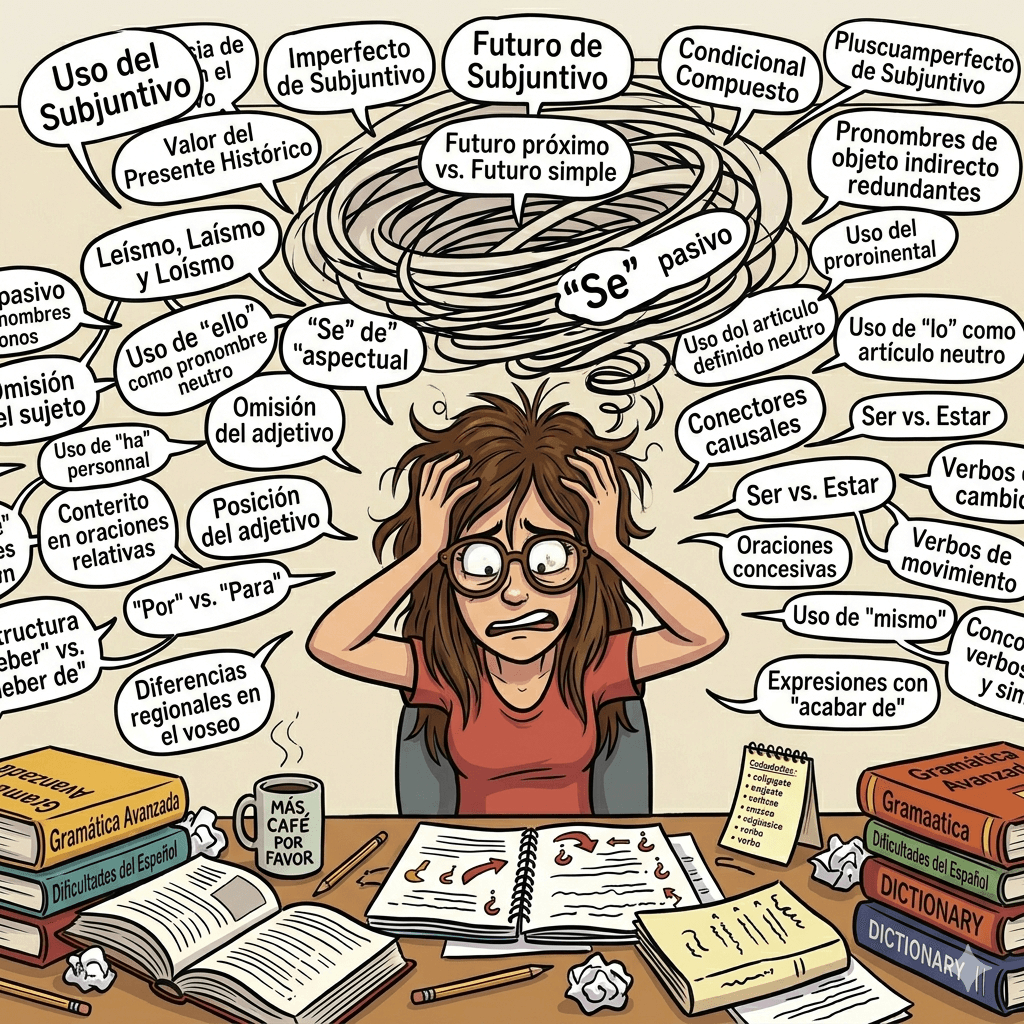
Many of my students compare English to their native language instead of learning its patterns. This is never a good idea because English follows its own unique (often frustrating patterns and exceptions, so it’s best to approach learning with a different mindset. You can’t always rely on translation.
Sometimes students focus too much on mistakes they make, like mispronunciation, which inhibits them from speaking. They think that fluency means achieving perfection and having the right accent, which couldn’t be further from the truth.
Conclusion
Modern-day English is a language that has evolved from many influences, including Germanic Old English, French, Latin, Spanish, Arabic, and many more. This mix gives the language its richness, but also explains its irregular spelling, unpredictable rules, and surprising vocabulary. Simple things like the fact that nouns don’t have a gender also feel strange to some of my Spanish-speaking students, although this is something they get used to very fast and even appreciate, as it makes memorisation of new words easier.
English can be messy, funny, confusing, and wonderful. Like learning any language, it is a long and sometimes frustrating process. What matters is that you keep trying, keep practicing and find strategies that work for you. Enjoy the journey. And trust me: if millions of learners around the world can do it, so can you.