You’ve decided to learn a new language. It could be for travel, career advancement, or the thrill of connecting with another culture.
But here’s the thing. In-person classes and tutors cost a fortune. The good news? You can actually learn a new language by yourself.
It’s incredibly effective when you know what works. And I’m not talking about those “get fluent in 30 days” gimmicks. I’m talking about real, science-backed strategies that linguists and successful self-learners have proven time and again.
Let’s get into it.
How to Learn a Language by Yourself Without a Teacher (Quick Answer)
Learning a language by yourself works when you combine high-frequency vocabulary, spaced repetition, and daily speaking practice. Most self-learners reach basic conversation in 6–12 months with 30–60 minutes a day, as long as learning includes active speaking, not just passive input.
Why Learning a Language By Yourself Works
Whether you’re trying to learn English fast or improve your Italian, here’s why you should start building solo:
- You set the pace: Have a busy work or school schedule? No pressure. Studying on your own means you decide when, how, and how much to learn. You just need to fit your language classes.
- Relevant choices: With a formal in-person class, you learn everything. But with solo classes, you pick what aligns with your goals. Let’s say you want to learn basic survival phrases for a trip or formal business vocabulary. You can start with that.
- More confidence: Let’s be honest. A classroom setting can feel intimidating. Learning privately gives you a chance to experiment and make mistakes in a safe space. Way less stressful.
Science-Backed Strategies on How to Learn a New Language by Yourself
If you’re going to learn a language, you need to know that certain techniques outperform others. Here they are:
Start with High-Frequency Words and Phrases
Here’s a game-changer. You don’t need to memorize an entire dictionary to have real conversations.
Focus on survival phrases first. Think:
- Greetings
- Questions (“Where is…?” “How much…?”)
- Ordering food
- Expressing basic needs
By the time you know about 1,000 base words in a specific language, you’ll already be on the intermediate level. So here’s the trick. As soon as you learn words like “bathroom” and “where” separately, you can start saying “Where is the bathroom?”
Use Spaced Repetition Systems
The spacing effect is one of the most replicated findings in learning science: reviewing information at gradually increasing intervals produces significantly stronger long-term retention than cramming the same material in a single session. The reason is straightforward — each time you retrieve a memory just before it fades, you strengthen the neural pathway slightly. Cramming skips this process entirely.
Let’s talk about why cramming doesn’t work. Remember how you crammed for that high school exam and forgot everything a week later?
That’s because your brain wasn’t designed to retain information like that.
Spaced repetition is what you need as a self-learner. And this is not just a theory. Research on spaced repetition consistently shows that distributing practice across time produces stronger long-term retention than massed study. The principle — spacing reviews at progressively longer intervals — is one of the most replicated findings in cognitive psychology, and it’s the basis for how tools like Anki and Jolii schedule vocabulary review.
Here’s the rhythm. You review information at progressively longer intervals: first after a day, then after three days, then after a week, then after two weeks. A simple pattern to fight forgetfulness.
The beauty for solo learners? Jolii automates spaced repetition through AI — adapting review schedules to your individual forgetting curve while building exercises around real video content you’ve already watched. The vocabulary you encounter in a Spanish show or song comes back at the optimal moment for retention, in context rather than as an isolated flashcard.
Immerse Yourself
I know you might say, “But I can’t afford to move to France/Japan/Mexico!” Trust me, you don’t need to.
The beauty of digital tools and AI language apps lies in their immersion. It brings the language to you. Here’s what to do:
- Change your phone’s language settings: Yes, it’ll be confusing for a week. But your brain adapts fast. Soon, you’ll confidently say “settings,” “notifications,” and “battery” without trying.
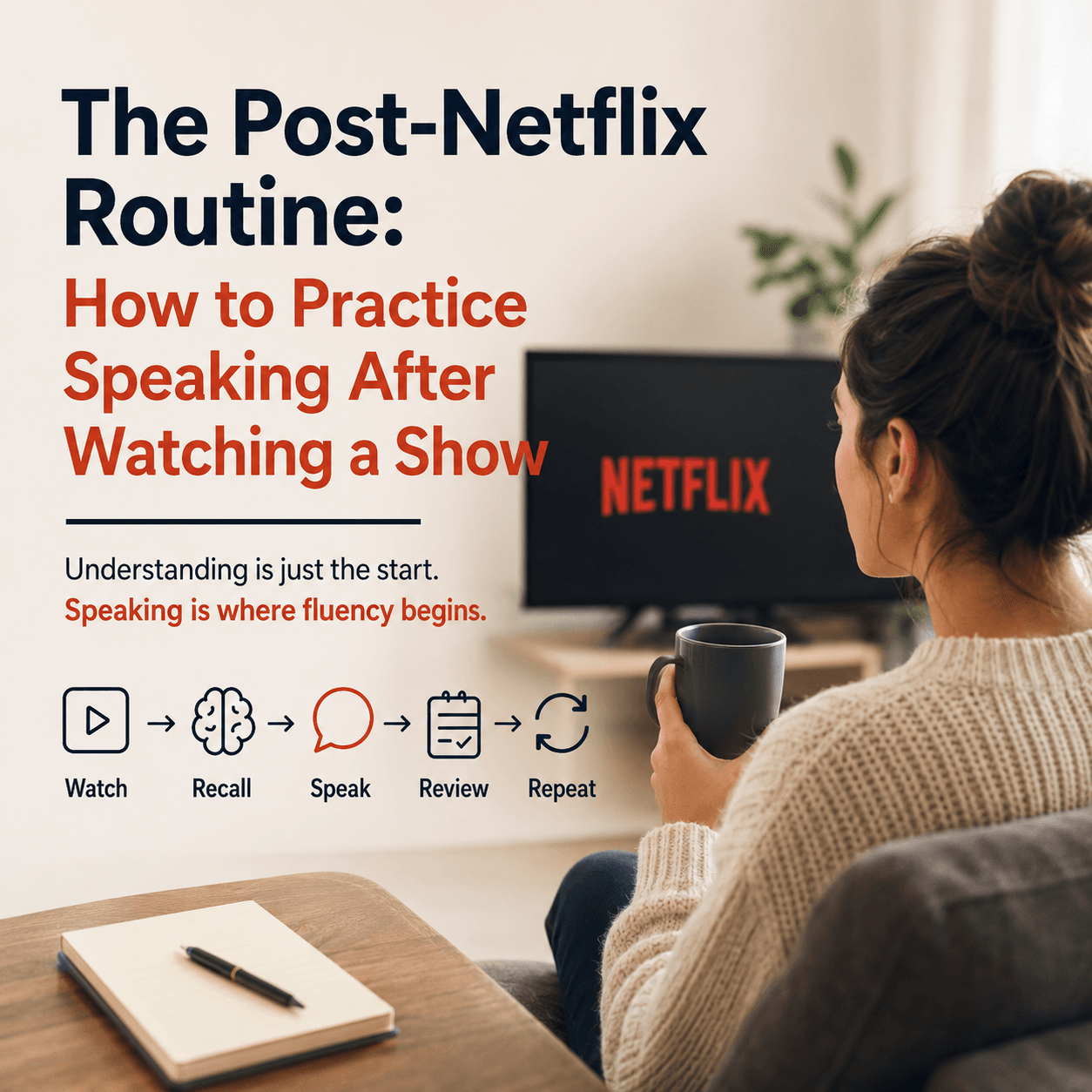
- Watch Netflix shows in your target language: Start with English subtitles, then switch to target language subtitles, then go subtitle-free.
- Listen to podcasts: Commute? Doing dishes? Folding laundry? Podcast time. Even if you only catch 30% at first, that’s more than yesterday.
- Use social media: Those favorite Instagram accounts and TikTok creators? This is the perfect time to follow them. Plus, you’ll learn slang that textbooks never teach.
This aligns with Stephen Krashen’s comprehensible input hypothesis, which emphasizes that we acquire language when we understand messages slightly beyond our current level.
Recent 2025 research has expanded on this, showing that comprehensible input works best when it’s understandable. In short? Challenging enough to stretch you, but not so hard that you’re lost. For a practical application of this principle, Can You Learn a Language With Netflix? breaks down exactly how to use authentic content at the right difficulty level.
Pro tip: Make it fun. Love cooking? Find recipe videos. Into true crime? There’s a murder podcast in every language.
How to Practice When Learning a New Language by Yourself
Here are quick tips to always remember:
- Schedule daily practice sessions. 10-15 minutes is enough
- Keep a voice journal that allows you to record yourself as you speak. You’ll see the progress.
- Talk to yourself. Narrate your life. “I’m making coffee.” “The water is boiling.” “I need to add milk.” It feels weird at first, but it’s effective.
Final Takeaway
Learning a new language by yourself is about combining proven strategies. The science is clear; you need to immerse yourself and factor in spaced repetition. But the key to all this is consistency. The good thing is that language learning apps like Jolii.ai are designed for self-learners like you.
The conversation feature lets you practice speaking without the anxiety of making mistakes in front of a real person.
FAQs
How long does it take to learn a new language by yourself?
Honestly? It depends on the language and how serious you are. The FSI estimates 600-750 hours for easier languages, 2,200+ for challenging ones.
Can you really learn a new language by yourself?
Yes — but with one honest caveat. Self-study works best for input skills: vocabulary, reading, and listening. Speaking is harder to develop alone because it requires real-time retrieval under social pressure. The solution isn’t necessarily to find a teacher immediately. You can build low-stakes speaking habits first: self-talk, voice memos, AI conversation practice. Once those become automatic, real conversations feel significantly less intimidating. Try to get into speaking with real people, it will help you improve faster!
How can I learn a new language by myself for free?
Simple. YouTube is a gold mine. Free channels are excellent. If you’re paying for Netflix, you already have free classes. Also, language apps offer free trials and plans to support conversational practice.