Music makes it easier to memorize sounds, structures, and new words, while also developing the ear for the musicality of French. It’s also a way to connect with French culture effortlessly, simply by listening to a song several times.
Among all the songs, “Dernière danse” 🔊 by Indila holds a special place. Its steady tempo, clear enunciation, and mix of strong emotions make it an ideal learning tool. Learners can find expressions from everyday life, common structures like je remue / je danse / je cours, and an emotional vocabulary useful for expressing themselves with nuance.
By discovering this song step by step, learners can practice listening, repeating, learning vocabulary, and improving their pronunciation, exactly like modern learning tools based on active repetition. An approach that current learning apps, such as those that focus on guided listening, already use to make the experience more immersive and effective.
Presentation of “Dernière danse”
1. Context
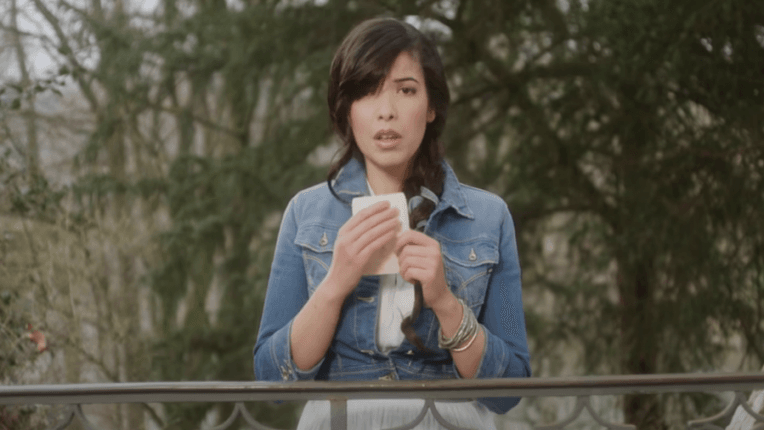
Released in 2013, “Dernière danse” is the song that introduced Indila to the public. It became an international phenomenon, accumulating over a billion listens on YouTube and remains one of the most popular French-language songs used on TikTok and Instagram today.
Musically, it blends pop, oriental sounds, and an almost cinematic atmosphere (without overstepping). The mood is both intense, melancholic, and captivating.
2. Why this song helps learners
• Very clear pronunciation
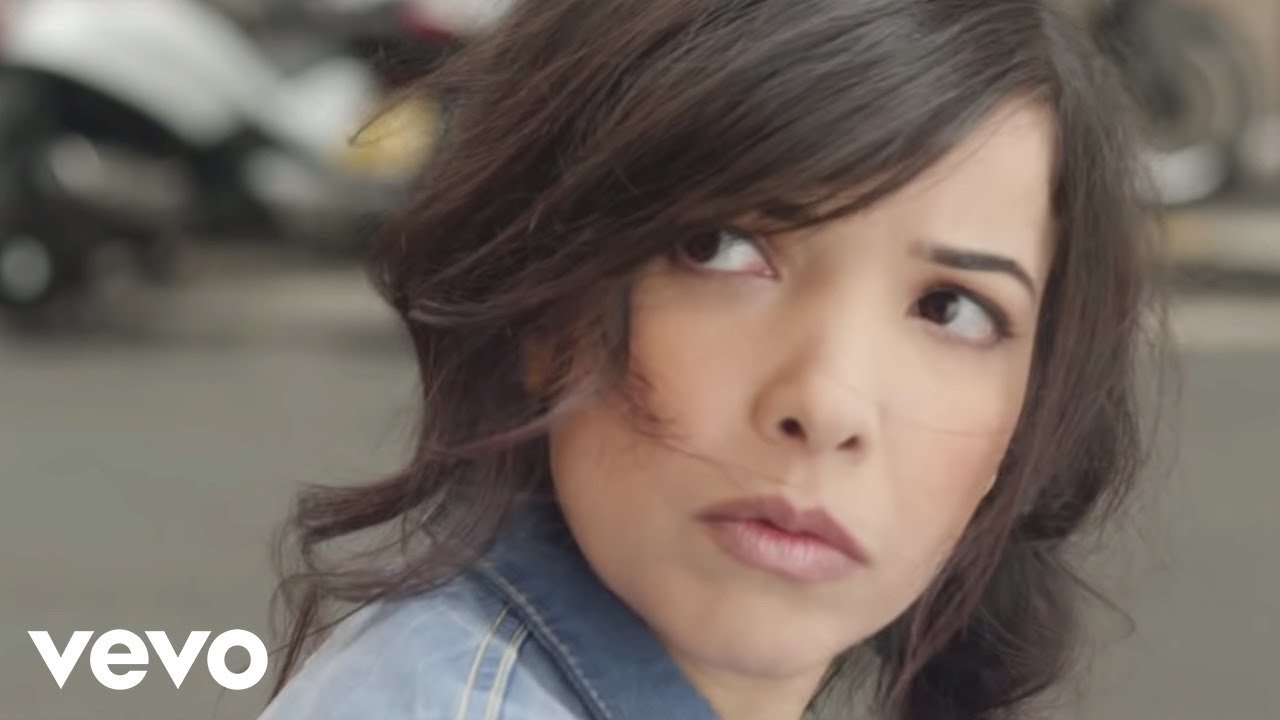
Indila pronounces each word with great precision. The French sounds stand out clearly, which makes understanding and reproducing the phrases easier.
• A pleasant tempo to follow
The song is neither too fast nor too slow, giving you time to hear each word, recognize the sounds, and even repeat some parts along with the singer.
• Natural repetitions
The chorus and certain verses are repeated multiple times. You’ll find simple structures like :
These elements are easy to memorize, turning the listening experience into a language exercise, simple and intuitive.
What Learners Can Learn from This Song

1. Modern Emotional Vocabulary
“Dernière danse” is rich in expressive, emotional language that learners don’t often find in textbooks. The song blends concrete words (things you can picture) with abstract words (feelings, sensations), which makes the vocabulary both memorable and useful. Here are some examples that appear in the song:
| French Word | Meaning in English | Type of Word |
| fuir 🔊 | to run away, to escape | concrete action |
| douleur 🔊 | pain | abstract emotion |
| peine 🔊 | sorrow, difficulty | abstract emotion |
| m’envole 🔊 | I fly away / I drift away | metaphorical action |
| souffrance 🔊 | suffering | abstract concept |
| peur 🔊 | fear | emotional action |
Why it helps:
Learners acquire vocabulary that expresses emotions, conflict, sadness, release, themes that appear often in everyday conversations, films, and French storytelling. Because the song’s mood is strong, these words tend to stick in memory.
2. Useful Repetitive Structures (“je veux / je remue / je danse”)
One of the reasons “Dernière danse” works so well for learning is that it repeats simple but powerful structures such as:
- je veux…🔊 → I want…
- je remue…🔊 → I stir…
- je danse…🔊 → I dance…
These patterns appear naturally throughout the song, always in emotional or descriptive contexts. This repetition allows learners to internalize:
- how French pronouns work
- how present-tense verbs sound when sung
- how sentence rhythm flows in real speech
How to memorize them while listening:
- Focus on the first word (je) and the verb ending
- Repeat them during each chorus (shadowing)
- Pause after each line and say your own sentence: je veux + something / je remue + something
The melody reinforces the grammar, making it easier to remember.
3. The Syllabic Rhythm of French
French is a syllable-timed language: each syllable is pronounced with a similar duration. Indila articulates each syllable clearly in repeating lines such as:
- Je remue le ciel, le jour, la nuit 🔊
- Je danse avec le vent, la pluie 🔊
- Et je danse, danse, danse… 🔊
- Je m’envole, vole, vole… 🔊
These lines are perfect for learners because they contain:
clear, even syllables
Words like je remue, je danse, je m’envole are pronounced with a steady rhythm.
repeated structures
Repetition (danse, danse, danse / vole, vole, vole) helps internalize pronunciation patterns.
smooth natural liaisons
For example, the transitions in je remue or je m’envole flow naturally and softly.
Mini pronunciation exercise (now aligned with lyrics)
Practice these short fragments taken from the song (no full lines reproduced):
Focus on:
- giving each syllable the same weight
- keeping the rhythm slow and steady
- linking sounds smoothly (je-m’en-vole)
This mirrors the calm, measured timing of Indila’s delivery.
4. Understanding the Imperative and Indirect Requests
Indila does not use direct commands. However, the lyrics include strong expressions of desire and intention, especially:
- Je veux m’enfuir 🔊 → I want to run away
- Que tout recommence 🔊 → expresses a wish for things to start over
- Je veux… 🔊 repeated emotionally
These aren’t imperatives, but they express powerful emotional requests or needs, which are just as useful for learners.
How this helps learners
- understanding how French expresses desire (je veux)
- seeing how infinitive verbs follow this structure (je veux m’enfuir)
- learning emotional, natural spoken French rather than textbook commands
- noticing how intonation conveys urgency and vulnerability
Everyday examples using the same structure (NOT from the lyrics)
These help learners reuse the grammar:
- Je veux comprendre. 🔊 → I want to understand.
- Je veux partir. 🔊 → I want to leave.
- Je veux essayer. 🔊 → I want to try.
The emotional tone in the song makes je veux + infinitive memorable.
Step-by-Step Analysis of 4 Key Lines

Below are four short excerpts from the song, not full lyrics, chosen because they illustrate useful grammar, vocabulary, and pronunciation patterns that learners can immediately reuse.
Line 1 – “Dans tout Paris…” (fragment)
Linguistic explanation:
This fragment highlights how French uses spatial expressions to convey emotional states. In the song, (“Dans tout Paris, je m’abandonne” 🔊) expresses being overwhelmed, drifting through the city, or feeling lost. Using dans + place is a common structure to describe where an emotional or physical action unfolds.
Paris is a recurring symbol in French music, often representing solitude, wandering, or emotional tension. Indila follows this tradition by using the city as a backdrop for inner turmoil.
How to listen (shadowing tip)
Focus on the flow. Repeat the sequence several times while keeping the rhythm steady and fluid.
Line 2 – “Je veux…” (fragment)
Linguistic explanation:
This is a classic subject + verb French pattern used constantly in daily life. The verb vouloir (to want) is high-frequency and extremely helpful for making requests or expressing intentions.
French songs often express desire directly. Compared to English, where “I’d like” softens the sentence, French is comfortable with the strong, emotional je veux in music and poetry.
How to listen (shadowing tip):
Pay attention to the vowel in veux, it’s a round sound that doesn’t exist in English. Try isolating it and repeating:
Sing it lightly with the melody so the pronunciation becomes automatic.
Line 3 – “J’ai peur…” (fragment)
Linguistic explanation:
This expression uses the structure avoir + noun to express emotions (avoir peur, avoir faim, avoir froid 🔊). It’s extremely common in spoken French. In the song, (je cours et j’ai peur 🔊) conveys urgency and vulnerability.
French pop often blends fragility and intensity. Expressing fear directly with j’ai peur fits this emotional style, simple words with strong impact..
How to listen (shadowing tip):
Pay attention to the final -r in peur, which is soft and almost swallowed. Repeat:
Try to keep the three syllables (je / cours / j’ai peur) evenly timed to follow the syllabic rhythm of French..
Line 4 – “Je m’envole…” (fragment)
Linguistic explanation:
This is a pronominal verb (s’envoler 🔊 = to fly away, to lift off). It expresses escape, release, or emotional elevation, a key theme in the song. The nasal sound en and the flowing connection between m’envole make it a great pronunciation practice word.
Indila often uses imagery of air, wind, and flight in her songs. It reinforces the cinematic, poetic style she’s known for, rising above pain, drifting away from reality.
How to listen (shadowing tip):
Practice the nasal vowel:
Keep the sound soft and continuous. Repeat it in rhythm with the song, especially as the line is repeated multiple times in a rising pattern.
How to Use This Song to Learn French (Jolii-Style Method)
Learning with music works best when you follow a structured routine.
Step 1: Listen Without Reading the Lyrics
Start by playing the song without looking at the text. Let your ear get used to:
- the melody
- the voice
- the rhythm of French
- recurring sounds or words
This first exposure builds natural familiarity, before bringing in any analysis.
Step 2: Read the Lyrics (and Highlight Key Words)
Listen again, this time with the lyrics. Look for:
- repeated verbs (écoute, brille, oublier 🔊)
- emotional vocabulary
- short expressions that appear more than once
Highlighting these will help you focus on what actually matters for comprehension.
Step 3: Repeat Out Loud (Shadowing)
Now comes the most effective step: shadowing. Repeat short fragments right after the singer, imitating:
- pronunciation
- rhythm
- intonation
- the flow of syllables
Because Indila sings clearly and with strong emotion, shadowing becomes surprisingly intuitive.
Step 4: Quick Mini-Test
Pause the music and test yourself:
- Can you recall 3 new words from the song?
- Can you say a sentence starting with je veux, je sais, or laisse-moi?
- Can you pronounce one line smoothly without reading it?
This reinforces active recall, which is essential for long-term learning.
Additional Resources
Similar Songs by Indila or with a Similar Learning Style
If you enjoyed learning with “Dernière danse”, listen other songs that have the same clarity, emotional depth, and lyrical richness, perfect for continuing your musical French-learning journey:
- “Tourner dans le vide”🔊 – Indila
Dramatic, poetic, and full of expressive verbs. Clear diction and strong imagery. - “S.O.S”🔊 – Indila
Slower, softer, and easier to follow. Great for emotional vocabulary and melodic pronunciation. - “On ira”🔊 – Zaz
A bright, uplifting song with clear articulation and lots of everyday expressions. - “Je te promets”🔊 – Johnny Hallyday
Classic French ballad with simple structures and repeated promises, ideal for practicing intonation. - “Je vole”🔊 – Louane
Soft and heartfelt, with very clean pronunciation and beginner-friendly phrasing.
These songs offer similar advantages: clear enunciation, strong emotional context, and repetitive patterns that make vocabulary easy to absorb.
Useful Expressions to Remember from “Dernière danse”
Some expressions and structures from the song that are both memorable and extremely useful in real conversations:
| Expression | Meaning | Why It’s Useful |
| je veux…🔊 | I want… | High-frequency verb for expressing desires or plans. |
| je remue…🔊 | I stir / I shake / I move… | Helps master present-tense conjugation in a repeated pattern. |
| je danse…🔊 | I dance… | Repetitive structure ideal for rhythm & pronunciation. |
| laisse-moi…🔊 | let me… | Common imperative structure used daily. |
| sans toi…🔊 | without you… | Useful emotional or relational expression. |
| dans tout Paris…🔊 | throughout Paris… | Shows how French uses spatial expressions poetically |
Conclusion
Beautiful French pop hit, “Dernière danse” is a compact learning tool packed. Through just one song, learners can absorb useful verbs, practice essential patterns, and get comfortable with natural spoken rhythm, liaisons, and expressive phrasing. Its poetic atmosphere also helps anchor new words in memory, making learning feel effortless and intuitive.
Modern language tools make this even smoother by guiding you through these steps automatically, turning music into a structured, personalized learning routine. Keep using songs as your secret weapon, and let the rhythm of French carry you forward. Let music become your daily shortcut to learning French fast, and let Jolii handle the hard part.
Takeaway
Learning French through music works best with songs like “Dernière danse”: clear diction, emotional vocabulary, and repetitive structures that stick instantly.Once you see how easily music boosts your comprehension and pronunciation, you’ll want to keep exploring more French songs, each one offering new sounds, new expressions, and new cultural insights.