The real issue is not the common mistakes that are slowing down your English language learning.
But it is the pattern that you are stuck in.
Your learning hindrances can include;
- paying too much attention to English grammar,
- focusing on your pronunciation mistakes instead of speaking,
- cramming the English vocabulary words and later not being able to use a single one of them,
- Trying to use the fancy/business English prior to learning routine conversation
And the list goes on – holding you back from being fluent in English.
Something is surely slowing down your progress and increasing your learning mistakes.
The article here will walk you through all the areas where people make common mistakes, slowing down your English learning.
Don’t Let Common Language Learning Mistakes Hold You Back
It is good to make mistakes, but it is even important to find the solutions to the mistakes you generally make that slow down your English learning capacities.
Stay close if you want to learn English effectively — it can change the way you learn any language, forever!
Part 1: Fix Your Learning Methods First — Learning Mistakes That Sabotage Your Success
It is not what you learn, it is how you learn that makes a difference.
Are Your Study Habits a Real Problem?
The process to learn any language makes/breaks the outcome.
A 2024 study conducted by L.David states that
The role of students’ studying habits greatly impacts how well they perform in their academics.
And learners often know that changing the approach to the real problem can solve their learning plateaus but often do not change it because of many reasons at their personal level.
Let’s have a look at the problems any English language learner may make.
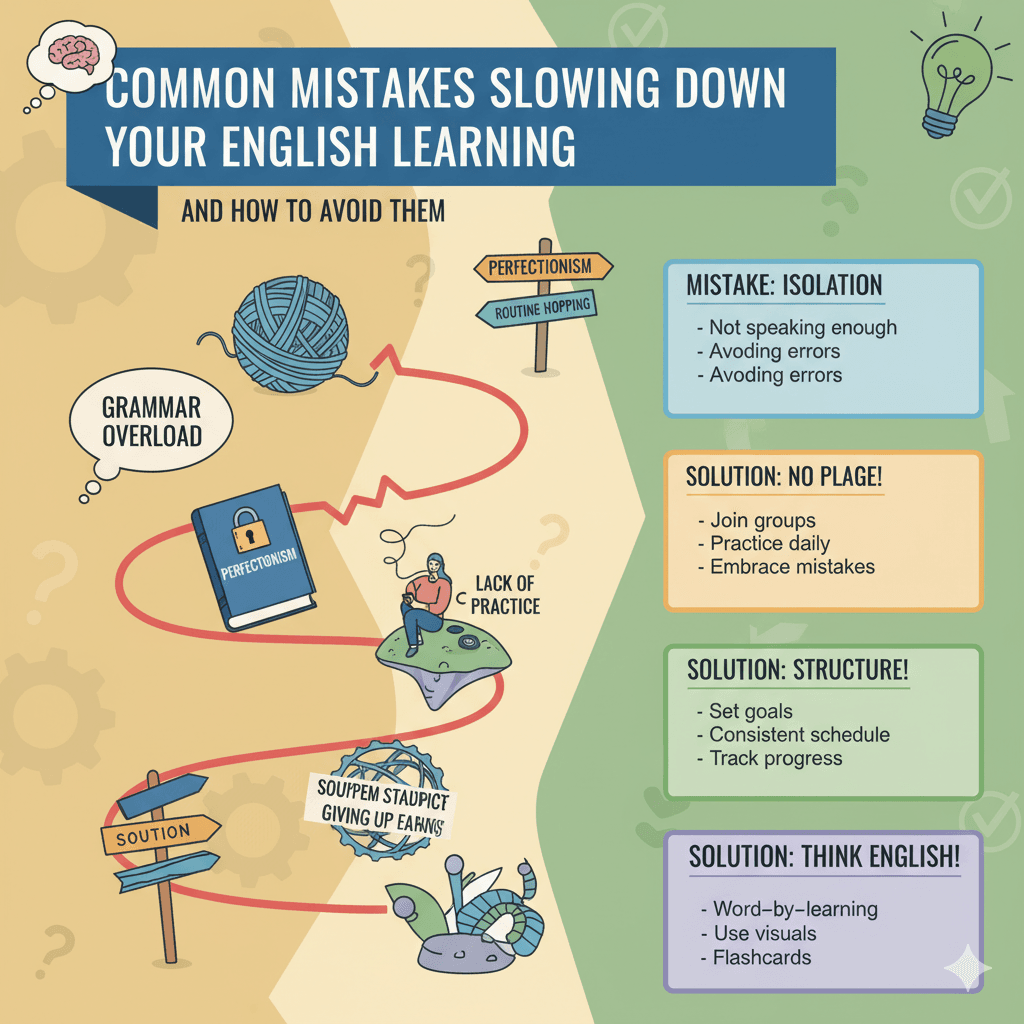
Mistake # 1: The Fear of Making Mistakes
A 2025 study conducted by the International Journal of Scientific Trends claims
There is massive power in making mistakes when you are learning a second/foreign language. We name them as obstacles in language acquisition, while they are stepping stones towards learning.
It states that if you want to create a learning environment, you need to create a psychologically safe learning environment where you do not fear making mistakes.
Solution: How to fix the fear of making mistakes
Surround yourself with people who do not judge you for your pronunciation mistakes.
A psychologically safe learning environment lets you contribute to making mistakes.
- Use the wrong English vocabulary.
- Speak any sentence in English without fear of using wrong grammar
- Do not follow any specific English dialect.
- You only need to speak in front of a partner, any online English tutor, or in a group.
- Your aim must be to communicate and speak without thinking about perfection. This is how you can overcome the fear of speaking English.
Mistake # 2: Being A Passive Learner Only
Are you among the ones who rely solely on watching movies to learn English?
You can find multiple places where people have sworn by learning English through passive learning methods.
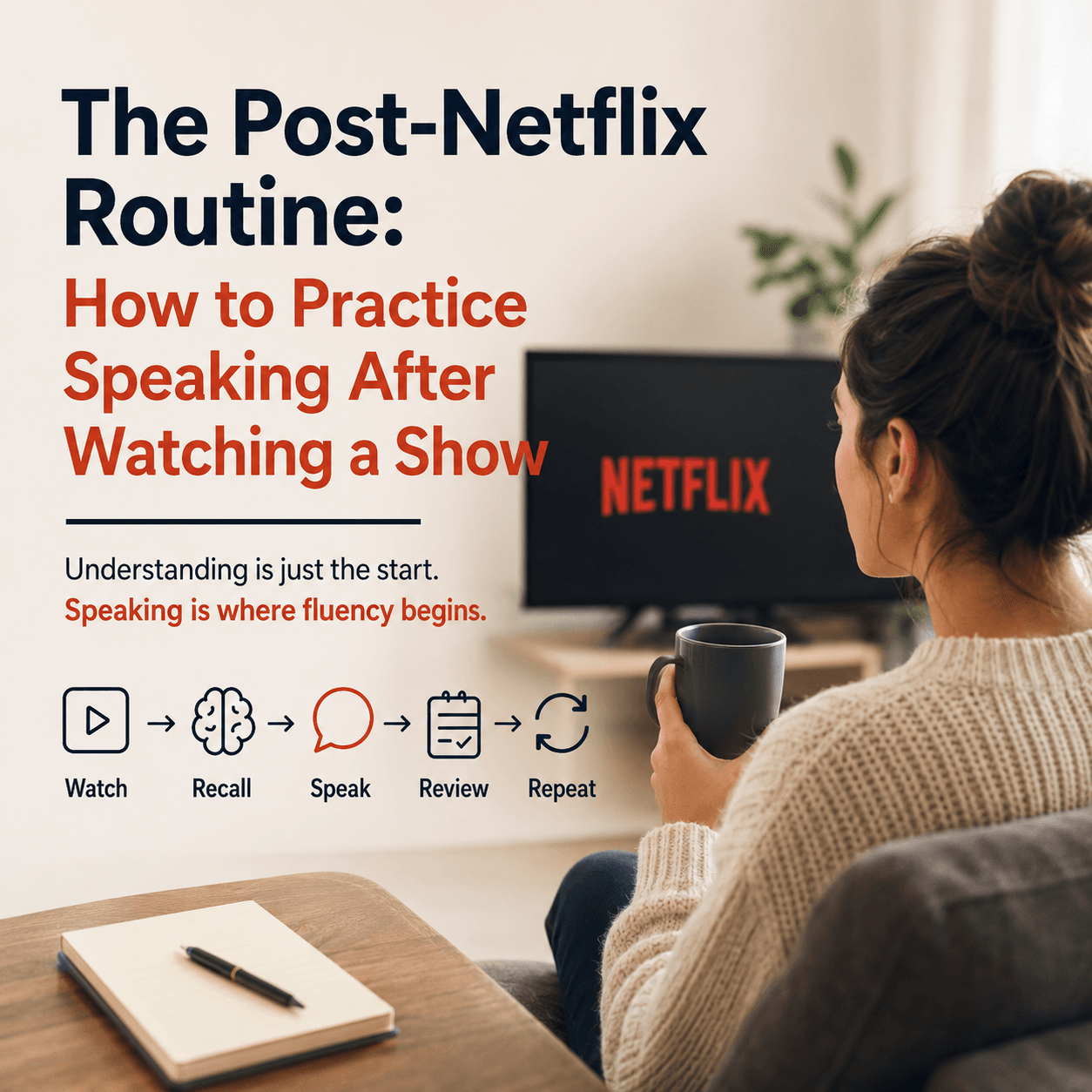
No doubt watching YouTube videos, listening to podcasts, or binge-watching your favorite movie on Netflix can help you improve your listening and comprehension skills.
But, there is a break, passive learning does not cover the necessary speaking of the language.
James Clear, in his famous book “Atomic Habits,” states
Passive learning is similar to a crutch that hinders action.”
He clearly says that passive learning is essential if you want to learn a particular language, but for actually learning the language, you have to speak and participate in active conversation.
Solution: How Active Learning Will Help You Learn English
Active listening improves your chances of speaking or mimicking what is already being spoken.
You can
- Adopt the shadowing technique while watching a movie
- Transcribe the movie scene
Mistake # 3 Inconsistent Practice
Spending 2 hours per week has less weightage than spending 15 minutes each day. Consistent practice of speaking English is a normal habit we see in people.
Solution: How to fix inconsistent English learning practice
You can practice speaking the language daily while you are brewing your coffee. You will not even feel you are saying because this is getting attached to the routine English practice with your coffee brewing.
Part 2: Common English Errors(And Exactly How to Fix Them)
Now that you know the psychology of learning a language and how to pace up, here we describe some core errors that normal English learners face.
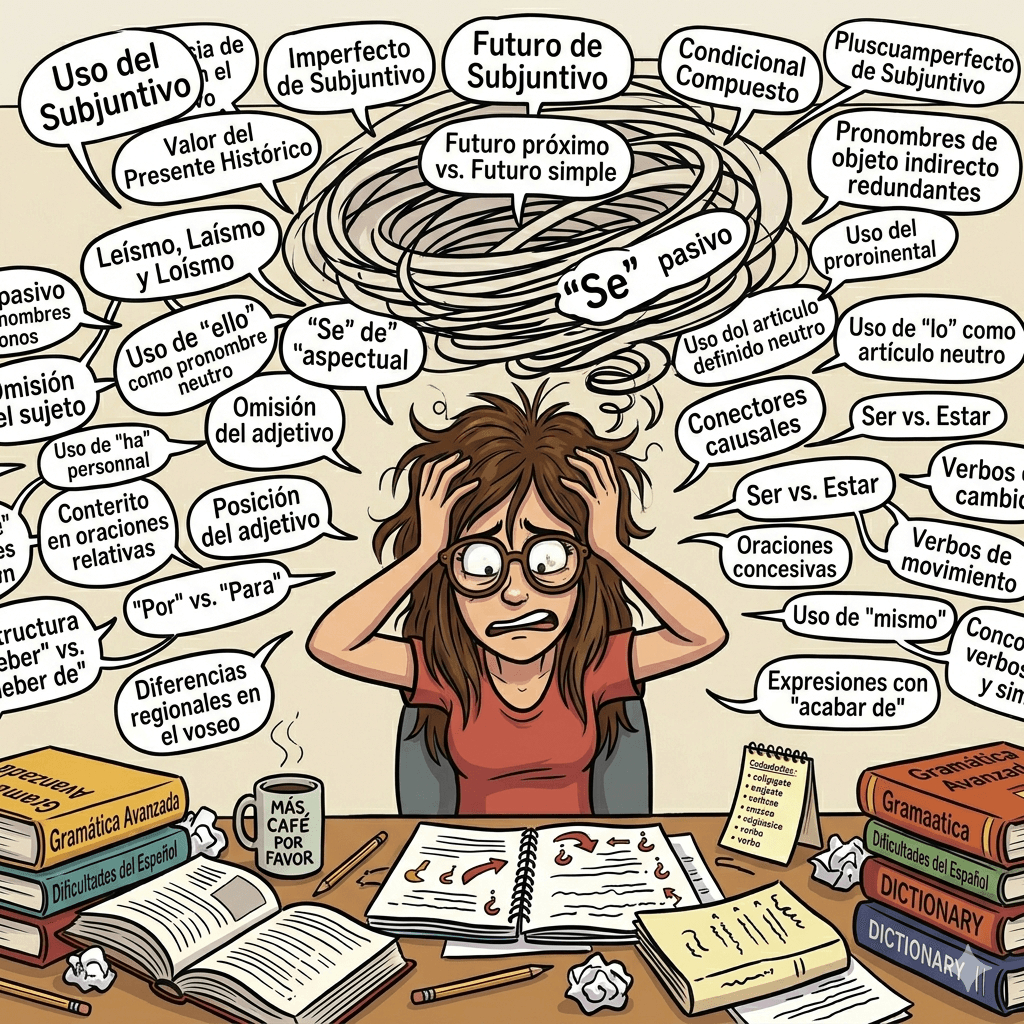
Let’s fix the core grammar errors that slow learners down. Instead of just memorizing corrections, focus on the simple rule behind each mistake. This approach helps you avoid them permanently. Here are five of the most frequent offenders.
The Most Common English Mistakes (Grammar, Vocabulary & Pronunciation)
1. Subject-Verb Agreement Errors
- Incorrect: Everybody are happy.
- Correct: Everybody is happy.
- Quick Fix: Remember that words like everybody, someone, and nobody are singular. Always use a singular verb (is, has) with them.
2. Confusing Simple Past & Present Perfect Tenses
- Incorrect: I have seen that movie yesterday.
- Correct: I saw that movie yesterday.
- Quick Fix: If you state a specific past time (like yesterday, last week), use the Simple Past (saw).
3. Incorrect Prepositions (at, in, on)
- Incorrect: See you in Friday.
- Correct: See you on Friday.
- Quick Fix: Use on for days/dates, at for precise times (at 5 PM), and in for months/years (in December).
4. Using ‘The’ for General Statements
- Incorrect: The life is beautiful.
- Correct: Life is beautiful.
- Quick Fix: Don’t use ‘the’ when speaking about abstract ideas (life, happiness, technology) or nouns in a general sense.
5. Incorrect Word Order in Indirect Questions
- Incorrect: Do you know where is the station?
- Correct: Do you know where the station is?
- Quick Fix: After question phrases like Do you know…, use normal sentence order (subject + verb).
Category B: Frequent Vocabulary & Phrasing Blunders
Fixing word choice makes you sound more natural. Here are five common phrasing blunders.
1. Borrow vs. Lend
- Incorrect: Can you borrow me your pen?
- Correct: Can you lend me your pen?
- Quick Fix: You lend something to someone. You borrow something from someone.
2. Me too vs. Me neither
- Incorrect: “I don’t like coffee.” “Me too.”
- Correct: “I don’t like coffee.” “Me neither.”
- Quick Fix: Use Me too to agree with a positive statement. Use Me neither to agree with a negative one.
3. Eat vs. Take for Medicine
- Incorrect: I have to eat my medicine.
- Correct: I have to take my medicine.
- Quick Fix: You always take medicine, pills, or vitamins.
4. Congratulations vs. Happy Birthday
- Incorrect: Congratulations on your birthday!
- Correct: Happy Birthday!
- Quick Fix: Congratulations are for achievements (a wedding, a new job).
5. Saying “I am agree”
- Incorrect: I am agree.
- Correct: I agree.
- Quick Fix: Agree is a verb. It doesn’t need “am/is/are.”
Part 3: Using Modern Tools To Accelerate Your Learning
In the modern world, where we have ample resources in the form of AI, learning English is not hard when we see it from modern perspectives.
Stop Making Mistakes: Your Smartphone Can Be A Great Tool In Learning Better English
You can find various language learning apps that can boost your English language faster. With the rise in use of AI, the Jolii.ai app has shown some fruitful results. You can check the best AI apps to learn English if you want to compare the credible ones.
- You can record yourself and speak with a chatbot.
- Listen to unlimited podcasts and watch videos you like with/without subtitles to improve shadow speaking.
- Becoming a passive listener and speaking with a chatbot makes you an active speaker, solving the foundational mistake common English learners commit.
Conclusion
Making mistakes is normal when speaking fluent English. Do not let the errors become an obstacle in your learning. Listen, speak, write, and repeat to improve comprehension, writing, and the spoken English language.
Use apps like Jolii to ensure you use a hybrid approach to learning English and overcome the common mistakes that English learners normally make.
FAQs
Q: How can I stop making the same grammatical mistakes again and again?
A: You can stop making the same grammatical mistakes by writing them in a diary or sticking them on a sticky note. So, keeping those mistakes handy can help you eliminate them whenever you practice speaking English.
Q: Why is my English not improving even though I am learning a lot?
A: You can improve your English by working on its individual areas one by one. Start small, take baby steps in reading to improve your English comprehension skills. Talk to someone fluent in English to improve your spoken English, and write at least 5 lines daily to improve your written English.
Q: What is the most common mistake in English grammar?
A: Using the second form of the verb with ‘did’ is the most common English grammar mistake. When we use the past tense, we have already used the second verb form, so we cannot use did.