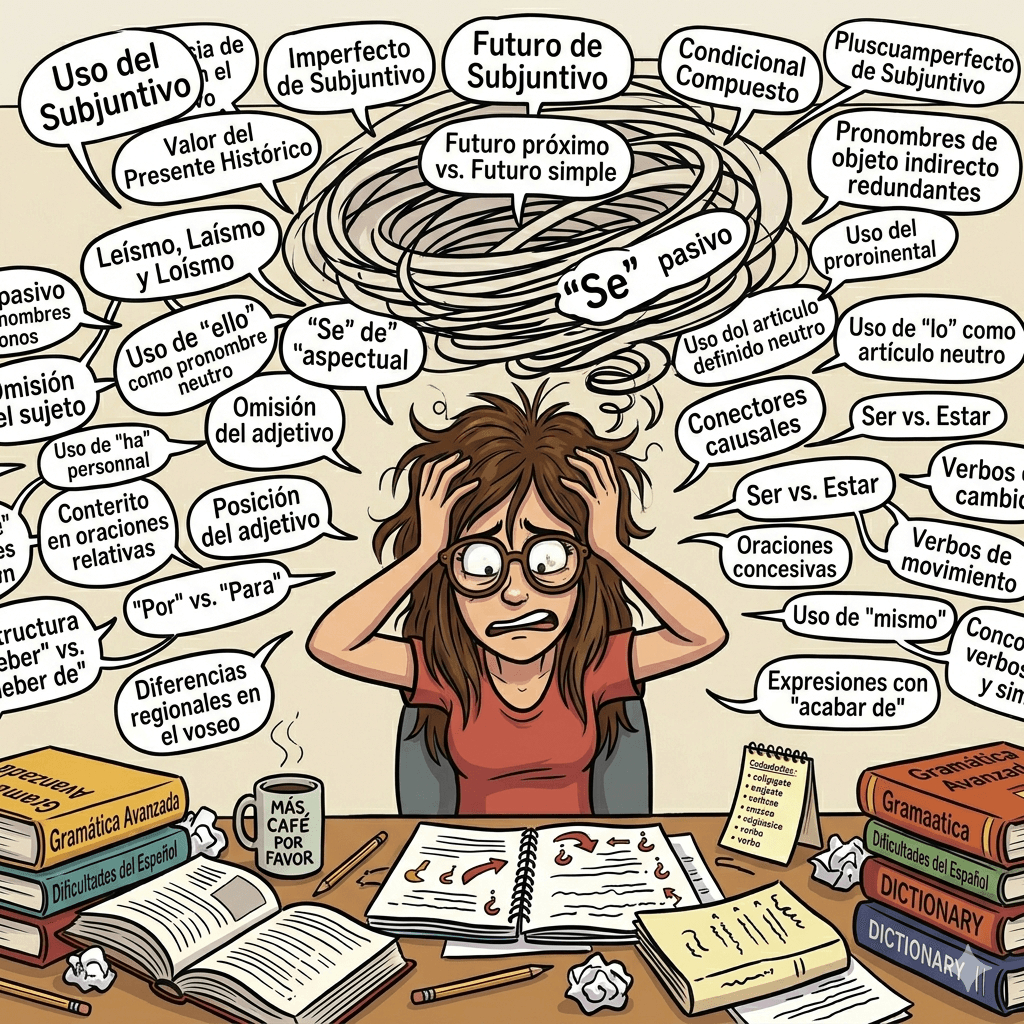
Is learning Spanish vocabulary not sufficient to speak fluent Spanish? I can explain what I want to say in Spanish, so why learn tenses?
You may find yourself in such situations where you will start having such random thoughts. If this is the case, here we have the answer to all your frustrating queries.
Learning tenses in Spanish explains when a ‘verb’ or a work happened, will happen, is about to happen, or is happening right now.
In this article, you will learn all about Spanish tenses. You can find examples to help you understand tenses completely.
Reasons To Learn Tenses In Spanish
Learning tenses is essential for improving your verbal and written Spanish communication. It indicates when something happened. Basically, the verbs in each tense change to match the time the actual work happened.
Each verb needs to be conjugated differently in each tense. So, to speak of tenses, we first need to learn about conjugation.
The prime benefit of learning Spanish tenses is that they are our personal time machine, which tells if the action occurred in the present, past, or future.
Do You Know How Many Spanish Tenses Exist?
In total, there are 16 Spanish tenses (10 in the indicative mood, 6 in the subjunctive mood) plus the imperative mood.
This might sound overwhelming at first, but don’t worry! Some tenses share patterns, and others are rarely used in everyday spoken Spanish.

As a beginner, it is totally fine to stick to simple tenses and even just use the present tense.
We definitely recommend that you learn one tense at a time, starting with the present indicative and then progressing to some past tenses for a solid foundation.
A Quick Mini Tip To Learn Spanish Tense As A Beginner
Rather than worrying about mastering them all, learn a few tenses right and use them correctly. For example, you can use time markers like ayer (yesterday) or mañana (tomorrow) to clarify when an action happens. This approach allows you to communicate effectively while gradually expanding your grammatical range.
And if you want a boost in your Spanish, try Jolii now! With Jolii, you can learn from content you genuinely enjoy, making language learning fun and entertaining at the same time.
How Are Spanish Moods Different Than Spanish Tenses
Verb tenses provide information about three key elements of an action:
time, mood and aspect.
Here is a breakdown with examples.
1. Time
Time tells us when an action occurs. Actions can happen in the past, present, or future.
| Time | Example in Spanish | Translation |
| Past | Hablé con mi amigo ayer. | I spoke with my friend yesterday. |
| Present | Hablo con mi amigo ahora. | I am speaking with my friend now. |
| Future | Hablaré con mi amigo mañana. | I will speak with my friend tomorrow. |
2. Mood
The mood reflects the attitude of the speaker towards the action or statement. Spanish has three moods (indicative, subjunctive, and imperative) which reflect whether something is factual, hypothetical possible, or a command.
| Mood | Example in Spanish | Translation |
| Indicative | Hablo español. | I speak Spanish. (factual statement) |
| Subjunctive | Espero que hables español. | I hope you speak Spanish. (hypothetical/possible) |
| Imperative | Habla español. | Speak Spanish. (command/request) |
3. Aspect.
Is the action completed, ongoing or repeated? Aspect is essential for expressing how the actions unfold in time and adds precision to communication.
| Aspect | Example in Spanish | Translation |
| Completed | Hablé con ella ayer. | I spoke with her yesterday. (The action is finished.) |
| In Progress | Estaba hablando con ella cuando llegaste. | I was speaking with her when you arrived. (The action was ongoing.) |
| Habitual/Repeated | Siempre hablaba con ella los domingos. | I always spoke with her on Sundays. (The action occurred regularly.) |
Before Learning the Conjugations
Before learning the conjugations, let’s take a look at four fundamental concepts to be familiar with to form Spanish tenses
| Concept | Definition | Examples |
| Personal Pronouns | Words that indicate who is performing the action. | yo (I) tú (you) él/ella (he/she) nosotros (we) vosotros (you all) ellos/ellas (they) |
| Infinitive Form | The base form of a verb before conjugation, ending in -ar,-er, or -ir. The stem of a verb remains after removing the -ar, -er, or -ir ending. | hablar (to speak) comer (to eat) vivir (to live) |
| Past Participle | A verb form used in compound tenses, typically ending in -ado (for -ar verbs) or -ido (for -er/-ir verbs). | hablado (spoken) comido (eaten) vivido (lived) |
| Auxiliary Verb (Haber) | The helping verb required to form composed tenses, always placed before the past participle. | he hablado (I have spoken) hemos comido (we have eaten) |
Spanish Tenses Coming Under Indicative Mood
The indicative is the mood used to present facts and reality. In the Spanish language, it is the most frequent mood, often preferred over the subjunctive. The indicative mood includes 10 tenses, of which 1 present tense, 5 past tenses, 2 future tenses and 2 conditional tenses.
Simple And Composed Tenses
These 10 tenses can be divided into simple and composed tenses. Simple tenses use a single verb form to express the action (e.g., hablo – I speak), whereas composed tenses combine the auxiliary verb haber with a past participle (e.g. hablado – spoken) to convey completed or relative actions (e.g., he hablado – I have spoken).
| Indicative Mood | |
| Simple Tenses | Composed Tenses |
| Present (hablo) | Present Perfect (he hablado) |
| Preterite (hablé) | Past Perfect/Pluperfect (había hablado) |
| Imperfect (hablaba) | Preterite Perfect (hube hablado) (rare) |
| Future Simple (hablaré) | Future Perfect (habré hablado) |
| Conditional Simple (hablaría) | Conditional Perfect (habría hablado) |
Let’s analyze each tense, along with examples. Please note that we will provide only the regular conjugations, but many exceptions exist.
Present Simple Tense
The present simple tense is one of the most important conjugations to learn as it will provide you with a foundation in the language. It is used to speak about present actions and habitual situations. To learn its conjugation, start by identifying the ending of the verbs in their infinitive forms: -ar, -er, and -ir. Each follows a conjugation pattern in the present tense.
| Subject | Hablar (to speak) AR | Comer (to eat) ER | Vivir (to live) IR |
| Yo | hablo | como | vivo |
| Tú | hablas | comes | vives |
| Él/Ella/Usted | habla | come | vive |
| Nosotros/Nosotras | hablamos | comemos | vivimos |
| Vosotros/Vosotras | habláis | coméis | vivís |
| Ellos/Ellas/Ustedes | hablan | comen | viven |
Usage examples:
Hablo con mi madre todas las mañanas. (I talk to my mother every morning.)
Los niños comen muchas golosinas. (Children eat a lot of sweets.)
Vivo en una ciudad muy grande. (I live in a very big city.)
Present Perfect Tense
The present perfect is used to describe recent actions that have a connection with the present, such as experiences or recent events that have occurred in a timeframe or are still ongoing. To form the present perfect, use the present tense of the auxiliary verb haber followed by the past participle of the main verb.
| Subject | Haber (Present) | Past Participle |
| Yo | he | hablado / comido / vivido |
| Tú | has | hablado / comido / vivido |
| Él/Ella/Usted | ha | hablado / comido / vivido |
| Nosotros/Nosotras | hemos | hablado / comido / vivido |
| Vosotros/Vosotras | habéis | hablado / comido / vivido |
| Ellos/Ellas/Ustedes | han | hablado / comido / vivido |
Usage examples:
He hablado con un famoso una vez. (I have spoken with a celebrity once.)
Hoy ya hemos comido. (We have already eaten today.)
Mis abuelos han vivido en esta casa por 30 años. (My grandparents have lived in this house for 30 years.)
Preterite Tense
The preterite tense is used to describe completed past actions. Unlike the present perfect, which often connects the past to the present, the preterite expresses actions that are entirely finished. To form the preterite, take the verb stem and add the preterite endings
| Subject | Hablar (to speak) AR | Comer (to eat) ER | Vivir (to live) IR |
| Yo | hablé | comí | viví |
| Tú | hablaste | comiste | viviste |
| Él/Ella/Usted | habló | comió | vivió |
| Nosotros/Nosotras | hablamos | comimos | vivimos |
| Vosotros/Vosotras | hablasteis | comisteis | vivisteis |
| Ellos/Ellas/Ustedes | hablaron | comieron | vivieron |
Usage examples:
Hablé con mi amigo ayer. (I spoke with my friend yesterday.)
Anoche comimos en un restaurante nuevo. (Last night we ate at a new restaurant.)
Vivimos en Madrid por cinco años y luego nos mudamos. (We lived in Madrid for five years and then moved.)
Past Perfect (Pluperfect) Tense
The past perfect, also known as pluperfect, is generally used with another past tense to provide background information or describe events that happened even before. To form the past perfect use the imperfect tense of the auxiliary verb haber followed by the past participle of the main verb.
| Subject | Haber (Imperfect) | Past Participle |
| Yo | había | hablado / comido / vivido |
| Tú | habías | hablado / comido / vivido |
| Él/Ella/Usted | había | hablado / comido / vivido |
| Nosotros/Nosotras | habíamos | hablado / comido / vivido |
| Vosotros/Vosotras | habíais | hablado / comido / vivido |
| Ellos/Ellas/Ustedes | habían | hablado / comido / vivido |
Usage examples:
Cuando llegué, ya habían hablado con el profesor. (When I arrived, they had already spoken with the teacher.)
No pudimos entrar porque habíamos comido demasiado. (We couldn’t go in because we had eaten too much.)
Mis abuelos habían vivido en esa casa antes de mudarse al campo. (My grandparents had lived in that house before moving to the countryside.)
Imperfect Tense
The imperfect tense is used when describing recurring events and descriptions in the past. Differently from the preterite and present perfect, which describe actions that occurred once or at a specific time, the imperfect emphasizes continuous, habitual, or descriptive aspects of the past – similar to “used to” in English.
To form the imperfect tense, take the verb stem and add the imperfect endings depending on whether the verb ends in -ar, -er, or -ir.
| Subject | Hablar (to speak) AR | Comer (to eat) ER | Vivir (to live) IR |
| Yo | hablaba | comía | vivía |
| Tú | hablabas | comías | vivías |
| Él/Ella/Usted | hablaba | comía | vivía |
| Nosotros/Nosotras | hablábamos | comíamos | vivíamos |
| Vosotros/Vosotras | hablabais | comíais | vivíais |
| Ellos/Ellas/Ustedes | hablaban | comían | vivían |
Usage examples:
Cuando era niño, hablaba con mis abuelos todos los días.
(When I was a child, I used to talk to my grandparents every day.)
Hacía frío y la gente comía en casa.
(It was cold, and people were eating at home.)
Vivíamos en una ciudad pequeña antes de mudarnos.
(We were living in a small town before moving.)
Past Anterior Tense (rare)
The past anterior is rarely used in spoken Spanish and is mostly found in literary or formal texts, so it is important to recognize and understand it. It describes an action that was completed immediately before another past action and is typically introduced by conjunctions like apenas (barely), cuando (when), or después de que (after). It is formed by combining haber in the preterite tense with the past participle of the main verb.
| Subject | Haber (Preterite) | Past Participle |
| Yo | hube | hablado / comido / vivido |
| Tú | hubiste | hablado / comido / vivido |
| Él/Ella/Usted | hubo | hablado / comido / vivido |
| Nosotros/Nosotras | hubimos | hablado / comido / vivido |
| Vosotros/Vosotras | hubisteis | hablado / comido / vivido |
| Ellos/Ellas/Ustedes | hubieron | hablado / comido / vivido |
Usage examples:
Apenas hube hablado con él, entendí la situación. (As soon as I had spoken with him, I understood the situation.)
Cuando hubo comido toda la cena, se sintió mejor. (When he had eaten all the dinner, he felt better.)
Después de que hubieron vivido en Madrid, se mudaron a Barcelona. (After they had lived in Madrid, they moved to Barcelona.)
The past anterior closes the list of past tenses in the indicative form. Following are the two future and two conditional forms.
Future Simple
The future simple is used to express actions that will happen, predictions about the future and promises. Unlike English, which uses the will + verb, in Spanish, the future is just one word and is formed by adding specific endings to the infinitive (and not the stem). It is common in formal speech and strong predictions, while “ir a” + infinitive is preferred in spoken Spanish for the near future.
| Subject | Ending | Hablar (to speak) AR | Comer (to eat) ER | Vivir (to live) IR |
| Yo | é | hablaré | comeré | viviré |
| Tú | ás | hablarás | comerás | vivirás |
| Él/Ella/Usted | á | hablará | comerá | vivirá |
| Nosotros/Nosotras | emos | hablaremos | comeremos | viviremos |
| Vosotros/Vosotras | éis | hablaréis | comeréis | viviréis |
| Ellos/Ellas/Ustedes | án | hablarán | comerán | vivirán |
Usage examples:
Mañana hablaré con el jefe sobre mi ascenso. (Tomorrow I will speak with the boss about my promotion.)
Este invierno hará mucho frío y no comeremos fuera. (This winter will be very cold, and we won’t eat outside.)
Te prometo que viviré en España algún día. (I promise you that I will live in Spain someday.
Future Perfect Tense
The future perfect tense is used to express actions that will have been completed at some point in the future and is useful for making assumptions or speculations. It is not the most used tense and is mostly used in formal speech. Similar to other composed tenses, it is composed by the auxiliary verb haber (in its future conjugation in this case) followed by the past participle.
| Subject | Haber (Future) | Past Participles |
| Yo | habré | hablado / comido / vivido |
| Tú | habrás | hablado / comido / vivido |
| Él/Ella/Usted | habrá | hablado / comido / vivido |
| Nosotros/Nosotras | habremos | hablado / comido / vivido |
| Vosotros/Vosotras | habréis | hablado / comido / vivido |
| Ellos/Ellas/Ustedes | habrán | hablado / comido / vivido |
Usage examples:
Para el viernes, ya habré hablado con el jefe.
(By Friday, I will have spoken with the boss.)
¿Dónde estará Juan? Habrá comido ya.
(Where could Juan be? He must have eaten already.)
En 10 años, habremos vivido en tres países.
(In 10 years, we will have lived in three countries.)
Simple Conditional Tense
The simple conditional tense corresponds to the English “would” and is used to describe hypothetical situations, express wishes and desires, and make polite requests. The endings are the same for all verbs and, like the future tense, they are added to the infinitive form of the verb.
| Subject | Ending | Hablar (to speak) AR | Comer (to eat) ER | Vivir (to live) IR |
| Yo | ía | hablaría | comería | viviría |
| Tú | ías | hablarías | comerías | vivirías |
| Él/Ella/Usted | ía | hablaría | comería | viviría |
| Nosotros/Nosotras | íamos | hablaríamos | comeríamos | viviríamos |
| Vosotros/Vosotras | íais | hablaríais | comeríais | viviríais |
| Ellos/Ellas/Ustedes | ían | hablarían | comerían | vivirían |
Usage examples:
Si tuviera más tiempo, hablaría con él.
(If I had more time, I would speak with him.)
¿Comerías algo más tarde?
(Would you eat something later?)
Dijeron que vivirían en España por un año.
(They said they would live in Spain for a year.)
Conditional Perfect Tense
The conditional perfect tense completes our list of indicative tenses. It is commonly used to describe “what-if” situations, express regrets, or talk about missed opportunities. This tense is formed using the conditional tense of haber followed by the past participle.
| Subject | Haber (Conditional) | Past Participle Examples |
| Yo | habría | hablado / comido / vivido |
| Tú | habrías | hablado / comido / vivido |
| Él/Ella/Usted | habría | hablado / comido / vivido |
| Nosotros/Nosotras | habríamos | hablado / comido / vivido |
| Vosotros/Vosotras | habríais | hablado / comido / vivido |
| Ellos/Ellas/Ustedes | habrían | hablado / comido / vivido |
Usage examples:
Si hubieras venido, habríamos hablado más.
(If you had come, we would have spoken more.)
Habría comido más, pero no tenía hambre.
(I would have eaten more, but I wasn’t hungry.)
Él no está aquí; habrá vivido en otro país antes.
(He’s not here; he must have lived in another country before.)
Spanish Tenses Under Spanish Subjunctive Mood
The subjunctive is the mood used to express uncertainty, doubts, and hypothetical situations. You can imagine it as a parallel world, where we encounter the past, present, and future, but often in the form of dependent clauses introduced by expressions like que (that) or specific triggers, such as espero que (I hope that) or dudo que (I doubt that).
| Subjunctive Mood | |
| Simple Tenses | Composed Tenses |
| Present (hable) | Present Perfect (haya hablado) |
| Imperfect (hablara/hablase) | Past Perfect/Pluperfect (hubiera/hubiese hablado) |
| Future (hablare) (rare) | Future Perfect (hubiere hablado) (very rare) |
A Pro Tip
The subjunctive can be challenging to grasp, especially for beginners. That’s why we recommend that you learn it once you have reached an intermediate level in Spanish and feel confident about the conjugations in the indicative mood.
Let’s analyze each tense of the subjunctive, along with examples.
Present Subjunctive Tense
The present subjunctive is most often introduced by phrases like quiero que (I want that), espero que (I hope that), or dudo que (I doubt that), to express doubts, emotions, and wishes. It may look similar to the present indicative, however its conjugation follows different and somehow opposite patterns. Indeed, in many cases (except the yo form), -ar verbs take -er endings, and -er/-ir verbs take -ar endings.
| Subject | Hablar (to speak) AR | Comer (to eat) ER | Vivir (to live) IR |
| Yo | hable | coma | viva |
| Tú | hables | comas | vivas |
| Él/Ella/Usted | hable | coma | viva |
| Nosotros/Nosotras | hablemos | comamos | vivamos |
| Vosotros/Vosotras | habléis | comáis | viváis |
| Ellos/Ellas/Ustedes | hablen | coman | vivan |
Usage examples:
Espero que hables con el director mañana.
(I hope that you speak with the director tomorrow.)
Dudo que comas tanto como dices.
(I doubt that you eat as much as you say.)
Es importante que vivamos en un lugar seguro.
(It’s important that we live in a safe place.)
Present Perfect Subjunctive Tense
The present perfect subjunctive is introduced using the same phrases as the present subjunctive; however, it is used to express doubts and uncertainties about past actions. It is formed using the present subjunctive of haber followed by the past participle.
| Subject | Haber (Present Subjunctive) | Past Participles |
| Yo | haya | hablado / comido / vivido |
| Tú | hayas | hablado / comido / vivido |
| Él/Ella/Usted | haya | hablado / comido / vivido |
| Nosotros/Nosotras | hayamos | hablado / comido / vivido |
| Vosotros/Vosotras | hayáis | hablado / comido / vivido |
| Ellos/Ellas/Ustedes | hayan | hablado / comido / vivido |
Usage examples:
Me alegra que hayas hablado con ella.
(I’m glad that you have spoken with her.)
Dudo que hayas comido suficiente.
(I doubt that you have eaten enough.)
Espero que hayan vivido una buena experiencia.
(I hope that they have lived a good experience.)
Imperfect Subjunctive Tense
In the Spanish language, the imperfect subjunctive is often introduced by si (if), or quería que (I wanted that).
There are two conjugation forms for the imperfect subjunctive in Spanish, which are both correct:
| Subject | Hablar (to speak) AR | Comer (to eat) ER | Vivir (to live) IR |
| Yo | hablara | comiera | viviera |
| Tú | hablaras | comieras | vivieras |
| Él/Ella/Usted | hablara | comiera | viviera |
| Nosotros/Nosotras | habláramos | comiéramos | viviéramos |
| Vosotros/Vosotras | hablarais | comierais | vivierais |
| Ellos/Ellas/Ustedes | hablaran | comieran | vivieran |
Usage examples:
Si hablara más despacio, lo entendería mejor.
(If he spoke more slowly, I would understand him better.)
Quería que comieras más verduras.
(I wanted you to eat more vegetables.)
Si vivieras en España, hablarías español fluido.
(If you lived in Spain, you would speak Spanish fluently.)
Past Perfect Subjunctive Tense
Spanish speaking people use the past perfect subjunctive when expressing regrets or hypothetical past situations. It is formed using the imperfect subjunctive of haber (hubiera or hubiese) followed by the past participle. The hubiera form is more common in spoken Spanish.
| Subject | Haber (Imperfect Subjunctive) | Past Participles |
| Yo | hubiera | hablado / comido / vivido |
| Tú | hubieras | hablado / comido / vivido |
| Él/Ella/Usted | hubiera | hablado / comido / vivido |
| Nosotros/Nosotras | hubiéramos | hablado / comido / vivido |
| Vosotros/Vosotras | hubierais | hablado / comido / vivido |
| Ellos/Ellas/Ustedes | hubieran | hablado / comido / vivido |
Usage examples:
Ojalá que hubiera hablado con ella antes de irse.
(I wish I had spoken with her before she left.)
Si hubieras comido menos, no te habrías sentido mal.
(If you had eaten less, you wouldn’t have felt bad.)
No sabía que hubieran vivido en México tantos años.
(I didn’t know that they had lived in Mexico for so many years.)
Future Subjunctive Tense (rare)
You probably have never encountered the future subjunctive tense in your Spanish studies. This form used to be used in legal, literary, and formal texts to express hypothetical or uncertain future events.
Why Future Subjunctive Tense Is Not Used In Spanish Tenses
Today, it has been replaced by the present subjunctive or future indicative. While knowing how to use this tense may not be essential, recognizing it and understanding it is important for reading comprehension in advanced Spanish fluency.
| Subject | Hablar (to speak) AR | Comer (to eat) ER | Vivir (to live) IR |
| Yo | hablare | comiere | viviere |
| Tú | hablares | comieres | vivieres |
| Él/Ella/Usted | hablare | comiere | viviere |
| Nosotros/Nosotras | habláremos | comiéremos | viviéremos |
| Vosotros/Vosotras | hablareis | comiereis | viviereis |
| Ellos/Ellas/Ustedes | hablaren | comieren | vivieren |
Usage examples (Formal/Archaic Spanish):
Si alguien hablare en contra del rey, será castigado.
(If someone were to speak against the king, they would be punished.)
Cuando comieren los invitados, se servirá el postre.
(When the guests have eaten, the dessert will be served.)
Donde vivieren los sabios, habrá conocimiento.
(Where the wise live, there will be knowledge.)
Future Perfect Subjunctive Tense (very rare)
Similarly to the future subjunctive, the future perfect subjunctive is no longer used in the Spanish language, but you still may find it in old documents and legal texts. Today, it has been replaced by the present perfect subjunctive (haya hablado) or the future perfect indicative (habrá hablado).
| Subject | Haber (Future Subjunctive) | Past Participles |
| Yo | hubiere | hablado / comido / vivido |
| Tú | hubieres | hablado / comido / vivido |
| Él/Ella/Usted | hubiere | hablado / comido / vivido |
| Nosotros/Nosotras | hubiéremos | hablado / comido / vivido |
| Vosotros/Vosotras | hubiereis | hablado / comido / vivido |
| Ellos/Ellas/Ustedes | hubieren | hablado / comido / vivido |
Usage examples (Formal/Archaic Spanish):
Si hubiere hablado contra la ley, será juzgado.
(If he/she had spoken against the law, they will be judged.)
Cuando hubieres comido, podrás salir.
(When you have eaten, you may leave.)
Donde hubieren vivido los antiguos, se construirá un monumento.
(Where the ancients have lived, a monument will be built.)
Spanish Tenses Under Spanish Imperative Mood
The imperative mood is used to express orders, requests, and commands about what to do or not to do. It lacks the yo form, as it focuses on actions directed at others. There is a distinction between affirmative (positive) and negative commands. Most forms follow the present subjunctive, but affirmative tú and vosotros are exceptions.
- Tú: Uses the third-person singular of the present indicative (habla, come, vive).
- Vosotros: Drops the -r of the infinitive and adds -d (hablad, comed, vivid).
| Subject | Hablar (to speak) AR | Comer (to eat) ER | Vivir (to live) IR |
| Tú | habla / no hables | come / no comas | vive / no vivas |
| Usted | (no) hable | (no) coma | (no) viva |
| Nosotros | (no) hablemos | (no) comamos | (no) vivamos |
| Vosotros | hablad / no habléis | comed / no comáis | vivid / no viváis |
| Ustedes | (no) hablen | (no) coman | (no) vivan |
Usage examples:
Habla más despacio. (Speak more slowly.)
No hables tan alto. (Don’t speak so loudly.)
Come más verduras. (Eat more vegetables.)
No comas demasiados dulces. (Don’t eat too many sweets.)
Vivid cada día al máximo. (Live every day to the fullest.)
No viváis con miedo. (Don’t live in fear.)
Important Notice for Language Learners
Don’t try to memorize all the conjugations by heart—that’s not how language learning works! The most effective way to internalize vocabulary and conjugations is by immersing yourself in real, authentic content in context.
Instead of drilling isolated rules, practice with songs, dialogues, and interactive exercises that reflect natural speech.
Looking for a fun and effective way to improve your Spanish? Jolii offers engaging, real-world content that helps you learn grammar naturally while enjoying the process. Start learning with Jolii today!