Uno means “one,” while primero means first. What is the relationship between them? Uno is the cardinal number, and primero is the ordinal number for the number “one.” When you are on your journey to learning to speak Spanish, you must learn to say Spanish numbers.
Since you are mastering Spanish words and phrases, it is high time to learn both ordinal and cardinal Spanish numbers to count.
You can import the video into Jolli, the language learning app, to practice learning Spanish counting. In this article, you will learn how to learn cardinal Spanish numbers in a beginner’s way. You will also learn about Spanish ordinal numbers.
What Are Cardinal and Ordinal Numbers
Cardinal numbers are the “counting numbers” that tell you “how many” or about the quantity of any item.
Ordinal Numbers tell you about the “order.” It tells if it is first or second place.
Example: The man wearing the shirt with number six is standing at the fifth place.
El hombre que lleva la camiseta con el número seis se encuentra en el quinto lugar.
Cardinal Numbers in Spanish
In Spanish, we use cardinal numbers “Números cardinales” to count any object. The cardinal numbers in Spanish do not have any plural or gender attached to them.
Cardinal Numbers In Spanish From 1 to 10
Let’s start with the first ten numbers. When learning any language, it is important to start with small, realistic goals and cheer for any success. Your first achievable goal is to learn to count until 10. Numbers up to ten are frequently used, especially when shopping or asking for the time.
Let’s listen to the audio and write cardinal numbers in Spanish.
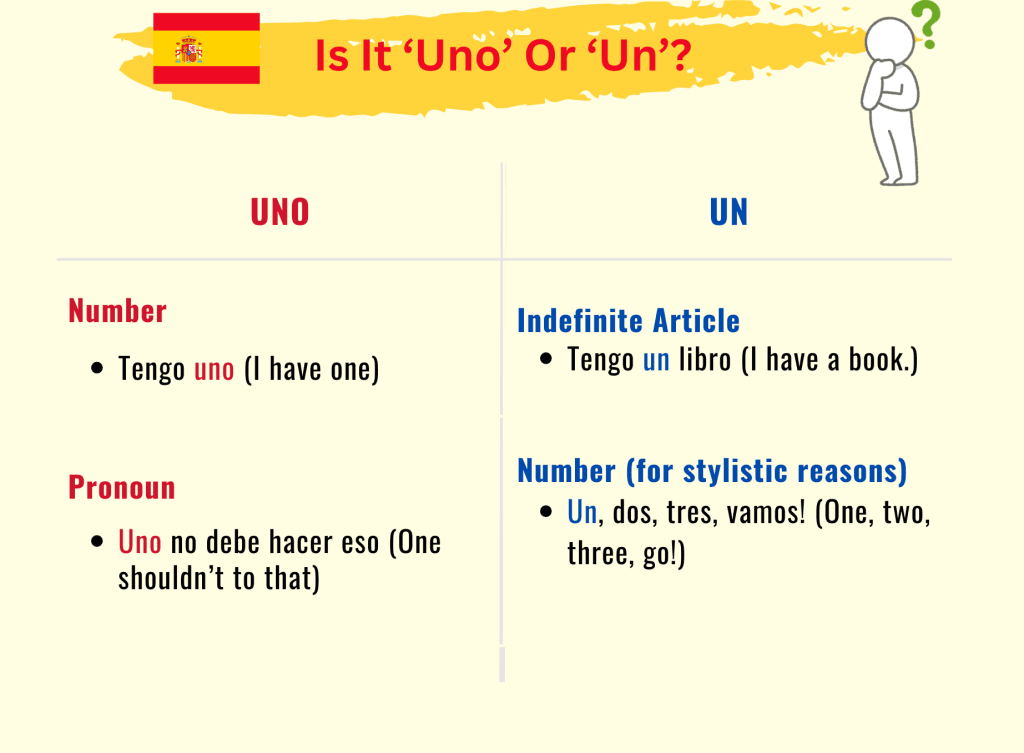
Is It ‘Uno’ Or ‘Un’
A question Spanish learners often ask is whether to use uno or un.
- Uno is a number or a pronoun.
Example as a number:
Tengo uno. (I have one.)
Example as a pronoun:
Uno no debe hacer eso. (One shouldn’t do that.)
- Un is an indefinite article.
Example:
Tengo un libro. (I have a book.)
But why do I often hear “un, dos, tres” instead of “uno, dos, tres”? For stylistic reasons. To improve rhythm and flow in speech or songs, like “Un, dos, tres.. Vamos!” (one, two, three.. go!), or in the song “Un, dos, tres” by Ricky Martin, “un” is often used.
Cardinal Numbers From 11 to 20: Learn the Teens in Spanish
Numbers from 11 to 20 are considered the most difficult to learn, as they are irregular and the first 5 differ significantly from other numbers. Notice how the numbers from 16 to 19 are composed of dieci (10) + seis, siete, ocho, and nueve.
| Number | Spanish |
| 11 | once |
| 12 | doce |
| 13 | trece |
| 14 | catorce |
| 15 | quince |
| 16 | dieciséis |
| 17 | diecisiete |
| 18 | dieciocho |
| 19 | diecinueve |
| 20 | veinte |
Spanish Cardinal Numbers From 21 to 30: The Veinti in Spanish
Now that you have mastered the numbers until 20, the rest becomes much simpler. Numbers from 21 to 30 are simply formed by combining veinti (20) with the units, forming a single word.
| Number | Spanish |
| 21 | veintiuno |
| 22 | veintidós |
| 23 | veintitrés |
| 24 | veinticuatro |
| 25 | veinticinco |
| 26 | veintiséis |
| 27 | veintisiete |
| 28 | veintiocho |
| 29 | veintinueve |
| 30 | treinta |
Cardinal Numbers In Spanish From 31 to 40: Tens and Units
Once you master numbers until 30, numbers are combined by combining tens and units and using y (and) in between. Once you understand the patterns, numbers become easier to build.
| Number | Spanish |
| 31 | treinta y uno |
| 32 | treinta y dos |
| 33 | treinta y tres |
| 34 | treinta y cuatro |
| 35 | treinta y cinco |
| 36 | treinta y seis |
| 37 | treinta y siete |
| 38 | treinta y ocho |
| 39 | treinta y nueve |
| 40 | cuarenta |
Spanish Cardinal Numbers From 40 to 100: Counting by tens
All tens numbers from 40 to 100 share a common ending: -enta.
Practice Numbers Singing In Spanish
Now that we have seen all numbers from 1 to 100, it is time to listen to them in the context of a song! In Spanish-speaking countries, children often learn counting through playful rhymes. Why not try a Spanish number song for practice?
Percentage in Spanish
In Spanish, percentage is expressed as por ciento (literally “per hundred”).
| Percentage | Spanish | Example in Spanish | Translation |
| 20% | Veinte por ciento | El descuento es del veinte por ciento. | The discount is 20%. |
| 50% | Cincuenta por ciento | Cincuenta por ciento es suficiente. | Fifty percent is enough. |
| 100% | Cien por ciento | Estoy cien por ciento seguro. | I’m 100% sure. |
Ordinal Numbers In Spanish
Once you have mastered the basics of counting, learning ordinal numbers is the logical next step. These numbers are useful when comparing, ranking, and even when choosing a dish in a restaurant (primer plato, segundo plato).
| Ordinal Number | Spanish |
| 1st | primero |
| 2nd | segundo |
| 3rd | tercero |
| 4th | cuarto |
| 5th | quinto |
| 6th | sexto |
| 7th | séptimo |
| 8th | octavo |
| 9th | noveno |
| 10th | décimo |
5 Expressions with Spanish Numbers from Zero to Five
Expressions are phrases that are words/sentences that have a separate literal meaning. Actually, their literal meanings have nothing to do with them because each language has its idiomatic phrases called expressions, which help you say more using fewer words.
Mostly, idioms and expressions in any language have a contextual meaning, which does not change when you use them explicitly. You can learn Spanish numbers and also learn a few commonly used Spanish expressions here.
| Expression | Translation (Literal) | Meaning | Example in Spanish | Example in English |
| Ser un cero a la izquierda | To be a zero on the left | To be useless or irrelevant | Siempre se siente como un cero a la izquierda en el trabajo. | He always feels useless at work. |
| Ser el/la número uno | To be the number one | To be the best | Messi es el número uno en el fútbol. | Messi is the best in football. |
| Cada dos por tres | Every two by three | Frequently or constantly | Cada dos por tres se le olvidan las llaves. | He forgets his keys all the time. |
| Ser cuatro gatos | To be four cats | To be very few people | En la fiesta éramos cuatro gatos. | There were very few people at the party. |
| Chocar esos cinco | To crash those five | To give a high five | ¡Buen trabajo! ¡Choca esos cinco! | Great job! High five! |
Tips for Learning Ordinal and Cardinal Numbers In Spanish
- Practice your ordinal and cardinal numbers daily. You can even get a textbook to learn them.
- Make a habit of learning numbers aloud; when you learn aloud, it becomes part of your permanent memory.
- Use the Jolii language learning app to explore videos that show counting. You can import the videos you like in the app and learn the way you want.
Conclusion
Learning cardinal and ordinal numbers will make you learn the quantities of any object in Spanish. The Spanish numbers will improve your Spanish word vocabulary and will help you know the date and the year in Spanish as well. You can get help while shopping to know the prices of any item. You can get more help from Spanish Ordinal numbers while waiting for your turn. It is always a better idea to learn Spanish numbers from the Jolii app, which is an immersive platform for all your language learning needs. Your watched videos become your language lessons. You can get your hands on selected videos plus any video you want to upload to become a language lesson. Download Jolii and learn the Spanish Ordinal and Cardinal numbers today.