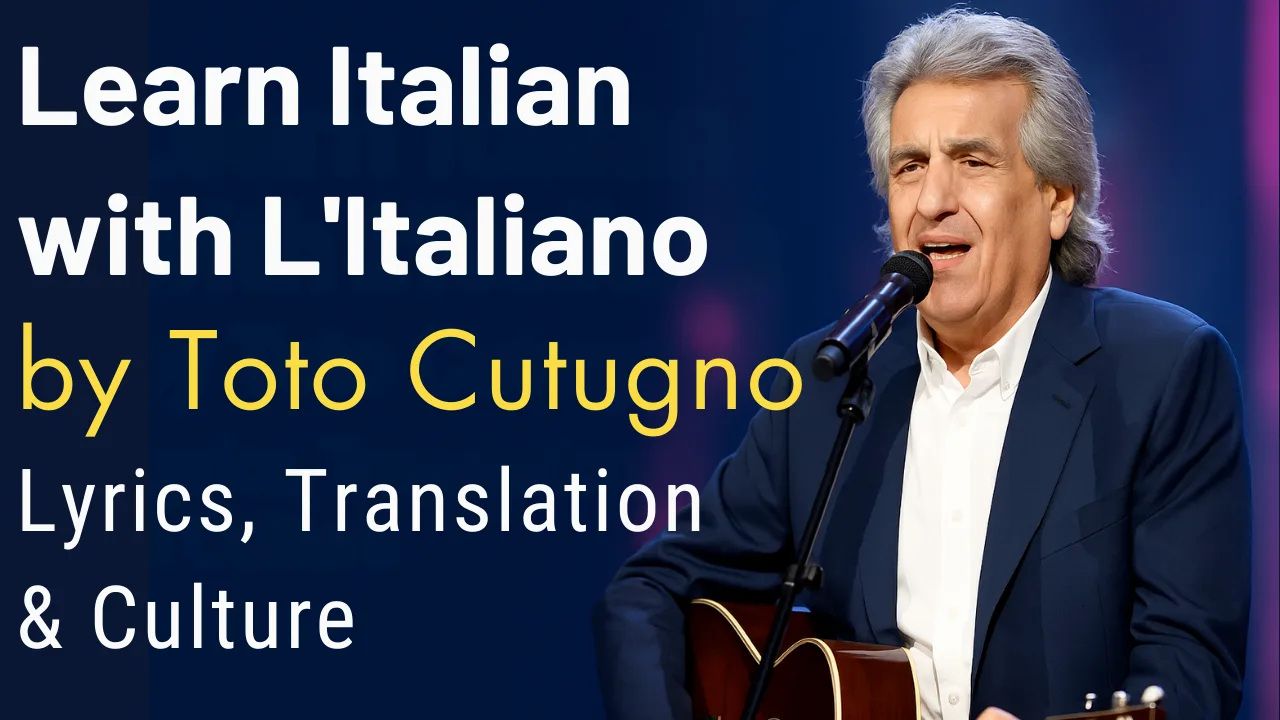
Let’s learn Italian with L’Italiano!
Do you know that the song L’ltaliano by the songwriter Toto Cutugno is considered the national anthem of Italy — though an unofficial one? Since 1983, when it was first released, it has become the most favorite song that every Italian wants to hum around. It paints a vivid picture of life in Italy, touching on everything from food to sports to everyday traditions, perfectly capturing the essence of Italy and its culture.
Then why not? Let’s Do in Rome as the Romans do.
Learning a new language is no longer confined to grammar drills or vocabulary lists. Let’s enjoy the song and take advantage of it to learn Italian.
In this article, you will find out how to learn Italian using the lyrics of the song in Italian, with its English translation. You will learn Italian vocabulary, gain cultural insights, and even learn some useful grammar structures—all while enjoying timeless music! Ready to dive deeper into Italian? Andiamo!
Why Learn Italian with Music?
Learning Italian is not just about picking up a new language; it’s about connecting with a rich cultural heritage deeply intertwined with music, art, and soccer. You can learn Italian with L’Italiano or many other Italian songs. Songs like “L’Italiano” offer a unique window into Italian life, celebrating the country’s culinary delights, everyday traditions, and, its big passion for soccer.
By immersing yourself in music, you not only grasp the language but also experience the emotions and stories that define Italian culture. This approach enriches your Italian for travel, allowing you to engage more deeply with locals and their traditions. With music, you can learn the Italian language faster.
Enhance Your Italian Learning Journey
Did you know? With Jolii, you can explore the nuances of “L’Italiano”, master key vocabulary, and reinforce your grammar in a fun and engaging way.
Lyrics Analysis: Learn Italian with L’Italiano
From the title alone, which means “The Italian,” you can already sense the heart of the song, inviting you to think about the quintessential Italian: proud, passionate, and deeply connected to the traditions. It is an ideal resource for learning Italian.
The title – Understanding “L’Italiano”
The title “L’Italiano” isn’t a nationalistic label—it reflects a love letter to Italy. In the lyrics Cutugno declares himself a true Italian – un italiano vero . As the title anticipates, each lyric of the song celebrates elements of life in Italy, from the rich flavors of the cuisine to the country’s deep historical roots.
The Verse: A Listening Exercise
To enhance your Italian learning experience, listen to “L’Italiano” and fill the blanks with the missing words from the lyrics. This exercise is great for improving listening skills and reinforcing vocabulary. You can also listen to the song and practice directly in the Jolii app.

Missing words:
Presidente, Spaghetti, Destra , Finestra , Cuore , Malinconia
| L’Italiano |
Buongiorno Italia, gli …………… al dente E un partigiano come …………….. Con l’autoradio sempre nella mano …………….. E un canarino sopra la ………… Buongiorno Italia, con i tuoi artisti, con troppa America sui manifesti. Con le canzoni con amore e con il ………… Con più donne, sempre meno suore. Buongiorno Italia, buongiorno MariaCon gli occhi pieni di …………. Buongiorno DioLo sai che ci sono anch’io |
Once you’ve filled the blanks, you’ll find that the lyrics become more memorable, giving you phrases you can use in daily Italian conversations.
Solution and translation:
| Italian Lyrics | English Translation |
| Buongiorno, Italia, gli spaghetti al dente E un partigiano come presidente Con l’autoradio sempre nella mano destra E un canarino sopra la finestra Buongiorno, Italia, con i tuoi artisti Con troppa America sui manifesti Con le canzoni, con amore, con il cuore Con più donne sempre meno suore Buongiorno, Italia, buongiorno, Maria Con gli occhi pieni di malinconia Buongiorno, Dio Lo sai che ci sono anch’io | Good morning, Italy, the spaghetti al dente And a partisan as president With the autoradio always in your right hand And a canary above the window Good morning, Italy, with your artists With too much America on the billboards With songs, with love, with heart With always more women and fewer nuns Good morning, Italy, good morning, Maria With those eyes full of melancholy Good morning, God You know I’m here too |
Key Vocabulary from the Verse
“L’Italiano” offers a range of practical, conversational Italian. Here are some key terms from the song:
- Spaghetti al dente : A reference to perfectly cooked pasta, a staple of Italian cuisine.
- Canarino sopra la finestra: A canary on the window, evoking a serene, traditional image of Italian homes.
- Buongiorno Italia : A repeated greeting to Italy, highlighting the importance of starting each day with love (amore) for your country.
- Malinconia : Meaning melancholy, reflecting the emotional depth often found in Italian culture and music.
By listening to the song and absorbing these words, you’ll start to pick up on Italian expressions that naturally integrate into your learning.
The Chorus of L’Italiano: Grammar Focus with the Verb “Lasciare”
| Italian Lyrics | English Translation |
| Lasciatemi cantare Con la chitarra in mano Lasciatemi cantare una canzone piano piano Lasciatemi cantare Perché ne sono fiero Sono l’italiano Un italiano vero | Let me sing With this guitar in hand Let me sing a song slowly slowly Let me sing Because I’m proud of it I am the Italian A true Italian |
The phrase Lasciatemi cantare (Let me sing) introduces learners to the imperative mood. It uses the verb lasciare (to let/allow) in an important structure that you’ll find useful when saying “let someone do something.”
Imperative Forms:
- Lasciatemi is the plural imperative form, used when addressing a group.
- Lasciami is the singular form, used when addressing one person.
Other Examples of the Imperative:
- Voglio studiare italiano → Lascia(te)mi studiare italiano! (I want to study Italian → Let me study Italian!)
- Marco vuole ballare → Lascia(te)lo ballare! (Marco wants to dance → Let him dance!)
- Io voglio suonare → Lascia(te)mi suonare! (I want to play → Let me play!)
- Noi vogliamo leggere → Lascia(te)ci leggere! (We want to read →Let us read!)
Other Contexts for “Lasciare”:
Lasciare can also be used in different tenses to convey the meaning of “to leave”:
- Ho lasciato il libro a casa. (I left the book at home.)
- Non lasciare la finestra aperta. (Don’t leave the window open.)
- Lascerò il lavoro domani. (I will leave the job tomorrow.)
Tip for Italian Language Learners: Create your own sentences using lasciare to practice making requests in Italian or to describe situations. It’s a versatile verb that can refer to letting, leaving, or abandoning something. It will come in handy in everyday conversations!
3 Cultural Insights from the “L’Italiano”
- Religion: Cutugno humorously addresses societal changes with the line “più donne e sempre meno suore” (more women, fewer nuns). He also addresses God directly with “Buongiorno Dio, lo sai che ci sono anch’io”. This reflects Italy’s evolving social landscape during the 1980s and highlights a shift in traditional religious roles within Italian society.
- Food and Coffee: The song encapsulates Italian identity through references to iconic foods like “spaghetti al dente ” and “caffè ristretto.” These culinary elements not only evoke a sense of nostalgia but also emphasize the importance of Italian cuisine in everyday life, showcasing how food is central to the culture.
- Calcio: While not directly mentioned, Italy’s deep-rooted love for calcio (football) permeates the song’s essence. The lyrics celebrate this passion, reflecting the joy of being Italian and the vibrant culture surrounding the sport. Notably, “E la moviola la domenica in TV” (And the slow-motion replay on Sunday TV) highlights the cultural significance of football matches in Italian households. Football represents Italy’s sense of community, pride, and friendly rivalry, further emphasizing the national identity that Cutugno celebrates in “L’Italiano.”
Other Italian Songs to Learn Italian through Music
If you enjoyed learning Italian “L’Italiano,” here are some other classic Italian songs that have achieved worldwide success and can enhance your language-learning journey:
- “Volare ” by Domenico Modugno: This iconic song captures the beauty of love and dreams, making it a romantic choice for learners.
- “Felicità ” by Al Bano and Romina Power: A delightful song emphasizing themes of joy and happiness while introducing essential vocabulary.
- “Azzurro ” by Adriano Celentano: Offers a nostalgic look at Italian life, and its catchy melody makes it easy to remember.
- “Domenica ” by Luca Barbarossa: A charming song that reflects on the joys of Sunday and family time, showcasing everyday vocabulary.
- “Bella Ciao“: While traditionally an Italian partisan song symbol of resistance during World War II, the song Bella Ciao has gained worldwide fame thanks to Spanish Netflix series “La Casa de Papel“
By immersing yourself in these classics, you’ll not only enjoy the music but also deepen your understanding of the Italian language and culture. Each song provides unique vocabulary, grammar structures, and cultural insights, making your learning experience both fun and effective.
And if you are looking for something more recent, “Zitti e Buoni” by the famous rock band Maneskin is another great choice to improve your Italian.
Ready to learn through entertainment?
Download the app now and start improving your skills!
Here’s what to expect!
How to Learn Italian Language Fast
Learning Italian at a faster pace is possible but it needs true learning effort from your end. With these handy tips you can accelerate your learning.
Immerse Yourself: Immersive learning includes using music, podcasts, talk-shows and movies in Italian so you can take the essence of each learning module and reinforce it.
Using Language Apps: Using AI apps to learn a language is a new and effective trend; among the many apps available, Jolii provides interactive lessons to make learning Italian with an app fun and effective.
Practice Speaking: The most natural way to learn any language is to speak it!
Whatever the learning happens, you must speak it out; if possible, try speaking with a native Italian speaker to improve your learning fluency.
Best Way to Learn Italian on Your Own
Learning Italian on your own is possible, period. But, it is not as easy as we think. To learn it all by yourself, you have to undertake these simple steps.
Set Realistic Goals: Break down your tasks into doable jobs that are manageable practically.
Create a Routine: Set a routine and stick to it — no matter what it may take. Consistency is key. Practice both grammar and speaking.
Use Resources: Explore free online Italian lessons and audio/video materials to enhance your skills.
Best App to Learn Italian Real Quick
Want to deepen your understanding of Italian through music? Try Jolii, an AI-powered language-learning app that turns songs like “L’Italiano” into interactive lessons.
Jolii breaks down the lyrics, offering personalized practice in vocabulary, pronunciation, and grammar, all while immersing you in Italian culture. Learning Italian with an app like Jolii allows you to master the language in a fun and engaging way, perfect for music lovers and language enthusiasts alike.
Conclusion
Toto Cutugno’s “L’Italiano” is more than just a beloved song—it’s an excellent resource for learning Italian vocabulary, grammar, and cultural insights. Whether you’re just starting your language journey or looking to deepen your skills, this song offers a fun and effective way to engage with the Italian language. Learn Italian and speak Italian like a native using an all-immersive approach.
With free online Italian courses and using Italian songs from the Jolii app, you can take your learning experience to the next level by turning music into your best ally on the path to fluency.
So grab your guitar (or just your phone), sing along, and embrace your inner italiano vero!
FAQs
How does listening to music help with learning Italian?
Music helps reinforce vocabulary through repetition and melody, making it easier to memorize words and phrases. Songs like “L’Italiano” also provide cultural context, which enhances language learning. Start incorporating music into your study routine today with the Jolii App to see how it can transform your language skills!
Is “L’Italiano” a good song for beginners to learn the Italian language?
Yes! The lyrics are straightforward, making it an excellent choice for beginners who want to expand their vocabulary and understand Italian culture. Did you know? You can import it into the Jolii App and try singing along and practicing the lyrics to boost your confidence!
What is Jolii, and how can it help me learn Italian?
Jolii is an AI-powered app to learn Italian that turns songs and videos into personalized language lessons, helping you master vocabulary, pronunciation, and grammar in a fun and engaging way. Download Jolii today to make your Italian learning journey more interactive and enjoyable!
Can I learn Italian just by listening to songs?
Learning Italian is possible by listening to songs but it needs your consistent effort and an all-immersive learning approach.
Is it difficult to learn Italian?
It is not difficult for people who can speak English to learn Italian. In fact, it is the opposite. English and Italian have a rich shared vocabulary. Here is you can start learning Italian by learning the Italian alphabet.
Can I learn the Italian language in 3 months?
It is a challenging task to learn Italian in 3 months, yet you can have the basic vocabulary and grammar in 3 months. How quickly you progress depends on factors like your native language, previous language learning experience, your learning methods, and how much time you dedicate to practice.
Is the Italian language hard for beginners?
For beginners, learning Italian is not hard. If you know English, it becomes relatively easier for you to learn Italian vocabulary, even if you’re a beginner.
What does L’Italiano mean in English?
L’Italiano simply means the Italian, meaning an Italian person. Toto Cutugno declares himself a real Italian and celebrates Italy through his song.