Quick Answer (TL;DR)
Content that is too difficult slows language learning because your brain spends energy decoding instead of recognizing patterns. Real progress happens when input is understandable, slightly challenging, and paired with active use.
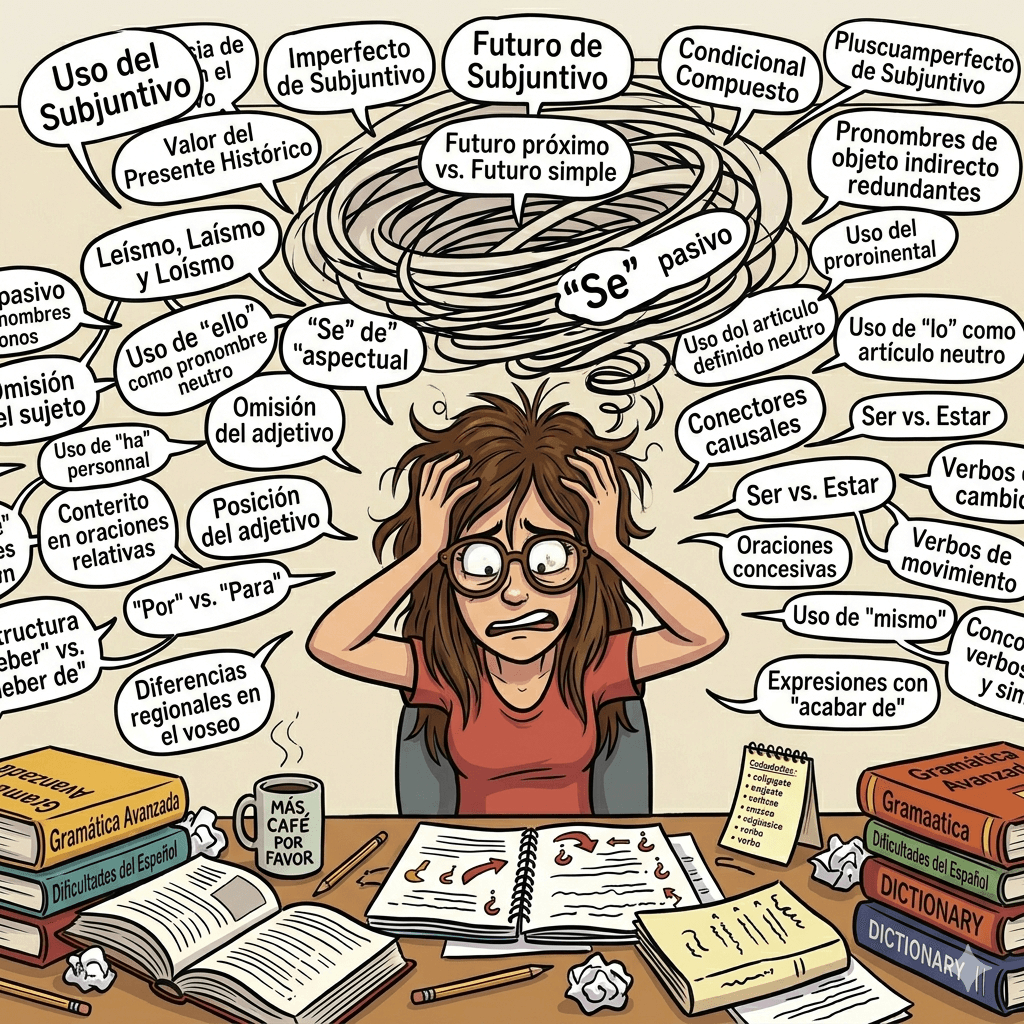
When we study content that is too difficult, it slows out learning because the brain cannot reliably get meaning, structure, and context. For the brain, the input becomes mostly incomprehensible. So instead of building language patterns, learners experience cognitive overload, which reduces retention and prevents acquisition.
This article focuses specifically on the cost of getting it wrong — what happens cognitively when you push into content that’s too difficult, and how to recognise the signs before months are lost to it. For the practical framework on choosing the right difficulty level in the first place, Finding the Sweet Spot covers the testing method and the research behind the 80-90% comprehension target.
The Core Problem: Input Only Works When It’s Mostly Understandable
The conventional wisdom in language learning is that “harder is better.” Although many learners believe that being exposed to more advanced material will hasten their progress.
In truth, research in second language acquisition is remarkably consistent in pointing toward a more accurate principle: we learn when we understand, not the other way around. Stephen Krashen’s Input Hypothesis shows learners acquire language by understanding input just beyond their level, with comprehension as the key mechanism.
When content is too difficult:
- The brain cannot anchor new words to meaning
- Grammar patterns are not recognized consistently
- Attention shifts from learning to survival (guessing, decoding, or zoning out)
Instead of learning efficiently, the learner enters a high-effort, low-retention state.
Why Hard Content Slows Language Learning
In short, content that is too difficult creates cognitive overload, which slows language learning. When students are unable to understand a majority of the input, it is impossible for the brain to create long-lasting connections between meaning and structure, wearing down retention and stalling acquisition.
The Cognitive Load Breakdown
From a cognitive science perspective, overly difficult input increases extraneous cognitive load. This means the brain is spending its limited working memory capacity on:
- decoding unknown vocabulary
- guessing grammar structures
- inferring meaning without context
Rather than:
- recognizing patterns
- strengthening memory pathways
- integrating new language structures
When cognitive load is too high, learning efficiency drops sharply.
Why “Harder Content” Feels Productive (But Isn’t)
Many students confuse difficulty with progress. Advanced videos or dense reading might feel like you’re being productive because there’s a lot of mental energy required.
However, effort ≠ acquisition.
If comprehension is too low (for example, below ~70–80%), the brain cannot:
- detect repetition patterns
- confirm correct interpretations
- stabilize vocabulary in memory
This leads to what educators often describe as false exposure: high contact time with minimal learning return. Some extensive reading research even suggests aiming for 95-98% comprehension when reading purely for pleasure and volume — though for active language acquisition, the 80-90% zone remains the target, since enough unfamiliar material needs to appear for new patterns to form.
Real Case: Why Anna Stalled Despite High Exposure
Anna, 32, an intermediate English learner, spent months trying to accelerate her progress by consuming native-level content exclusively.
Her routine included:
- Watching unsimplified news broadcasts
- Listening to fast-paced podcasts
- Reading long-form opinion articles
At first, she felt she was “immersing” herself deeply in the language. But over time, her progress plateaued and motivation sank.
What actually happened
Instead of learning new language structures, Anna began:
- Relying heavily on subtitles or translations
- Skipping over unknown sections
- Losing the thread of conversations quickly
Her brain was constantly in gap-filling mode, not learning mode. She eventually got frustrated and thought she would never become fluent.
The turning point
After adjusting her input level to slightly below her comfort ceiling (content where she understood roughly 80–90%) a shift occurred:
- She began noticing repeated sentence structures
- Vocabulary appeared in predictable contexts
- She could predict meaning without constant translation
Within a few weeks, her retention improved significantly, and she reported feeling less tired but able to achieve a more consistent progress.
Anna didn’t need more difficulty. She needed controlled comprehensibility.
Anna’s experience mirrors a common pattern explored in Why Some Netflix Shows Are Terrible for Language Learning — more exposure time doesn’t always mean more learning if the input itself is poorly matched to your level.
The Optimal Difficulty Zone
Effective language input typically sits in a “productive challenge zone”:
| Input Type | Comprehension Level | Learning Outcome |
| Too easy | 95–100% | Low growth (no challenge) |
| Optimal | ~80–90% | High acquisition efficiency |
| Too hard | <70% | Cognitive overload, low retention |
This balance ensures that learners are challenged enough to grow, but not overwhelmed to the point of breakdown.
What is The Best Difficulty Level For Learning?
The best difficulty level for language acquisition is a little beyond the learner in question, so that they understand most of what’s been said but come across new words and structures nonetheless. This balance maximizes understanding and acquisition.
The Hidden Risk: Over-Immersion Without Comprehension
“Just immerse yourself” is often misinterpreted as “consume native content immediately.”
But immersion without comprehension leads to:
- reduced motivation
- increased frustration
- passive consumption (not active learning)
- plateau in speaking ability
The brain requires pattern recognition cycles, which only occur when input is partially understandable.
What to Do Instead (Practical Shift)
To avoid slowing your progress:
- Choose content where you understand most of it (80–90%)
- Re-watch or re-read material instead of constantly increasing difficulty
- Gradually increase complexity, not abruptly
- Pair input with simple output (summaries, speaking, rewriting)
This creates a reinforcement loop:
→ comprehension → recognition → production
Learn Smarter, Not Harder
If you’ve stayed bogged down in your attempts to “power through” stuff that seems just beyond your reach, the problem is almost never motivation… it’s a misalignment.
When input is too far above your level, your brain stops building patterns and starts guessing. Progress slows, even if you’re spending more time.
Jolii.ai is designed to fix that gap. It has you interact with understandable, but slightly above your level input and make it active speaking practice so you’re not just exposed to language, but using it in real time.
Rather than advancing to more difficult content, you keep building fluency by remaining in the zone of where comprehension and production support one another. That’s where real progress happens.
How to avoid learning slowdown from difficult content
To prevent language learning from becoming too slow, you should work with primarily comprehensible input and incrementally challenge yourself, and they should pair listening or reading with active output.
FAQ: Too-Difficult Input in Language Learning
Why is hard content bad for language learning?
Intense, difficult content makes learning harder partly because it overwhelms working memory: If the brain cannot process meaning and retain new language patterns, learning slows dramatically.
Is it better to learn from native content or simplified content?
Simplified content tends to be better when you’re starting because it ensures comprehension while still introducing new vocabulary and structures. Native content becomes more useful once a strong foundation exists.
What happens if I don’t understand most of what I’m reading or listening to?
If you can understand very little, then your brain will shift into guessing mode instead of learning mode, which reduces retention and limits your vocabulary acquisition.
How do I know if the content is too difficult?
If you understand less than 70–80% of the material without constant translation or subtitles, it is likely too difficult for you to learn efficiently.
Language learning is not a test of endurance: it is a system of pattern acquisition. Progress doesn’t come from pushing harder content. It comes from understanding enough to let patterns stick.