Quick Answer (TL;DR)
AI is not just changing how we learn languages.
More importantly, it is reshaping how we experience and express them.
On the one hand, AI makes communication faster, easier, and more accessible than ever before.
On the other hand, it also changes how deeply we process language.
So while AI can help you sound fluent almost instantly, it also raises a deeper question:
👉 If AI helps you speak, are you still the one shaping meaning?
This is where language learning is evolving—from skill acquisition to identity formation.
The Shift: From Building Language to Accessing It
In the past, learning a language required effort.
You had to:
- Search for words
- Build sentences
- Make mistakes
And through that process, language gradually became part of you.
However, with AI, that process changes.
Now, you can:
- Generate sentences instantly
- Translate ideas in real time
- Communicate without fully constructing language yourself
As a result, communication becomes easier.
At the same time, however, the role of effort becomes less visible.
The Dual Impact of AI: Empowerment and Risk
It would be misleading to say that AI is harmful.
In fact, it creates new possibilities.

✅ The Positive Side
First, AI reduces friction.
Because of that, learners can:
- Express ideas earlier
- Gain confidence faster
- Explore more complex language
In addition, AI provides:
- Instant correction
- Alternative phrasing
- Exposure to natural structures
So instead of being stuck, learners can move forward continuously.
⚠️ The Hidden Risk
However, there is another side.
Because AI removes effort, it can also reduce deep processing.
For example, you might generate a sentence instantly.
Yet, you didn’t build it yourself.
As a result, your brain may:
- Recognize language
- But not fully internalize it
So while fluency appears faster, ownership develops more slowly.
The Cognitive Tension: Fluency vs Ownership
Because of this shift, a new gap appears.
Not between beginner and advanced.
But between:
- producing language
- and owning language
Example:
You use AI to write:
👉 “I truly appreciate your continued support.”
It sounds natural.
However:
- Would you say it spontaneously?
- Can you adapt it in conversation?
- Do you feel the tone behind it?
If not, then the sentence is correct—but not fully yours
What Is Linguistic Identity?
Linguistic identity is not about correctness.
Instead, it reflects:
- How you choose words
- How meaning takes shape
- How you connect with others
In other words, it is the difference between speaking correctly and speaking naturally.
Why AI Changes This Relationship
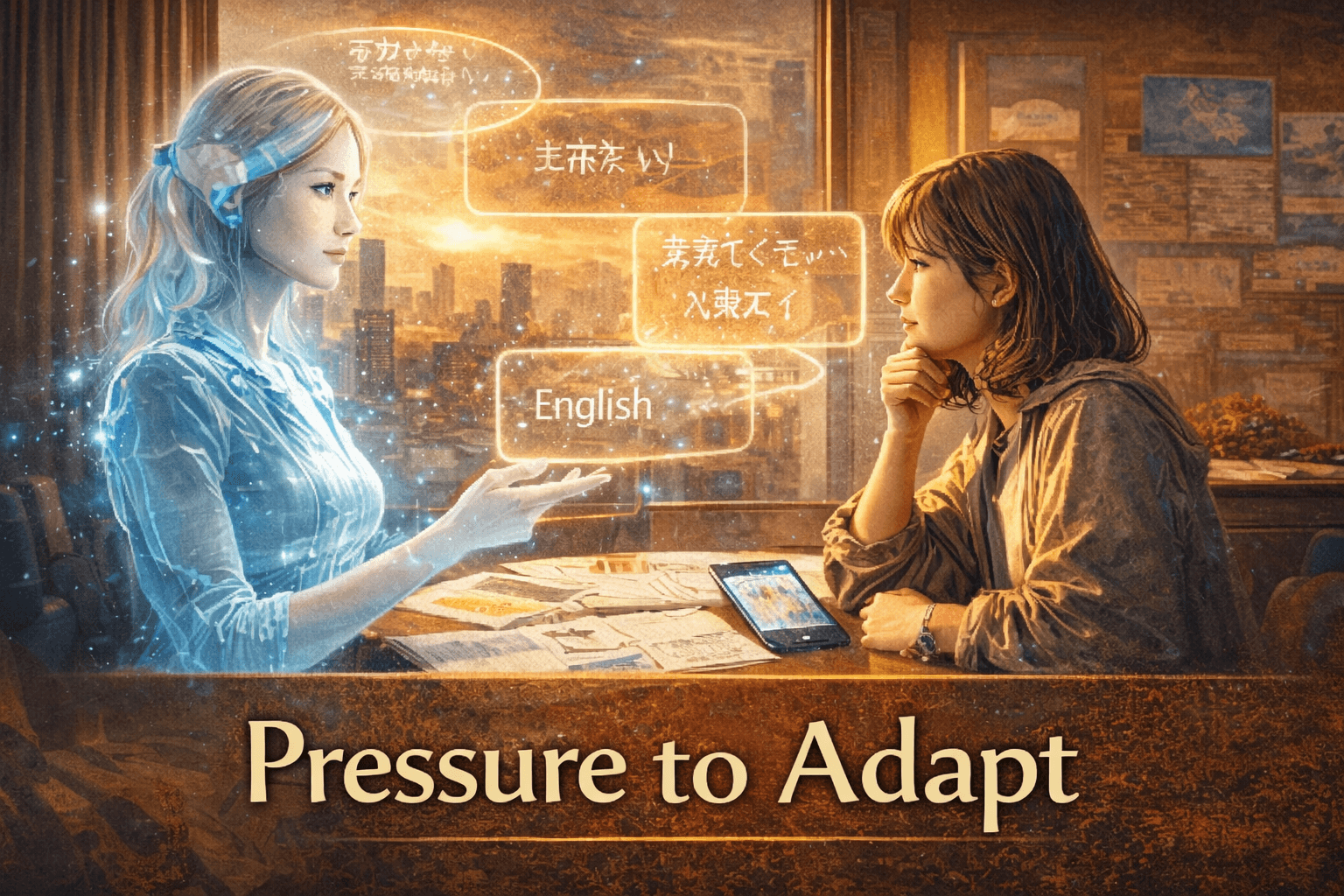
AI changes where language comes from.
Instead of building it internally, you can now access it externally.
Therefore, the process becomes faster.
However, it also becomes less personal if used without awareness.
Because without effort:
- Pattern recognition weakens
- Emotional connection reduces
Retention becomes shallow.
From Tool to Dependency
| Stage | What Happens | What Changes |
| Traditional learning | You struggle to form sentences | Language becomes internal |
| AI-assisted learning | You generate instantly | Language becomes accessible |
| Over-reliance | You depend on output | Ownership weakens |
| Balanced use | You reflect and adapt | Identity strengthens |
Where This Connects to Learning Tools
Not all AI tools support learning equally.
Some tools:
- Prioritize speed
- Remove thinking
- Give instant answers
However, others:
- Guide attention
- Encourage repetition
- Build patterns
This distinction matters.
As explained here:
👉 Why Browser Extensions Fail Where Apps Succeed
Because convenience alone does not create learning.
Structure does.
Research shows that meaningful interaction and active engagement are essential for language acquisition.
Additionally, studies on cognitive effort suggest that deeper processing leads to stronger retention and understanding.
In other words:
👉 The brain learns best when it is actively involved.
A Subtle Shift You Might Notice
At some point, you may notice something subtle.
You use AI to write a message.
It sounds natural.
So you send it.
However, when someone replies unexpectedly, you hesitate.
Because although the sentence was correct,
it was not constructed by you.
And that hesitation reveals something important.
A Moment I Realized This Myself
At one point, I relied on AI more than I realized.
Whenever I needed to write something in another language, I immediately turned to AI.
It was fast, accurate, and it made everything feel easier.
So at first, it felt like progress.
However, over time, something changed.
One day, I was in a real conversation.
There was no time to check, no time to generate, no time to refine.
And suddenly, I hesitated.
Not because I didn’t understand the situation.
But because I couldn’t construct the response on my own.
That moment felt strange.
Because I had been using correct language.
And yet, I couldn’t use it freely.
So I started noticing a pattern.
Whenever I wrote with AI:
- The sentences were better
- The structure was clearer
However, when I spoke:
- I paused more
- I relied on simple phrases
- I avoided complexity
At that point, something became clear.
I wasn’t building language.
I was selecting it.
And that realization changed everything.
Instead of replacing my thinking,
I began using AI to support it.
And gradually, that balance made my language feel more natural again.
So What Should You Do?
The answer is not to avoid AI.
Instead, it is to use it intentionally.
1. Use AI as a Mirror
Compare your version with AI output.
👉 Why: awareness builds understanding
2. Build Before You Refine
Try first, then check.
👉 Why: effort strengthens memory
3. Stay Connected to Context
Focus on when and why language is used.
👉 Why: context creates meaning
4. Maintain Personal Expression
Ask yourself whether the sentence reflects your own intent.
👉 Why: identity shapes fluency
A More Balanced Perspective on AI
AI is not replacing language learning.
Instead, it is redefining it.
On the one hand, it accelerates access.
On the other hand, it challenges depth.
Therefore, the goal is not to reject AI.
Rather, it is to:
- Use it consciously
- Combine it with real context
- Stay mentally engaged
Because ultimately, language is not just output.
It is experience.
FAQs
1. Can AI replace language learning?
No. It changes how we learn, but not why we learn.
2. Is using AI harmful?
Not necessarily. However, over-reliance can reduce deep processing.
3. How do I know if I rely too much on AI?
If you can generate language but struggle to respond naturally, that is a clear sign.
A Simple Way to Make This Work
The difference is not whether you use AI.
It is how structured your learning is.
That’s where Jolii comes in.
Instead of:
- Generating random sentences
- Relying on instant answers
Jolii helps you:
- Revisit patterns
- Connect language to context
- Build internal understanding
So rather than replacing your thinking,
it supports it.
And as a result, your fluency becomes more stable—and more personal.
Final Thoughts
The future of language is not just about fluency.
It is about identity.
AI can help you speak faster.
However, it cannot decide what you truly want to say, how your meaning takes shape, or how you connect with others.
And in the end, that is what language really is.