Quick Answer (TL;DR)
You can’t reach professional fluency in Spanish with general Netflix content.
To understand and use industry-specific Spanish, you need repeated exposure to the same vocabulary inside real professional contexts (medical, legal, creative).
Netflix dramas help because they show how language is actually used—not just what words mean.
You can learn basic Spanish through almost any Netflix show.
However, if your goal is to work, communicate, or think inside a specific field, general exposure is no longer enough.
Instead, you need repeated exposure to industry-specific language—terms and expressions that only appear in professional contexts.
And when that language is experienced through the right kind of Netflix content, your brain can start recognizing and using it naturally.
Why “Basic Fluency” Is Not Enough
At some point, conversational Spanish becomes manageable.
You can follow everyday conversations, respond in familiar situations, and understand most of what you hear.
And for a while, that feels like progress.
However, a different kind of difficulty appears when you try to go further.
You may want to:
- Work in a specific industry
- Study in a professional environment
- Communicate in more technical situations
And suddenly, something feels off.
You understand the language.
But not the conversation.
Because what’s missing is not grammar.
It’s domain-specific vocabulary. And without it, fluency starts to feel limited.
The Cognitive Insight: Why Specialized Language Feels Like a Barrier
This challenge is not about learning “more words.”
Instead, it’s about learning a different layer of the language.
1. General vs Domain-Specific Patterns
Everyday Spanish is built on:
- Common situations
- Predictable reactions
However, professional Spanish is built on:
- Structured environments
- Repeated technical interactions
So your brain cannot rely on the same patterns.
2. Recognition Without Context Breaks Down
You might recognize terms like:
- Diagnóstico (diagnosis)
- inversión (investment)
However, without context, they remain abstract.
As a result, your brain cannot retrieve them when needed.
3. Why Context Becomes Essential
Specialized vocabulary only becomes usable when:
- It appears in action
- It is tied to real situations
That is why professional dramas are powerful.
They don’t just show language.
They show how language functions inside a field.
Why Netflix Professional Dramas Can Help
Not all shows are equally useful.
However, when you choose the right professional dramas, something changes.
Instead of hearing general conversation, you are exposed to language that only exists inside specific industries.
🏥 Medical (Clinical Language — Respira / Breathless)
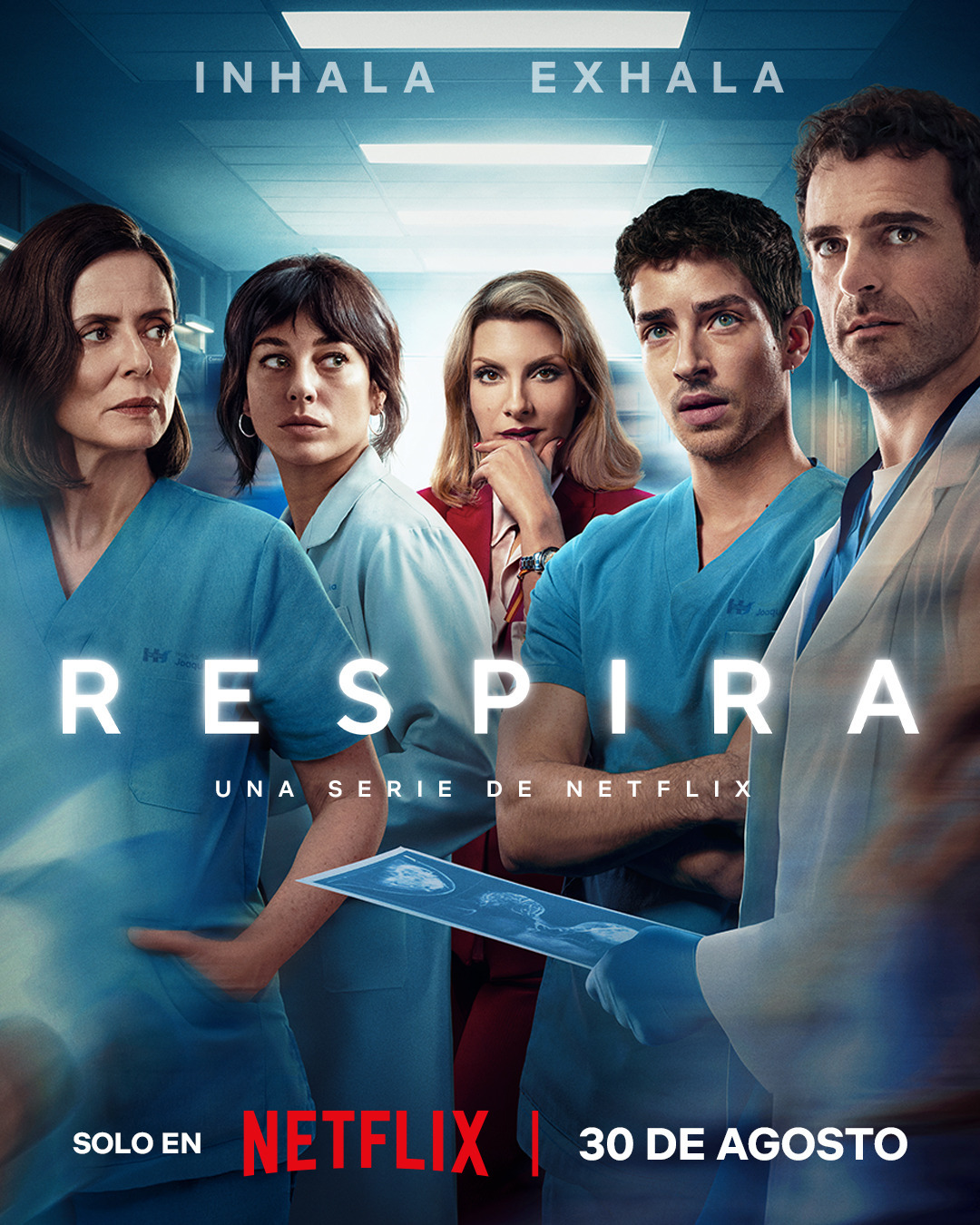
A strong example is Respira (Breathless), a Spanish medical drama on Netflix.
The series takes place in a hospital setting, where conversations revolve around diagnosis, urgency, and patient care.
Because of that, you hear clinical terminology such as:
- Insuficiencia respiratoria (respiratory failure)
- Intubación (intubation)
- Hemorragia interna (internal bleeding)
- Pronóstico reservado (guarded prognosis)
These are not everyday words.
However, because they appear repeatedly in similar situations—emergency rooms, ICU decisions, and consultations—your brain starts connecting them to specific meanings.
Instead of memorizing definitions, you begin to recognize when and why they are used.
💼 Business & Legal (Institutional Language — El Reino)

Another strong example is El Reino, a Spanish political drama.
While the setting is political, the language overlaps heavily with business, finance, and legal environments.
You will hear terms such as:
- Malversación de fondos (embezzlement)
- Licitación pública (public procurement bidding)
- Tráfico de influencias (influence peddling)
- Corrupción institucional (institutional corruption)
These expressions appear in:
- Negotiations
- Legal discussions
- Decision-making contexts
Because they are tied to high-stakes situations, your brain processes them as meaningful patterns—not isolated vocabulary.
🎨 Creative & Design (Technical Language — Velvet)

For creative industries, Velvet provides a strong example.
The show is set in a fashion house, where conversations revolve around design, production, and artistic direction.
You’ll hear terms such as:
- Colección de alta costura (haute couture collection)
- Patrón (garment pattern/template)
- Confección (garment construction)
- Diseño exclusivo (exclusive design)
These terms are specific to the fashion and design industry.
However, because they appear during fittings, production, and creative discussions, they become easier to understand and remember.
Studies show that language learned through context-rich environments is retained more effectively than isolated memorization.
In addition, research on situated learning suggests that knowledge becomes usable only when it is experienced within real-life scenarios.
In simple terms, this means your brain remembers what it experiences—not what it lists.
A Moment I Realized This Myself
At one point, I felt comfortable with a new language.
Daily conversations were no longer difficult.
I could understand most situations.
However, when I tried to go further, everything changed.
I became interested in a specific field.
And suddenly, I couldn’t follow conversations anymore.
Not because my level was low.
But because I didn’t understand the language used in that field.
It felt like a wall.
A gap between:
- Knowing the language
- And using it professionally
Then I tried something different.
Instead of memorizing vocabulary lists, I started watching shows related to that field.
At first, it felt overwhelming.
However, over time, patterns started appearing across similar situations, and even the tone began to feel familiar.
And gradually, those words stopped feeling technical.
They started feeling usable.
That was the shift.
From General Understanding to Professional Usage
| Stage | What You Notice | What’s Actually Missing |
| Watching casually | “I get what’s happening” | No domain-specific detail |
| Learning vocabulary | “I recognize the term” | No situational usage |
| Entering a field | “I hear unfamiliar terms” | No contextual patterns |
| Repeated exposure in context | “I connect meaning to situations” | Patterns begin forming |
How to Learn Industry-Specific Spanish Effectively

1️⃣ Choose the Right Shows
Focus on:
- Professional environments
- Structured dialogue
- Realistic scenarios
👉 Why: context must match your goal
2️⃣ Stay Within One Domain
Avoid switching too often.
Instead:
- Go deep in one field
👉 Why: repetition builds stronger patterns
3️⃣ Focus on Situations, Not Terms
Ask:
- What is happening?
- Why is this term used here?
👉 Why: meaning comes from context
4️⃣ Replay Key Scenes
Focus on:
- Decision-making moments
- Emotionally intense scenes
👉 Why: emotion strengthens memory
Why Choosing the Right Show Matters
Many learners assume that any exposure is helpful.
However, that’s not always true.
Some shows:
- Use unrealistic dialogue
- Lack repetition
- Prioritize entertainment over communication
As explained here:
👉Why Some Netflix Shows Are Terrible for Language Learning
Choosing the wrong content slows progress.
However, choosing the right one accelerates it.
FAQs
1. Can I learn professional Spanish just from Netflix?
No. However, it helps you understand how language is used in real contexts.
2. How long does it take to learn specialized vocabulary?
With consistent exposure, noticeable improvement can happen within weeks.
3. Should I still study vocabulary separately?
Yes. However, context makes vocabulary usable.
4. What if I don’t understand technical terms at first?
That’s normal. Understanding builds through repetition.
A Simple Way to Make This Work
The challenge is not effort.
It’s structure.
That’s where Jolii helps.
Instead of:
- Random content
- Inconsistent exposure
You get:
- Structured scenes
- Repeated patterns
- Focused context
So instead of memorizing vocabulary,
you experience how it is actually used.
Final Thoughts
Learning a language is one level.
Using it professionally is another.
That gap is where most learners stop.
Not because they lack ability.
But because they lack exposure to the right kind of language.
Professional dramas change that.
They don’t just give you words.
They give you situations.
And once your brain starts recognizing those patterns,
language stops feeling general.
And starts becoming usable.