Repetition improves short-term recall, but only variation builds adaptability. Fluency depends on retrieving language patterns under changing conditions — not repeating the same sentence perfectly. If your practice feels smooth but real conversations feel unstable, variation is likely missing.
Repetition builds familiarity.
Variation builds adaptability.
Fluency requires adaptability.
For a long time, I believed that repeating the same dialogues, grammar drills, or listening clips would eventually turn into fluency. And in the beginning, repetition does help. It stabilizes patterns. It makes sentences feel smoother. It reduces hesitation.
But fluency is not about saying one sentence perfectly.
It’s about being able to adjust that sentence when the situation changes.
That’s where variation comes in.
Why Repetition Feels Like Progress
Repetition strengthens recognition and short-term retrieval.
When you repeat the same sentence multiple times:
- Processing effort decreases
- Recall becomes faster
- Errors temporarily disappear
That smoothness feels like mastery.
I remember repeating a Korean dialogue for several days. By the end of the week, I could recite it almost flawlessly. I felt confident — until someone slightly altered the phrasing during a real conversation. One small variation, and I froze.
A few months later, I ran a simple experiment on myself. For one week, I repeated the same 20 sentences daily. By day five, I could deliver them effortlessly. The following week, I took the same structures but rotated tense, subject, and context. The second week felt slower and slightly frustrating — but when I entered a spontaneous conversation, only the varied structures transferred. The memorized ones collapsed under pressure.
That moment showed me something important: I had trained recall in one fixed condition. I had not trained adaptability. Repetition improves performance in stable environments.
Fluency requires performance in changing ones. If you also understand but can’t respond spontaneously, you may be experiencing the input–output gap.
What Fluency Actually Requires
Fluency is not perfect recall.
Fluency is flexible retrieval under variation.
In real conversation:
- Vocabulary shifts
- Speakers vary
- Tone and speed change
- Questions are unpredictable
Your brain must retrieve language patterns while adapting to new input.
Cognitive science describes this through the contextual interference effect, which suggests that varied practice strengthens long-term retention and transfer more effectively than blocked repetition.
In simple terms:
Blocked repetition improves short-term performance.
Interleaved and varied practice improves long-term adaptability.
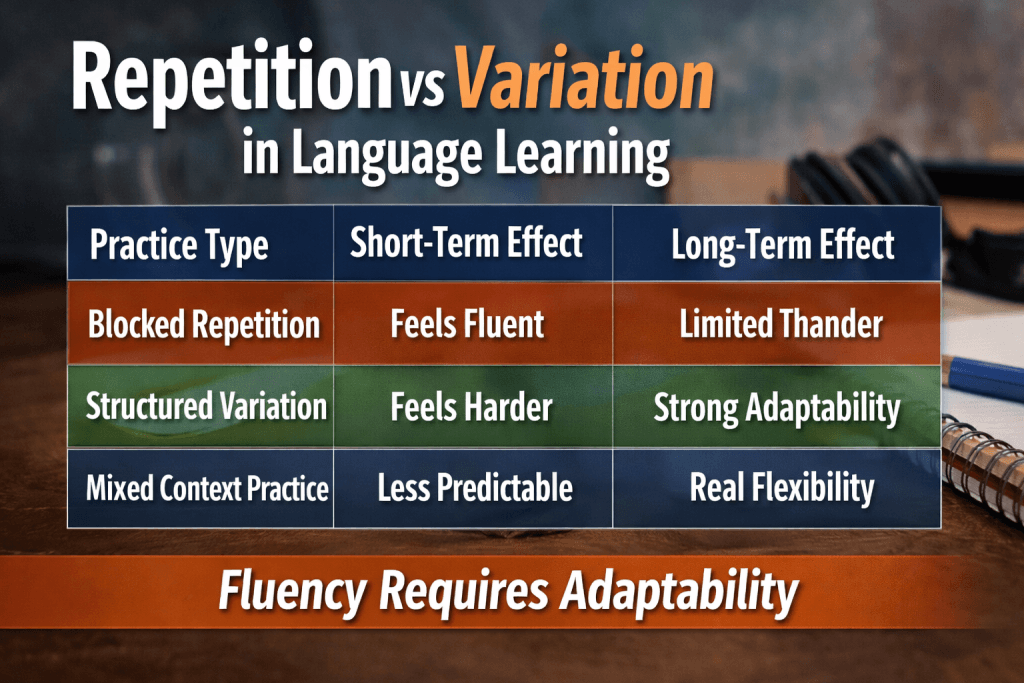
Repetition vs Variation: The Core Difference
| Practice Type | What It Builds | Short-Term Effect | Long-Term Effect |
| Blocked Repetition | Retrieval Strength | Feels smooth and fluent | Limited transfer |
| Structured Variation | Storage Strength | Feels harder | Strong adaptability |
| Mixed Context Practice | Adaptive Retrieval | Less predictable | Real conversational flexibility |
Research on “desirable difficulties” explains why slightly harder, varied practice produces more durable learning (overview: https://bjorklab.psych.ucla.edu/research/desirable-difficulties/).
Repetition strengthens recall in one condition.
Variation strengthens performance across conditions.
Fluency depends on the second.
Why Repetition Alone Stops Working
Repetition strengthens retrieval strength — your ability to recall something in the same situation.
Variation strengthens storage strength — your ability to use that pattern in new situations.
I noticed this clearly with listening practice. Replaying the same podcast episode made me understand it almost perfectly. But when I switched to a different speaker with a different rhythm, my comprehension dropped again.
Repetition built comfort.
Variation built adaptability. Without variation, learning becomes narrow. And narrow learning struggles under real-world unpredictability
The Turning Point in My Own Practice
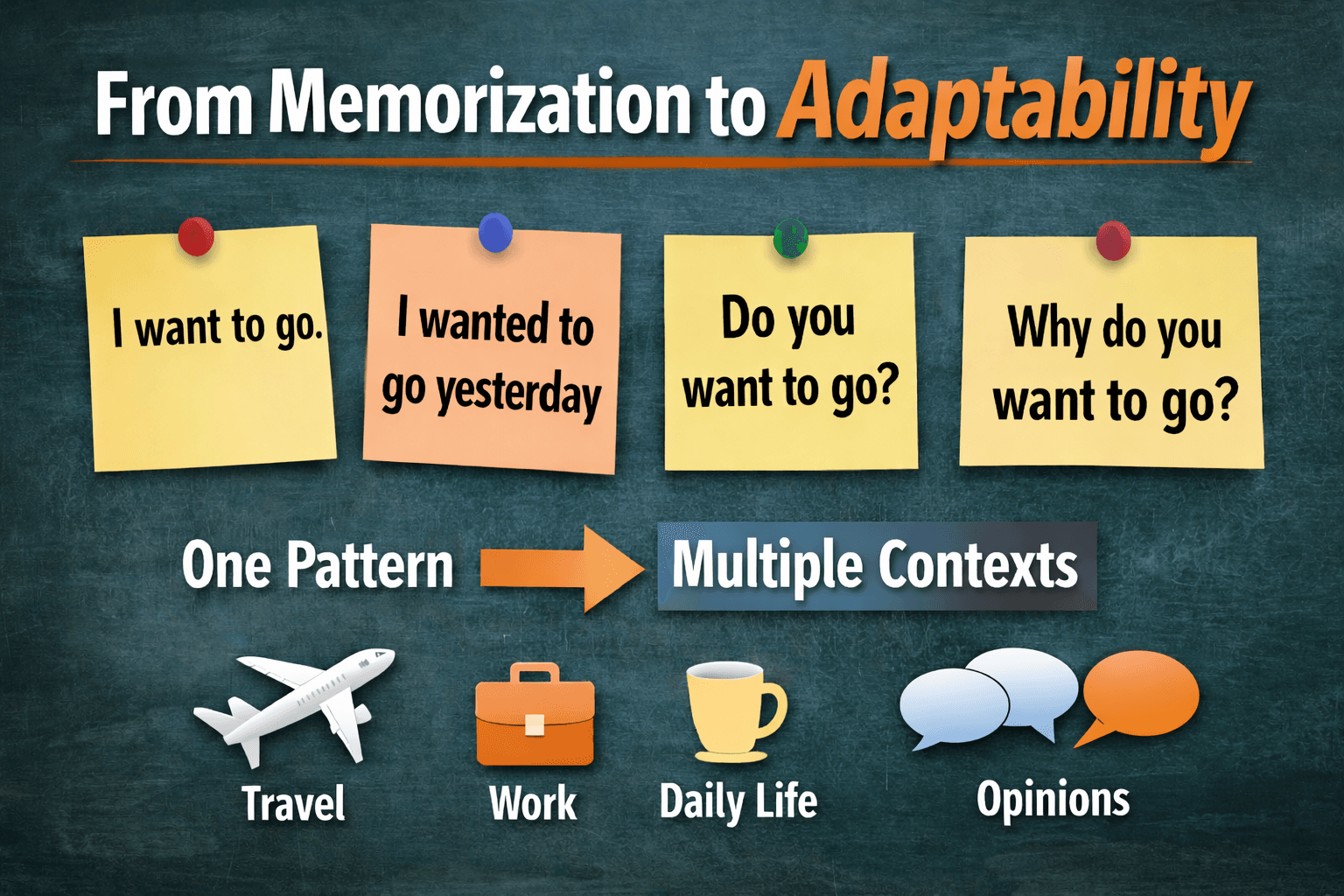
My progress changed when I stopped rehearsing identical sentences and started rotating contexts.
Instead of repeating:
“I want to go to the store.”
I practiced variations such as:
“I wanted to go yesterday.”
“I don’t want to go.”
“Do you want to go?”
“Why do you want to go?”
The grammar structure remained similar, but the conditions changed.
At first, it felt slower and slightly uncomfortable. But within weeks, something shifted. I wasn’t recalling memorized lines anymore — I was generating responses. That was the difference between rehearsal and fluency training.
The 3-Layer Variation Framework
Variation does not mean randomness.
It means structured diversity.
Over time, I realized that simply “adding more content” wasn’t helping. What helped was changing how I interacted with the same structures. The shift wasn’t about quantity — it was about design. I now think of this as a three-layer system. It is the framework that made repetition finally start working for fluency instead of against it.
1️⃣ Micro-Variation
Instead of constantly introducing completely new grammar, keep the core structure stable and adjust only small elements — such as subject, tense, object, or modifiers.
Take a simple pattern:
- “I’m learning Korean.”
Now expand it gradually:
- “I’m learning French.”
- “I’m learning slowly.”
- “I’m learning again.”
- “I was learning last year.”
- “I’ve been learning for months.”
The grammatical backbone stays recognizable, but each variation forces your brain to retrieve and adapt slightly differently. You are no longer memorizing a single sentence — you are strengthening a reusable structure.
This builds flexibility without overwhelming cognitive load. The difficulty remains manageable, yet adaptability increases steadily. Over time, the structure becomes something you can manipulate naturally rather than recall word-for-word.
2️⃣ Context Variation
Structures become fragile when they are tied to only one scenario.
For a long time, I associated certain patterns only with specific textbook themes — travel dialogues, restaurant orders, classroom examples. The moment the topic shifted, my confidence dropped.
Context variation solves this.
Take one sentence pattern and reuse it across different domains: travel plans, work discussions, daily routines, personal opinions, even hypothetical situations. When a structure survives topic changes, it becomes flexible rather than situational.
For example, instead of practicing a request only in a restaurant scenario, use the same request structure in:
- Work emails
- Friend conversations
- Planning discussions
- Family contexts
This prevents what I call “pattern dependency” — the habit of linking one grammar form to one memorized script. When a structure works across contexts, it starts becoming automatic.
3️⃣ Retrieval Variation
Variation is not only about what you change — it’s also about how you retrieve.
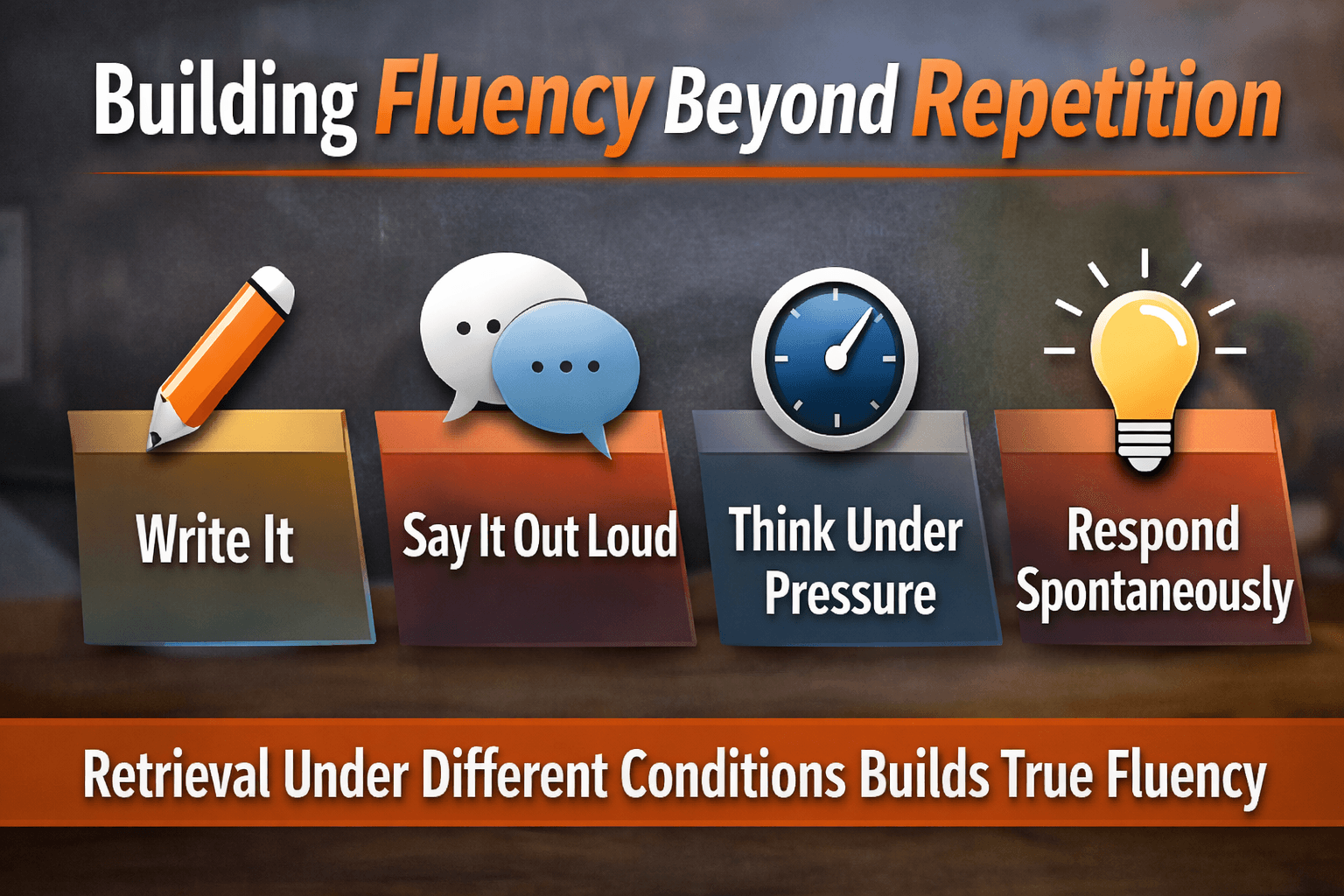
If you always practice in the same comfortable format, your brain adapts only to that condition.
Try rotating retrieval modes:
- Write the sentence from memory
- Say it aloud without looking
- Respond spontaneously to a prompt
- Answer under mild time pressure
When I first experimented with this, I noticed something revealing. I could write sentences smoothly, but speaking them without preparation exposed hesitation I hadn’t noticed before. Adding even a slight time constraint forced faster retrieval and real-time adjustment.
Fluency develops when retrieval works under multiple conditions — not just calm, rehearsed ones.
If a structure only functions when you have time to think carefully, it hasn’t yet become automatic. By varying retrieval conditions, you train your brain for real conversation — where pressure, unpredictability, and speed are normal.
Why Variation Feels Harder (But Works Better)
Variation introduces mild instability.
That instability is productive.
When practice feels too smooth, adaptation is low. When practice feels slightly effortful — when you hesitate and reformulate — your brain is reorganizing patterns for transfer.
Transfer is the real goal of fluency.
Research in skill acquisition consistently shows that learning designed for transfer produces stronger long-term adaptability than learning optimized for immediate performance. Studies on interleaved practice demonstrate that mixing conditions improves retention and real-world application compared to blocked repetition.
In other words, if practice only feels smooth, it may not be preparing you for variability.
FAQ About Repetition and Fluency
1. Does repetition help at all?
Yes. Repetition stabilizes patterns and improves early retrieval speed. But repetition alone strengthens performance only within the same context. Without variation, those patterns remain fragile when conditions change.
2. Why do I feel fluent during practice but freeze in real conversation?
Because practice often happens in controlled environments. Real conversation introduces unpredictability — different speakers, vocabulary, pacing, and emotional pressure. If variation is missing in practice, adaptability remains undertrained.
3. How much variation is necessary?
You don’t need constant randomness. Even small changes — tense shifts, subject changes, topic rotation — can significantly increase transfer. Three to five structured variations per pattern is often enough to begin building flexibility.
4. Is variation better than repetition?
They serve different purposes. Repetition builds stability. Variation builds flexibility. Fluency requires both — but variation must eventually dominate.
A Smarter Way to Introduce Structured Variation
One reason repetition dominates language learning is that many platforms allow passive replay without structural change.
Jolii’s “Learn Actively, Not Passively” feature addresses this by turning real content into interactive practice — encouraging engagement with transcripts, active response prompts, and retrieval tasks instead of endless rewatching.
That subtle shift naturally introduces variation.
Fluency does not grow from saying one sentence perfectly.
It grows from adapting that sentence when it changes.
Final Thoughts
Repetition builds familiarity.
Variation builds adaptability.
Fluency is not smooth rehearsal.
It is flexible response.
If your practice feels repetitive but your conversations still feel unstable, the issue may not be effort — it may be structure.
Fluency is built through cumulative exposure hours, but those hours must include variation to create transfer. If you’re curious how exposure time and practice design interact, you might find this breakdown helpful
Sometimes progress doesn’t require more repetition.
It requires better-designed variation.