TL;DR
Japanese honorifics (-san, -sama, -kun, -chan) are suffixes added to names to signal respect, closeness, or social hierarchy. Which one you use depends on your relationship with the person and the situation. If you’re unsure, -san is the safest default in everyday Japanese.
If you’re learning Japanese through anime, podcasts, or real conversations, honorifics can feel confusing fast.
Why is one person called -san, another -kun, and someone else -sama — even when they seem to be saying the same thing?
This confusion is one of the most common reasons learners feel unsure speaking Japanese in real life. This gap between understanding and speaking is completely normal.
Why someone’s a ‘san’, someone else a ‘kun’… and what it all really means? Japanese honorifics are suffixes added to people’s names to show respect, familiarity, or social status — and they’re a key part of everyday communication in Japan.
You’re reading, watching anime, or listening to a podcast, and suddenly you notice:
Everyone’s name has something tacked onto the end.
Sometimes it’s -san, sometimes -kun, other times -sama or even -chan… and you’re left thinking:
“Wait… why are these little suffixes showing up after people’s names? And why is one person a san, another a sama, and someone else a kun?”
Honestly, I remember the first time I heard Okyaku-sama (お客様) — which literally means “honoured guest” or “dear customer”.
- Okyaku (お客) means “guest” or “customer”,
- and sama (さま) is an honorific that shows deep respect.
I remember thinking, “Who is this Okyaku person that every staff member keeps mentioning?”
Turns out, these little suffixes are called Japanese honorifics, and they’re a big deal. They’re not just fluff or politeness for politeness’ sake — they’re social cues, tiny signals that say a lot about relationships, respect, closeness, and hierarchy. Once you start picking up on them, it’s like someone handed you a decoder ring for Japanese conversations.
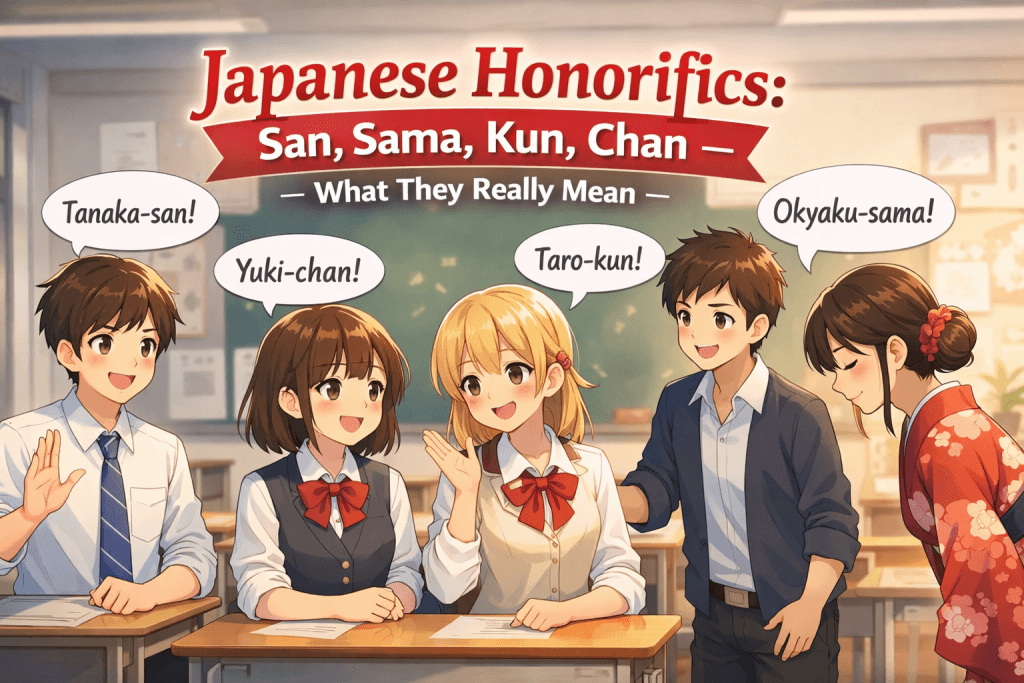
1. What Are Japanese Honorifics, Really?
At their core, Japanese honorifics are kind of like the Japanese version of “Mr.” or “Ms.” in English — but… much more layered.
In English, “Mr. Smith” might just be a formality. But in Japanese, calling someone Tanaka-san vs Tanaka-kun vs Tanaka-sama? That’s not just style — that’s relationship mapping. They help you navigate how close or distant you are from someone. Whether you’re showing respect, affection, neutrality, or a mix of all three. They’re basically shorthand for “here’s how I see you, and here’s how I want to come across.”
2. The Main Types of Japanese Honorifics: San, Sama, Kun & Chan
| Honorific | Politeness Level | Typical Use | Risk for Learners |
|---|---|---|---|
| -san | Neutral, polite | Default for adults, colleagues, strangers | Very low |
| -sama | Very polite | Customers, clients, VIPs | Sounds stiff if overused |
| -kun | Casual | Younger males, subordinates | Can sound condescending |
| -chan | Affectionate | Children, close friends, pets | Very high outside close relationships |
2.1 Using San (さん) in Names and Daily Speech
Think of san as the Swiss army knife of Japanese honorifics. It’s polite, neutral, and works in about 90% of situations. You can use it with colleagues, acquaintances, teachers, even the cashier at the konbini.
Example:
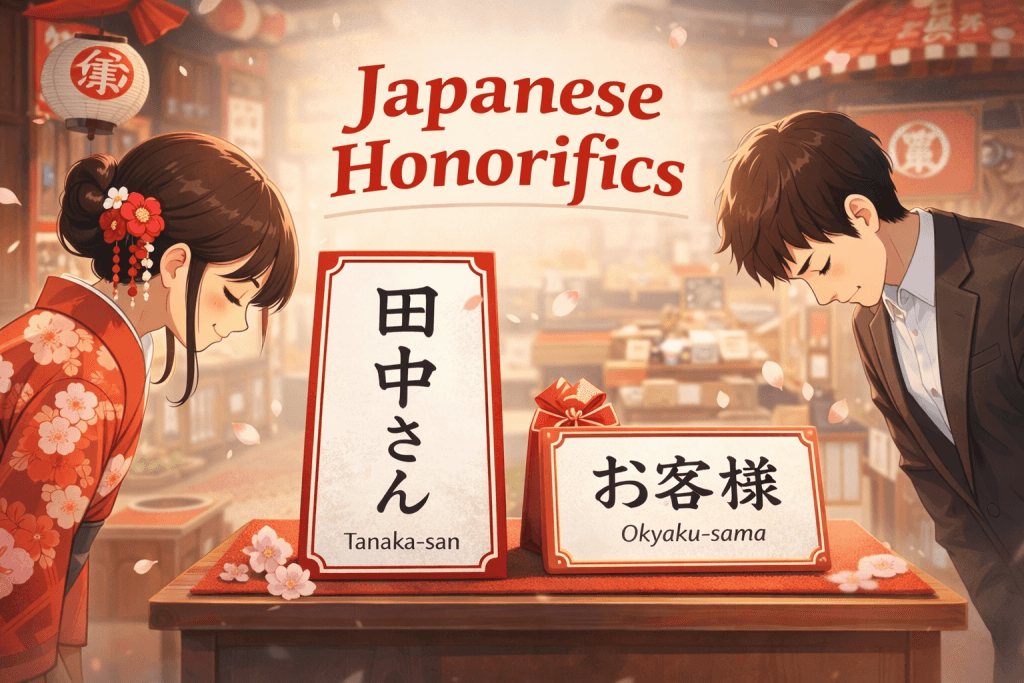
- Tanaka-san (田中さん) – Mr./Ms. Tanaka
It’s the “I respect you, but let’s keep it professional-ish” suffix. If you’re unsure which honorific to use, san is your friend.
2.2 What Sama (さま) Means in Polite Japanese
You’d use sama for customers, clients, VIPs, or people you admire deeply. It shows deference, the kind that puts the other person on a bit of a pedestal.
Example:
- Okyaku-sama (お客様) – customer (very polite)
You’ll often hear this in stores or restaurants. “Okyaku” means guest, and “sama” is the formal way of showing that guest matters — a lot.
2.3 How Kun (くん) Works in Japanese Honorifics
Ah, kun. This one has a more casual, somewhat affectionate tone. You’ll hear it used for boys, younger males, or subordinates — but not always in a condescending way.
Example:
- Taro-kun (太郎くん) – Taro (friendly or junior male)
2.4 Understanding Chan (ちゃん) in Japanese Honorifics
Chan is all about intimacy and tenderness. It’s commonly used for children, pets, and close friends — especially girls.
Example:
- Yuki-chan (雪ちゃん) – Yuki (playful, close, affectionate)
3. How to Choose the Right Japanese Honorifics in Any Situation
It’s part art, part instinct, part cultural logic. But here’s a rough guide:
- Respect & hierarchy? → Use san or sama
- Familiarity or closeness? → Use kun or chan
- Not sure? → San is your safety net
- Trying to be funny with a pet? → Chan it is
- Trying to impress a client? → Definitely sama
And yes — mistakes happen. You’ll mess up. We all have. Just correct yourself and move on. People appreciate the effort.
A Quick but Powerful Insight: What These Suffixes Really Say
Want a rock-solid definition of -san (さん)? Here’s the Cambridge Dictionary entry for -san — quick, clear, and actually worth bookmarking.
So here’s something that hit me a bit later — something I didn’t catch while I was busy memorising when to use san or kun.
Japanese honorifics aren’t just about being polite. They’re actually doing emotional work.
I know that sounds a bit dramatic, but hear me out. In English, if we want to show warmth or distance, we change our tone, or body language, or throw in a smile. In Japanese, a huge chunk of that happens through language — especially through honorifics.
It’s kind of wild when you think about it. Saying Tanaka-san vs Tanaka-chan doesn’t just shift the level of formality — it quietly says, “This is how I feel about you. This is how close (or not close) we are.”
And once I saw it that way, everything started making more sense.
Like, why do shop staff call you okyaku-sama and not just okyaku-san?
Because sama doesn’t just say you’re a customer — it says you matter. That’s how businesses in Japan express deep respect without gushing over you.
There’s a brilliant intro here from TCJ that breaks that down with great examples.
I also came across an article that explained how honorifics are part of a much bigger system of showing social awareness — not just who you’re speaking to, but how you feel about them, and how you want to be seen in return.
Once you look at it through that lens, the whole thing just… clicks.
The deeper I dug, the more I realised — Japanese honorifics are like emotional tuning knobs.
You’re not just naming someone. You’re signalling your relationship to them, how much space you’re giving them, or how warm you’re trying to be.
Sometimes you even switch mid-conversation, depending on how things are going. And when native speakers do this? It’s smooth. Subtle. Masterful.
And all of that… from just one little word stuck to the end of a name.
FAQ About Japanese Honorifics
Do I always have to use honorifics?
In Japan, most of the time you do add a suffix — it’s kind of the default. If you’re unsure, -san is the safest “everyday” choice (Tanaka-san).
When people say “you can skip honorifics,” they usually mean dropping the suffix completely (呼び捨て / yobisute). That’s not casual-neutral — it’s close (or risky) depending on the relationship. With close friends, some people switch to -chan or -kun, or go no-suffix. But in public or unfamiliar settings? Stick with -san.
What if I get it wrong?
You probably will. And honestly, that’s normal. The simplest rule is: when in doubt, use -san.
Most awkward moments come from jumping too fast to -chan, -kun, or no-suffix. If you realise you used the wrong one, just correct yourself lightly — “Ah, sorry—Tanaka-san.” People usually appreciate the effort.
Can I use them with family?
Yes — but family is its own little universe. Inside the family, suffixes are often dropped, replaced with nicknames, or softened with -chan (especially for kids).
But if you’re not sure — like with older relatives, in-laws, or anyone you want to sound polite to — -san is still a safe option. And remember: “no-suffix” in a family context can be affectionate… or it can sound sharp, depending on tone.
Final Thoughts on Using Japanese Honorifics Naturally
Mastering Japanese honorifics isn’t about getting 100% right all the time. It’s about tuning into how relationships work — who you are to someone, who they are to you, and what kind of dynamic you’re creating with your words.
They’re like mirrors — reflecting respect, closeness, distance, and tone, all in one tiny suffix.
So don’t rush it. Let it come naturally. Listen more than you speak.
And someday, when you call someone “Tanaka-san” without even thinking about it — that’s when you know. You’re in.
Want a smoother learning path? Pair this with Japanese Alphabet Explained so you can recognise names and suffixes faster.
Still Unsure About Japanese Honorifics?
Still feel unsure about when to use san or chan? That’s normal. These things don’t click overnight. But practice helps — especially in real conversations.
If you’re looking to build confidence using Japanese honorifics the natural way, Jolii app can help. It’s designed to give you real-world examples, everyday context, and actual practice — not just textbook rules.
Because this stuff? It’s not about grammar. It’s about connection.