First published: March 2026. Last updated: June 2026
Quick Answer
Shadowing is a speaking technique where you repeat native audio in real time. For German learners, it trains rhythm, pronunciation, and response timing by synchronizing listening and speech. Short daily shadowing sessions help bridge the gap between understanding German grammar and speaking naturally.
Many German learners understand grammar and vocabulary but still hesitate when speaking. The words are there, but sentences come out slowly or with unnatural rhythm. This happens because speaking requires timing, not just knowledge. This timing gap is part of the broader input-output problem explored in Why Passive Watching Doesn’t Build Speaking Skills. Shadowing helps close this timing gap by training your brain and mouth to produce German in real time.
The Speaking Timing Gap
Native conversations move very quickly. Research shows that turn-taking gaps between speakers average about 200 milliseconds. If your brain needs more time to plan a sentence, you hesitate or lose the moment to respond.
Shadowing helps close this timing gap by synchronizing listening and speaking in real time. Many learners notice this effect quickly. After several weeks of shadowing short German clips, sentences begin to come out faster and with fewer pauses because the brain no longer has to assemble each word individually.
In this guide, you will learn what German shadowing is, why it works, and the best way to use it with modern tools for faster results.
What is German Shadowing?
German shadowing is repeating native German audio as you hear it. The focus is on matching rhythm, stress, and pronunciation.
Short daily sessions build faster fluency because they train timing and automatic speech, not just knowledge.
What is the concept behind “German Shadowing”?
German shadowing is a speaking technique refined by Alexander Arguelles. The concept is simple.
- You listen to native German audio.
- You repeat it immediately.
- You match the speaker’s timing and prosody.
- You repeat short clips many times.
Why Shadowing Works?
Shadowing works because it uses working memory correctly.
Speech sounds are held briefly in the phonological loop. This system includes a sound store that retains audio for approximately 1–2 seconds. It also utilizes an inner rehearsal process to constantly refresh the stored information.
Shadowing forces continuous rehearsal. That links perception to articulation. Over time, it consolidates into long-term speech patterns.
Pro-Insight: Confidence increases when speech becomes automatic. Shadowing reduces the mental load of “planning speech,” so learners hesitate less and recover faster from mistakes.
Benefits of Shadowing for German Learners
German shadowing enhances aspects that learners typically struggle with, such as reading and grammar drills.
Pronunciation and problem sounds
Shadowing is especially effective for:
- ü/ö placement and lip rounding
- ich/ach tongue positioning
- German “r” connected to stress and linking
- consonant clusters in connected speech
Listening speed and segmentation
Shadowing trains the brain to segment speech in real time. This helps with:
- fast conversational German
- compound noun parsing
- reduced, mumbled, or casual speech patterns
Fluency and timing
Fluency is not only about accuracy. It is timing.
Native turn-taking gaps average around 200 milliseconds. Shadowing trains faster response timing by reducing the lag between hearing and speaking.
How to Do German Shadowing the Right Way?
Following these specific steps ensures you build muscle memory and master natural pronunciation effectively.
Step 1: Choose an audio you can follow
Shadowing should be i+1, not i+5. The audio should become 90–95% comprehensible after 2–3 listens. Good level-matched sources:
- Deutsche Welle: Nicos Weg (A1–B1)
- Deutsche Welle: Langsam gesprochene Nachrichten (B1–B2 transition)
- Easy German clips (B1+, short loops)
Step 2: Use the transcript first, then remove it
- Early stage: audio + transcript to reduce cognitive load
- Later stage: audio only to maximize auditory focus
Important constraint: Reading while recording shifts attention to text instead of sound. This reduces the effectiveness of the method.
Step 3: Use the three-stage shadowing sequence
- Silent shadowing: Listen and track rhythm and soundscape.
- Whisper shadowing: Keep flow and intonation with lower physical strain.
- Full shadowing with recording: Speak clearly, record, compare to the native model, and re-record when errors cluster.
Step 4: Loop short clips
The best pattern is micro-repetition:
- Loop 20–30 seconds,
- Repeat many times,
- Correct errors quickly
Long podcasts are inefficient for shadowing. Most of the cognitive load is spent keeping up, not refining pronunciation and timing. Short repeated segments also follow the micro-immersion principle, where small pieces of authentic language create stronger learning signals than long passive exposure.
Step 5: Add movement
Walking while shadowing increases alertness and working memory engagement. It also simulates real-world speaking conditions.
Best Resources for German Shadowing Practice
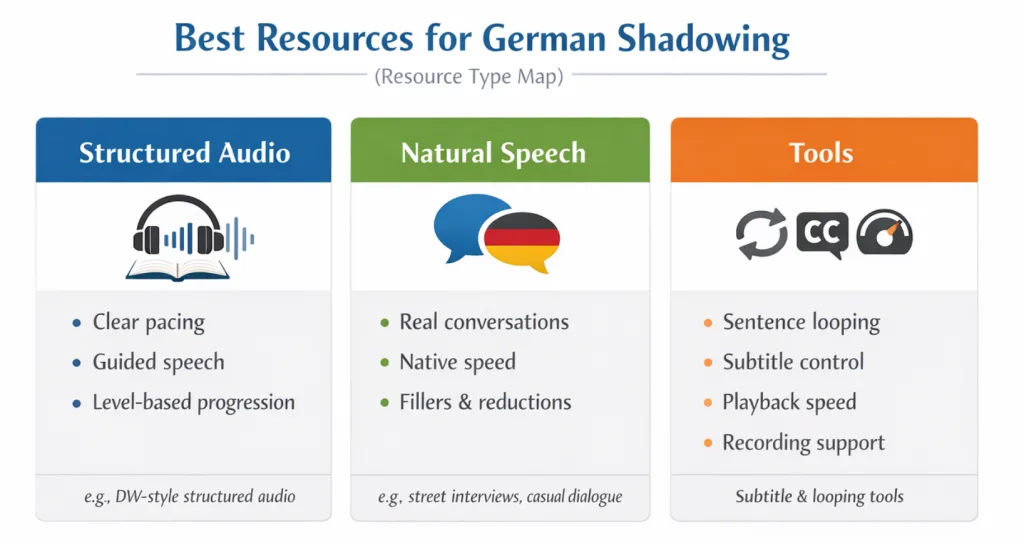
These top-rated resources provide the perfect audio and transcripts for effective shadowing.
Audio sources
- Deutsche Welle (graded courses, news, Nicos Weg)
- Easy German (real conversation, best in short segments)
- Slow German (clear pacing, controlled speech)
- Pimsleur (clean audio for early motor training)
Tools that make shadowing easier in 2025
Shadowing improves when tools reduce friction:
- dual subtitles
- sentence looping
- quick rewind
- recording workflow
Strong options:
- Language Reactor (YouTube control + subtitles)
- InterSub (auto-pause per subtitle line)
- YouGlish (word-level native examples)
- Trancy and similar subtitle tools (use cautiously for colloquial translation reliability)
Real-Life Results: Does German Shadowing Actually Work?
There is no single magic number. Results depend on how often you practice.
Common convergence ranges:
- 10–20 hours of focused shadowing: noticeable rhythm and segment accuracy improvements
- 30–50+ hours: clearer accent smoothing and more native listener feedback
A realistic interpretation of “a few weeks” looks like this.
- Around 3–5 weeks of practice, with 20–30 minutes per session, done 4–5 times per week.
That adds up to roughly 6–12 total hours of focused shadowing.
Expected early outcomes:
- smoother rhythm
- reduced hesitation
- faster sentence completion
- stronger comprehension
Pro-Insight: Intelligibility and comprehensibility improve earlier than “accentedness.” Learners often become easy to understand long before they sound native.
Common Mistakes to Avoid With German Shadowing
- Shadowing too fast before comprehension stabilizes
- Never repeating the same clip
- Choosing audio far above your level
- Staying in whisper mode only
- Skipping recording and comparison
- Using poor-quality audio that causes mishearing
You must learn to manage error fossilization. It happens when misheard sounds are repeated without correction.
How Often Should You Practice German Shadowing?
- Minimum: 10–15 minutes a day
- Ideal: 30 minutes daily
- Consistency > Length of time
- Use it as a warm-up before other studying
Tracking Progress With German Shadowing
Use a simple feedback loop:
- Record weekly
- Compare rhythm and stress, not only individual sounds
- Track omissions and hesitations
- Revisit older recordings to measure improvement objectively
Optional support:
- Capture unknown words into Anki
- Shadow the same clip again after a week for clean benchmarking
AI Trends for Shadowing in 2025–2026
The most useful development for shadowing practice is AI pronunciation feedback that operates at the phoneme level — identifying not just whether you said a word correctly but which specific sound was off. This moves shadowing closer to deliberate practice: repeat, measure, correct, re-run. Jolii’s pronunciation feedback works on this principle, making it particularly effective for the German sounds that cause the most difficulty for English speakers — ü/ö, ich/ach, and the German r.
FAQs
Q. Is German shadowing good for beginners?
German shadowing works at A1 when transcripts and short clips are used. Blind shadowing becomes dominant later.
Q. Can I shadow without understanding everything?
Shadowing remains effective without perfect understanding. Comprehension should reach high clarity after a few listens to avoid overload.
Q. Is shadowing better than conversation practice?
Shadowing builds automatic speech and timing. Conversation builds interaction and flexibility. Shadowing functions best as a bridge into speaking. For a broader overview of how shadowing fits into a speaking practice routine, The Role of Shadowing in Speeding Up Your Language Learning covers the technique across all languages.
Q. How long until I see results?
Rhythm and hesitation improvements typically appear first within weeks of consistent practice. Accent smoothing lags and requires higher total hours.
Final Verdict:
Shadowing is one of the most effective “shortcuts” to bridge the gap between understanding German grammar and actually speaking the language naturally.
German shadowing builds speed and confidence by training timing and prosody. It also develops automatic speech execution under real-time pressure.
Tools that reduce friction make shadowing easier. Jolii turns short video segments into interactive practice loops with sentence replay, recording, and pronunciation feedback. This helps learners repeat the same segment multiple times without losing the conversational context.