Struggling with kanji, grammar, and vocabulary? You aren’t alone.
Here’s the uncomfortable truth: Japanese isn’t hard because you’re bad at learning languages. It’s hard because most study plans are garbage.
Most study plans are built for imaginary people with infinite time and monk-level discipline.
Today, better systems exist. Progress now comes from structured schedules, spaced repetition, and faster feedback.
In this guide, you will discover a practical Japanese language learning schedule designed for busy adults.
What’s a Realistic Japanese Study Schedule?
A realistic Japanese language learning schedule follows these ranges:
- 30–45 minutes per day minimum for gradual progress
- 75–120 minutes per day for optimal, sustainable improvement
For most non-immersion learners, 2 hours per day is the upper limit before burnout and review backlogs become likely.
Why You Need a Daily Routine?
Japanese is one of the hardest languages for English speakers.
Institutional benchmarks show that professional working proficiency in Japanese requires thousands of hours of exposure.
For self-learners, progress depends entirely on consistency and structure.
| Daily Study Time | Expected Progress |
| 2 hours/day | Strong progress, lower burnout risk |
| 1 hour/day | Slow but sustainable progress |
| Inconsistent study | High dropout probability |
Pro-Insight: Japanese rewards daily repetition. Skipping days causes faster memory loss than in most European languages.
Daily repetition works because:
- Spaced review reactivates memory right before it decays (that’s the whole point).
- Cognitive performance drops after 45–60 minutes of continuous focus, so micro-sessions are more efficient than marathons.
- Studying near bedtime can improve consolidation by about 20–30% when you review before sleep.

Core Daily Study Elements
A balanced daily Japanese language learning schedule includes four parts.
Vocabulary (10–15 mins)
Use spaced repetition. Tools like Anki or WaniKani schedule reviews before memory decays.
- Keep SRS reviews in the 15–30 minute lane.
- Sustainable load: 100–200 reviews/day.
- Ideal speed: 5–7 seconds per card.
- If your backlog grows, stop adding new cards. Your future self will thank you.
Kanji Practice (10 mins)
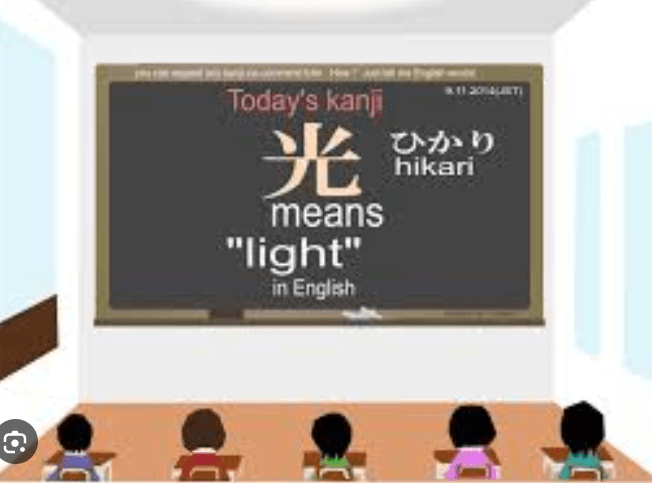
Japanese has ~2,000 commonly used kanji, plus multiple readings.
Without daily review, kanji recall drops fast (often 50%+ within 24 hours when unrehearsed).
Start early. Don’t wait for “after I finish Genki.” That day never comes.
Grammar (15–20 mins)
Use Genki I & II or Tae Kim’s Guide. Keep it sentence-based.
If you don’t understand roughly 80% of the words in a sentence, grammar study turns into dictionary parkour, and your brain rage-quits.
Listening (10–15 mins)
Use NHK Easy News, JapanesePod101, or structured content first. Anime is fine, but only if you’re not using it as “studying” cosplay.
Sample Daily Study Plan for Beginners (with Times)
| Time | Activity | Goal |
| 7:30 AM | Anki vocab + reviews (10–15 min) | Daily memory reactivation |
| 12:00 PM | Grammar + 1–2 example sentences (15 min) | Pattern recognition |
| 5:00 PM | Kanji practice (10 min) | Recall + radicals |
| 9:00 PM | Listening (10–15 min) | Rhythm + comprehension |
Pro-Insight: Split High-Load vs Low-Load Tasks
- Morning (high-load): SRS, kanji recall, grammar analysis, sentence mining
- Evening (low-load): listening, re-listening, light shadowing, easy reading
Reason: Morning focus is better for effortful recall, and evening exposure stacks with sleep consolidation.
Tools to Make Daily Study Easier
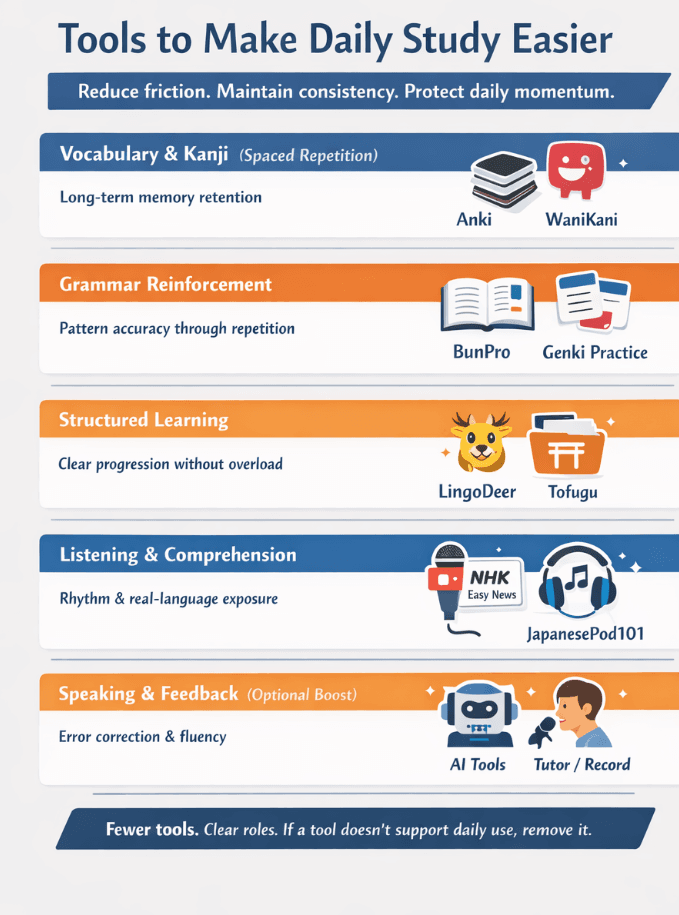
The right tools simplify daily study instead of adding complexity. Stacking helps you stay consistent, reduce friction, and focus on actual learning rather than managing apps.
SRS and Structure
- Anki (custom SRS control)
- WaniKani (kanji system with built-in spacing)
- BunPro (grammar SRS that keeps you honest)
Guided Learning
- LingoDeer (structured beginner ramp)
- Tofugu (kanji + study strategy resources)
Immersion + Listening
- NHK World Japan / NHK Easy News
- JapanesePod101
YouTube (when you need an explanation, not a vibe)
- Japanese Ammo with Misa
- Nihongo no Mori
- MattVsJapan (immersion-heavy perspective)
Why Weekly Planning Helps You Stay Consistent?
Weekly structure prevents:
- burnout from doing everything daily at full intensity
- the mid-beginner plateau (usually months 3–6), where you “study” but don’t progress
Targets that work:
- 7–10 hours/week total
- 6 structured days + 1 flexible day (recovery + backlog control)
Sample Weekly Breakdown
| Day | Focus | What to do |
| Mon | Grammar + Practice | Genki/Tae Kim + exercises + 5 sentences aloud |
| Tue | Kanji + Writing/Typing | WaniKani/Anki + typing practice |
| Wed | Listening + Comprehension | NHK Easy + shadow 3–5 lines |
| Thu | Speaking | Self-talk, roleplay, tutor, or recording |
| Fri | Vocabulary Review | SRS heavy day, clear weak cards |
| Sat | Reading | Graded reader, manga, short articles |
| Sun | Review + Quiz | Catch-up, test yourself, adjust next week |
Pro-Insight: Active immersion beats passive immersion (By a Lot).
15–30 minutes of active immersion (full attention, lookups, shadowing, notes) can equal hours of passive background audio in actual learning impact.
Passive input still plays a role, but it cannot replace active study.
Weekend Deep Dives
Weekends are best for output.
Options include:
- Speaking practice (self-talk or tutor)
- Writing short paragraphs
- Shadowing native audio
Even 10–15 minutes of output per day reduces fossilized errors and improves fluency.
Track Your Progress Weekly
Logs are tools for measurement, not motivation.
Track:
- minutes spent per task type
- SRS retention (watch for drops below ~85%)
- backlog size (danger zone: 150–200+ reviews)
- energy level and friction points
Celebrate wins that prove momentum:
- 50 kanji retained
- 10 grammar patterns used in sentences
- 30 days with zero missed exposure (the “zero-day rule”)
FAQs About Japanese Language Learning Schedules
Q. What is a realistic Japanese study schedule?
Daily: 30–45 minutes minimum, 75–120 minutes optimal. Weekly total: 7–10 hours with one flexible day.
Q. How long does it take to become fluent in Japanese?
FSI-level reality: around 3,800–4,000 hours to professional working proficiency (ILR 3) in a full-time training context. For self-learners without immersion, timelines often stretch into multi-year territory.
Q. Should I study Japanese every day?
Yes. Even 5–10 minutes protects recall chains and prevents review pile-ups.
Q. How do I balance kanji, grammar, vocab, and speaking?
Keep SRS + kanji + grammar short and consistent, then add listening + output later.
Final Thoughts
Japanese progress depends on steady, structured repetition. Irregular study routine quickly breaks retention and momentum.
Your job is not to “study harder.” Your job is to run a schedule that survives your life.
Keep your Japanese language learning schedule tight, trackable, and feedback-driven.
For additional speaking practice and feedback, AI-based tools such as Jolii can complement a structured study plan by adding guided output and correction.