Let’s be honest: when the internet says “get ready to learn Chinese buddy,” it’s not just roasting failed NBA players and washed-up execs.
What it really means is this:
“If you mess up here, hope you like ni hao because your next employer is in Shanghai.”
This meme is quietly telling you where power, money, and opportunity are drifting.
This guide decodes the viral “Get Ready to Learn Chinese, Buddy” meme, and reveals why it contains surprisingly great advice for beginners.
What Does this Meme Even Mean?
The Get ready to learn Chinese buddy meme signals professional wipeout, geopolitical submission, or economic displacement. It hits these stress triggers simultaneously.
The internet didn’t invent this one from thin air. It exploded after the 2019 NBA–China fallout when Daryl Morey’s tweet triggered China to basically tell the NBA: “Play nice or lose billions.”
In 2022, a parody graphic of Adam Silver saying “Get Ready to Learn Chinese, Buddy” turned the phrase into a modern template across Twitter/X, TikTok, and Reddit.
Reddit then franchised it across Valorant, Smash Bros, NFL forums, and anywhere else someone was failing spectacularly.

Why This Meme Took Off?
Because it compresses Western economic anxiety, cultural insecurity, and geopolitical FOMO into one spicy sentence.
- Economic dependence: China remains a multi-trillion-dollar manufacturing bedrock in 2025.
- Tech influence: EV batteries, AI hardware, robotics, 5G—China is either #1 or close behind.
- Cultural takeover fears: TikTok narratives, NBA controversies, and trade-war headlines fuel repeat meme cycles.
Whenever the West fumbles, the internet yells: “Go study Mandarin, king.” It’s satire—but also a market forecast.
The Real Talk – Why Learning Chinese Is Actually Smart?
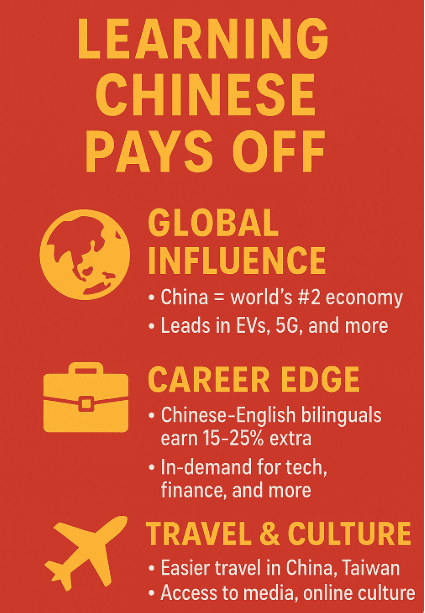
Learning Chinese is one of the smartest career moves you can make today.
Here’s why:
China’s Growing Global Influence
China is the world’s #2 economy by nominal GDP (around 19–20 trillion USD) and sits near the top in purchasing power. It dominates:
- EV batteries
- Advanced manufacturing
- Logistics and e-commerce
- Significant chunks of AI infrastructure and 5G
Also, the yuan has overtaken the dollar in China’s own cross-border settlements and is now a major trade finance currency.
The meme’s “better learn Chinese” subtext is backed by actual transaction flows.
Learning Chinese = Career Boost
Chinese–English bilinguals pull a documented 15–25% salary premium across tech and finance. In big hubs (SF, NYC), roles touching China can climb to 20–30% extra.
Cross-border finance (M&A, equity research, PE, corporate banking) often pays a 10–20% bump tied directly to Mandarin capability.
Roles that explicitly want Mandarin:
- Supply chain/operations for Asia-based manufacturing
- Engineers and PMs shipping China-facing products
- Business development for brands expanding in Chinese cities
- Government, intel, and policy roles needing Chinese linguists and analysts
You don’t need native-level. Functional “business Mandarin” moves your comp.
Travel, Culture, and Flex
Mandarin unlocks more than WeChat screenshots:
- Easier travel in China, Taiwan, and Singapore
- Direct access to C-dramas, music, news, and online discourse
- And yes, the social flex of ordering in Chinese and not sounding like a tourist with Wi-Fi.
Is Mandarin Really That Hard?
Mandarin feels hard because tones and characters trigger visual and auditory load.
The grammar load is minimal by European standards. Verbs stay in one form, nouns rarely change, and the language skips gender and articles entirely.
Time is handled through particles and context. Syntax stays largely Subject–Verb–Object. Difficulty shifts into hours of listening and symbol recognition, not memorizing verb tables.
What do the numbers say?
The Foreign Service Institute places Mandarin at roughly 2,200 classroom hours to reach professional proficiency.
A2 functional basics sit around 250–500 hours. B1 independence lands closer to 700–1,100 hours. At a sustainable 2–5 hours per week, A2 takes 1–2 years. B1 takes 3–5 years.
Sample Sentences to Get Started
Stop memorizing single words. Start learning useful phrases so that you can start speaking confidently from day one.
| English | Chinese (Pinyin) | Characters |
| Thank you | Xièxiè | 谢谢 |
| I’m good. | Wǒ hěn hǎo. | 我很好。 |
| I don’t understand | Wǒ bù dǒng | 我不懂 |
| Where’s the bathroom? | Cèsuǒ zài nǎlǐ? | 厕所在哪里? |
| Can you speak slower? | Qǐng shuō màn yī diǎn. | 请说慢一点 |
How to Actually Start Learning
- Use a structured beginner app such as HelloChinese for tones, pinyin, and early speaking.
- Layer a grammar-first option like LingoDeer for controlled progression.
- Add ten characters per week with spaced repetition.
- Watch subtitled Chinese content for listening volume..
Pro-Insight: The Meme Is Funny… Because It’s True
The meme isn’t just humor. It’s a behavioral funnel pushing people into actually learning Mandarin. Here are some stats:
- The global Chinese learning market hit roughly $7.4 billion in 2025 with about 12 percent annual growth.
- K–12 Chinese education reached about $4.96 billion in 2025 and is projected to reach $16.55 billion by 2035.
- University enrollments in the U.S. and U.K. are down 25–35 percent from prior peaks, but private digital learning continues to climb.
FAQs
Q. Is learning Chinese still useful in 2025?
A. Yes. Trade currency realignment, supply-chain consolidation, and tech manufacturing dominance reinforce Mandarin as a must-learn language.
Q. How long does it take to learn Chinese?
A. A2 basics take roughly 1–2 years part-time. B1 independence typically takes 3–5 years at the same pace.
Q. Is it better to learn Simplified or Traditional Chinese?
A. Simplified for most learners unless the target region is Taiwan or Hong Kong.
Final Thoughts:
“Get ready to learn Chinese buddy” isn’t just a meme anymore. It’s a career development roadmap disguised as a meme.
Economic gravity is drifting toward Mandarin-speaking markets. Salary premiums, trade access, and tech supply chains all reward anyone who can operate in Chinese, even at A2/B1.
If you want the easiest on-ramp, start with Jolli.ai and let the AI babysit your pronunciation while you pretend you’re not learning a geopolitically strategic language.