Introduction
French is famous for its elegance, but when you listen to real people chatting everywhere, you’ll hear a completely different side of the language. Everyday French is full of slang French words that rarely appear in textbooks but show up constantly in casual conversations. Mastering these French slang words will help you understand natural conversations beyond textbooks and scripted lessons.
For travel, friendships, or cultural immersion, understanding slang helps you sound more natural and understand what natives actually mean. These expressions carry cultural nuance, humor, and sometimes a little attitude, which is why they’re so popular.
French Slang Words – Quick Guide
French slang words are informal French expressions used in everyday speech rather than textbooks or formal settings. They help learners sound natural and understand real conversations.
In this guide, you’ll learn:
– 50+ common French slang words actually used today
– Everyday expressions heard in cafés, streets, and social media
– Youth slang and classic slang forms (including verlan)
– How and when to use slang safely in conversation
– Real dialogue examples with slang in context
Why French Slang Matters

The language spoken in everyday life is vibrant. Slang French words play a major role in shaping the tone, identity, and rhythm of modern French conversations.
Slang reflects what’s happening in society, youth culture, music, social movements, and even regional identities. In France, slang evolves quickly, especially in urban areas where multicultural influences mix together. You’ll hear expressions born from banlieue culture, rap music, internet trends, and even older dialects.
Understanding slang helps you:
- Follow conversations more easily, especially in informal settings
- Sound more natural and confident
- Understand humor and cultural references
- Connect with native speakers on a more personal level
- Avoid misunderstandings, because many slang words don’t translate directly
Slang is also a marker of belonging. Young people use it to signal identity or group membership, while older generations might use different expressions or avoid slang altogether. Some slang terms even become mainstream, while others remain niche or disappear quickly.
Another interesting aspect is that French slang often uses creative wordplay, such as reversing syllables (verlan), shortening words, or borrowing from other languages. This creativity makes slang fun, but sometimes confusing for learners.
Because slang changes so fast, learning it gives you a snapshot of contemporary French culture. It’s like tuning into the pulse of the language.
How to Use French Slang

Learning slang French words is exciting, but using them correctly requires nuance. Slang is informal by nature, and context matters a lot.
1. Match the tone of the conversation
Slang belongs in informal settings, chatting with friends, messaging, social media, or casual work environments. Avoid slang in formal situations such as:
- job interviews
- academic presentations
- customer service interactions
- conversations with older people (unless you know them well)
2. Listen before you speak
Native speakers often mix formal and informal language. Before using a slang term, pay attention to:
- who is speaking
- how close they are
- the tone (funny, serious, sarcastic, etc.)
Slang can sound rude if used in the wrong context.
3. Start with safe, widely used expressions
Some slang terms are harmless and used everywhere (e.g., cool, ouais, bof). Others carry strong cultural or regional connotations.
Begin with the neutral ones and build your confidence.
4. Understand that slang can be temporary
Because slang evolves quickly, some terms disappear after a few years. What’s popular in 2020 might sound outdated in 2025.
5. Avoid slang you don’t fully understand
Some words may look innocent but have offensive or sexual meanings. If you’re unsure, ask a native speaker or look it up, don’t guess.
6. Use slang to connect, not to imitate
Slang helps you fit in, but it shouldn’t sound forced. A single well-placed expression can elevate your French more than a long list of terms.
What to Avoid
- Using street slang with people you just met
- Mixing slang from different regions unless you know the nuance
- Overusing slang, it loses impact
- Copying slang from movies without knowing the context
- Using verlan or sensitive terms in professional settings
50+ French Slang Words Explained
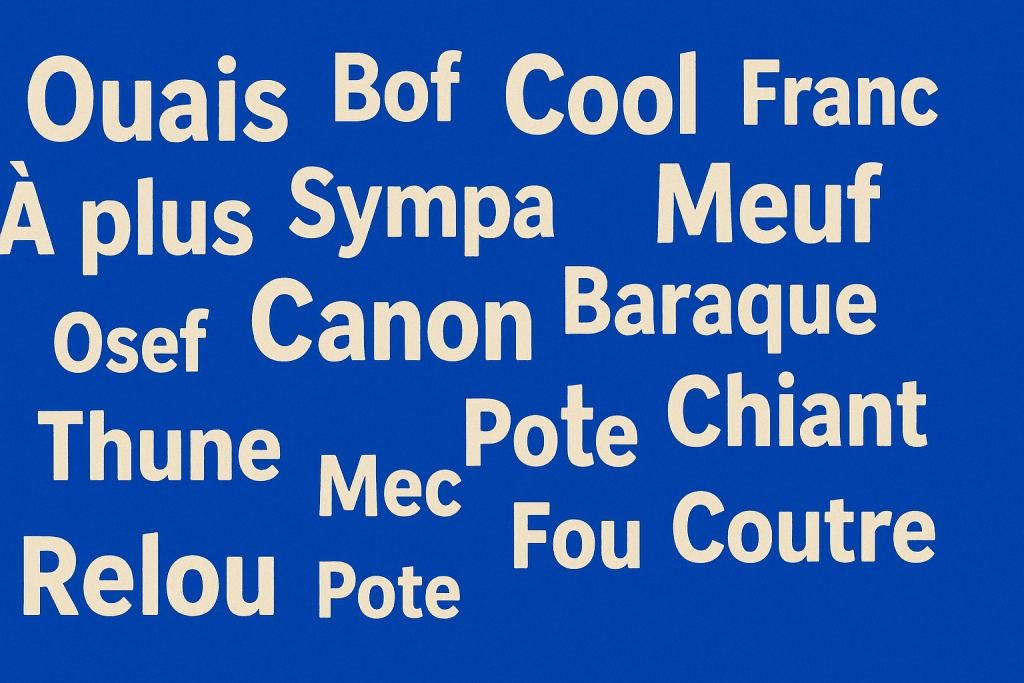
French conversations are full of slang French words, and many of them fall into recognizable categories.
Everyday Expressions
These are widely used and perfect for learners.
- Ouais – Yeah
- Ouais, ça marche. – Yeah, that works.
- Ouais, ça marche. – Yeah, that works.
- Bof – Meh / Not great
- Cool – Cool
- Ça roule ? – How’s it going?
- À plus – See you later
- À plus !
- À plus !
- Nickel – Perfect
Words for “Good” or “Nice”
- Chaud – Cool / exciting (literally “hot”)
- Le concert était chaud ! – The concert was amazing/exciting!
- Le concert était chaud ! – The concert was amazing/exciting!
- Sympa – Nice
- Il est vraiment sympa. – He’s really nice.
- Il est vraiment sympa. – He’s really nice.
- Top – Great
- C’est top ! – It’s great!
- C’est top ! – It’s great!
- Canon – Gorgeous / awesome
- Elle est canon. – She’s gorgeous.
- Elle est canon. – She’s gorgeous.
Words for “Bad” or “Annoying”
- Nul – Lame / useless
- Ce film est nul. – This movie is lame.
- Ce film est nul. – This movie is lame.
- La galère – A nightmare
- C’est la galère aujourd’hui. – It’s a nightmare today.
- C’est la galère aujourd’hui. – It’s a nightmare today.
- Relou – Annoying (verlan of “lourd”)
- Il est trop relou. – He’s so annoying.
- Il est trop relou. – He’s so annoying.
- Bidon – Fake / rubbish
- C’est bidon. – It’s rubbish.
- C’est bidon. – It’s rubbish.
Emotions & Reactions
- Mdr (short for Mort De Rire, literally meaning “death of laughter”) – Laughing (like “LOL” or more like “LMFAO”)
- Ouf – Phew / relief
- Ouf, c’est fini ! – Phew, it’s over!
- Ouf, c’est fini ! – Phew, it’s over!
- Wesh – Hey (very informal)
- Wesh, ça va ? – Hey, how’s it going?
- Wesh, ça va ? – Hey, how’s it going?
Words for Friends & People
- Pote – Buddy
- C’est un pote à moi. – He’s a buddy of mine.
- C’est un pote à moi. – He’s a buddy of mine.
- Meuf – Girl / girlfriend (informal)
- Ta meuf est cool. – Your girl is cool.
- Ta meuf est cool. – Your girl is cool.
- Mec – Guy
- Un mec sympa. – A nice guy.
- Un mec sympa. – A nice guy.
- Baraque – Big person/building (slang metaphor)
- C’est une vraie baraque. – He’s a real powerhouse (or “She’s a real powerhouse” if referring to a woman).
- C’est une vraie baraque. – He’s a real powerhouse (or “She’s a real powerhouse” if referring to a woman).
Money & Spending
- Fringues – Clothes
- J’ai acheté des fringues. – I bought some clothes.
- J’ai acheté des fringues. – I bought some clothes.
- Thune – Cash
- J’ai pas de thune. – I don’t have any cash.
- J’ai pas de thune. – I don’t have any cash.
- Pognon – Money
- Ça coûte cher, ça demande du pognon. – It’s expensive, it takes a lot of money.
- Ça coûte cher, ça demande du pognon. – It’s expensive, it takes a lot of money.
- Se faire des sous – To make money
- Il se fait des sous avec ça. – He makes money from that.
- Il se fait des sous avec ça. – He makes money from that.
Slang for “Lying / Being Fake”
- Baratin – Nonsense
- Arrête ton baratin ! – Stop with the nonsense!
- Arrête ton baratin ! – Stop with the nonsense!
- Mytho – Liar (short for mythomane)
- C’est un mytho. – He’s a liar.
- C’est un mytho. – He’s a liar.
- Pipo – Bullshit
- Que du pipo ! – It’s all bullshit!
- Que du pipo ! – It’s all bullshit!
Verlan (Reversed Syllables)
- Feume → Meuf (often used in verlan context)
- Ouf → Fou – Crazy
- Chelou → Louche – Weird
- C’est chelou. – It’s weird
- C’est chelou. – It’s weird
- Teuf → Fête – Party
- On va à la teuf ! – We’re going to the party!
- On va à la teuf ! – We’re going to the party!
- Zarbi → Bizarre – Strange
- C’est zarbi. – It’s strange.
- C’est zarbi. – It’s strange.
Words for “Cool / Impressive”
- Balèze – Impressive / strong
- C’est balèze. – That’s impressive.
- C’est balèze. – That’s impressive.
- Chanmé – Amazing (verlan of “méchant”)
- Ce truc est chanmé ! – This thing is amazing!
- Ce truc est chanmé ! – This thing is amazing!
- Mortel – Awesome (literally “deadly”)
- C’est mortel. – It’s awesome.
- C’est mortel. – It’s awesome.
Negative or Angry Expressions
- Putain ! – Damn! (more like the F word)
- Merde ! – Crap! / Damn!
- Foutre – To mess up (very informal)
- Tu as foutu en l’air tout ça ! – You messed it all up!
- Tu as foutu en l’air tout ça ! – You messed it all up!
- C’est chiant – It’s annoying
- C’est chiant ce truc. – This thing is annoying.
- C’est chiant ce truc. – This thing is annoying.
Expressions About Being Tired or Lazy
- Crevé – Exhausted
- Je suis crevé. – I’m exhausted
- Je suis crevé. – I’m exhausted
- H.S. – Out of order / dead tired
- À bout – At the end of your rope
Social & Internet Slang
- BG – “Beau gosse”, handsome guy
- TKT – “T’inquiète”, don’t worry
- Slt – Salut
- Pk – Pourquoi
- Srx – Sérieux
Miscellaneous Fun Slang
- Boulot – Job
- Kiff – Love / enjoy
- Je kiffe ce morceau. – I love this track.
- Je kiffe ce morceau. – I love this track.
- Oklm – Chill (from “au calme”)
- J’suis oklm. – I’m chilling.
- J’suis oklm. – I’m chilling.
- Gavé – Too much / Fed up (depending on the context)
- J’suis gavé. – He ate a lot (he’s stuffed). Or I’ve had enough!
- J’suis gavé. – He ate a lot (he’s stuffed). Or I’ve had enough!
Examples in Real Conversations
Slang French words become much easier when you see them used in natural conversations.
Conversation 1 – Friends Chatting
Notes
- Ça roule ? → casual way to ask “How’s it going?”
- Bof → “meh,” used when you’re not feeling great
- Teuf → verlan for “fête,” meaning party
- Mortel → awesome
Conversation 2 – Complimenting Something
A: Tu as vu le nouveau clip ?
B: Ouais, il est chanmé !
A: Carrément, la prod est balèze.
Notes
- Chanmé and balèze are positive slang
- Often used in youth culture, especially in music contexts
Conversation 3 – Expressing Annoyance
Notes
- Relou = annoying
- Chiant = irritating
- Very common in informal conversations
Conversation 4 – Talking About Money
A: Tu m’avance ? J’ai plus de thune.
B: Désolé, moi aussi je suis à sec.
A: Putain…
Notes
- Thune = money
- À sec = broke
- Putain = frustration (very informal)
Notes
1. Slang differs by region
Paris, Marseille, Lyon, and the banlieues (subborbs) each have their own slang flavors.
For example:
- Wesh is associated more with urban youth culture
- Ouf and chelou are widely used but originated from verlan
2. Verlan is a major part of youth identity
Verlan (reversing syllables) is used to sound “in” or “cool.” It has been popular since the 80s and continues today.
3. Rap culture influences slang heavily
French rap artists introduce new slang that spreads quickly among young people. Words like kiffer, bolos, or tarpin gained popularity through music.
4. Some slang has strong social or political connotations
Certain expressions relate to specific neighborhoods or backgrounds, so they carry more meaning than just vocabulary.
5. Slang is fluid and constantly evolving
What’s trending today might be old-fashioned tomorrow, which makes slang exciting but unpredictable.
Summary

Learning slang French words opens a door into the real rhythm of everyday French. Beyond grammar and textbooks, slang reveals how people laugh, complain, bond, and express emotion in a more natural and unfiltered way. Slang is alive, creative, and deeply embedded in social identity. It reflects generational trends, musical influences, regional subtleties, and even social tensions. Because it evolves so quickly, mastering it requires both curiosity and exposure. That is why learners need to progress much faster.
Takeaway:
Understanding French slang is about sensing the tone, the context, and the relationships between speakers. When you grasp the nuance behind expressions you start to hear the language as natives do. And the best way to strengthen this skill is through consistent practice with materials that reflect real-life usage rather than scripted textbook dialogue.This is where tools like Jolii AI come in. It provides conversations, examples, and practice scenarios, up-to-date language, including the kind of slang you actually hear on the streets and online. When you integrate slang into your learning journey thoughtfully and gradually, you move closer to understanding French as it is truly spoken, lively, expressive, and full of personality.