Saying German numbers from 1 to 100 is simple once you understand the core system.
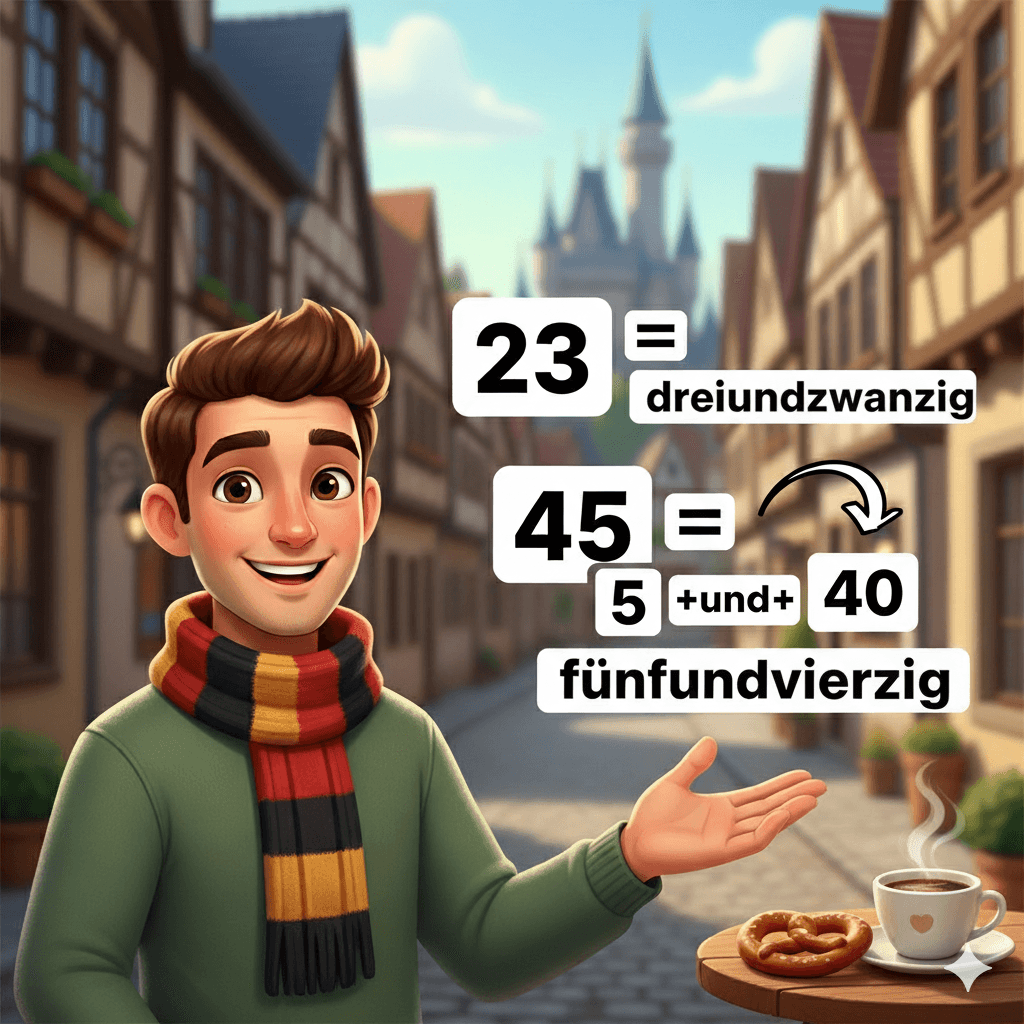
Compound numbers above 20, like dreiundzwanzig (twenty-three), often intimidate learners.
In reality, they consistently follow a predictable, simple pattern:
ones place + und (and) + tens place.
In this comprehensive guide, you will:
- Find a full, easy-to-read list of all German numbers from 1 to 100.
- Learn specific rules and pronunciation for numbers above 20.
- Get the simple tricks needed to say and remember every number instantly.
How To Say Basic German Numbers 0-12
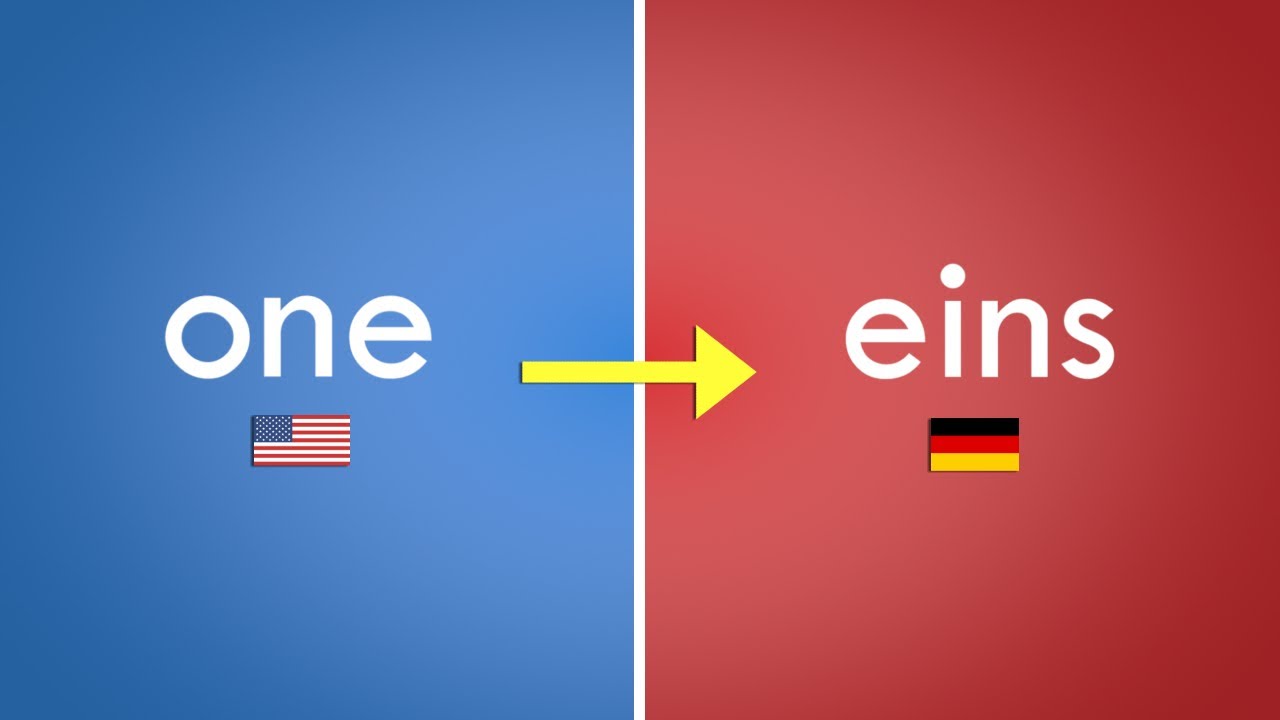
Basic German numbers start from 0 and end at 12. You need to oil your memory muscles because some actual memorization is necessary to learn the German numbers from 1 to 12.
But here is my take on how to memorize these numbers; some of them have a close resemblance to their English counterpart.
| Number | German Word | The Secret Tip (Your Voice) |
| 1 | eins | eins → pronounced like “ines” (rhymes with ‘lines’) |
| 2 | zwei | The German ‘Z’ is always a ‘TS’ sound—like the end of the word ‘cats’! |
| 3 | drei | Simple! It sounds almost exactly like the English word ‘dry‘. |
| 4 | vier | Remember that in German, ‘V’ sounds like an English ‘F’ (fee-r). |
| 5 | fünf | The ‘ü’ is tricky: make an ‘ee’ sound but with your lips rounded. |
| 6 | sechs | sechs → pronounced “zeks”, starting with a ts/z sound. |
| 7 | sieben | Emphasis on the first syllable (ZEE-ben). |
| 8 | acht | That ‘ch’ sound is the classic German throat-clearing sound. Practice it! Acht=8=Eight, how similar. |
| 9 | neun | Easy to remember—it sounds very close to the English word ‘nine’. |
| 10 | zehn | Again, starts with the ‘TS’ sound and has a long ‘ay’ vowel. |
| 11 | elf | Seems like the word itself. |
| 12 | zwölf | Starts with ‘TS’ and that tricky ‘ö’ (like the ‘i’ in ‘bird’ but with rounded lips). |
Our goal is to ensure you never stumble over German numbers again!
Tip: Learn these 12 numbers by heart, and the rest of the German counting is —- super easy.
Quick tip: If memorizing numbers feels tricky, Jolii.ai can help. It transforms YouTube videos into interactive lessons, so you can hear and repeat German numbers in real-life situations—making learning intuitive and fun.
German Numbers 13–20 (Patterns & Exceptions for Teenagers)
Numbers 13 to 20 follow a simple formula or trick: a suffix “zehn” is added at the end.
Say the lowest number first, followed by zehn.
The Rule is simple: Number + Zehn (10).
For example:
In English, we say 13= three+ teen (thirteen, with a slight spelling change)
In German, we say 13= drei+zehn(dreizehn)
The rest all follow the same pattern with slight changes in spelling for just a few of them.
| Number | Pattern | German Word | Translation/Your Voice Tip |
| 13 | 3 + 10 | Dreizehn | Straightforward: Three-Ten. No tricks here! |
| 14 | 4 + 10 | Vierzehn | Four-Ten. Just stick vier onto zehn. |
| 15 | 5 + 10 | Fünfzehn | Five-Ten. The fünf keeps all its letters. |
| 16 | 6 + 10 | Sechzehn | Wait! Where did the ‘s’ go? Sechs drops the ‘s’ before joining zehn. |
| 17 | 7 + 10 | Siebzehn | And where did the ‘en’ go? Sieben shortens dramatically—it just becomes Sieb-. |
| 18 | 8 + 10 | Achtzehn | Eight-Ten. Back to the easy pattern! |
| 19 | 9 + 10 | Neunzehn | Nine-Ten. Perfect! |
| 20 | The Exception | Zwanzig | Plot Twist! This one is a new base number for the next phase. Notice the ‘-tig’ ending (pronounced “-tsik”) |
Memory hack: 16 and 17 drop letters (sechzehn, siebzehn). Tiny quirks, nothing to stress over.
Number 20 is a new family, so it has the name Zwanzig.
Learn the German Tens 20, 30, 40….100
Learning the tens in German gives you a complete hold of counting from 20 to 100, but there are a few exceptions. I will mention the exceptions along the way, but let me tell you one thing, Zig is your best friend in learning German tens.
20= Zwanzig(Its own name, but still has the zig at the end)
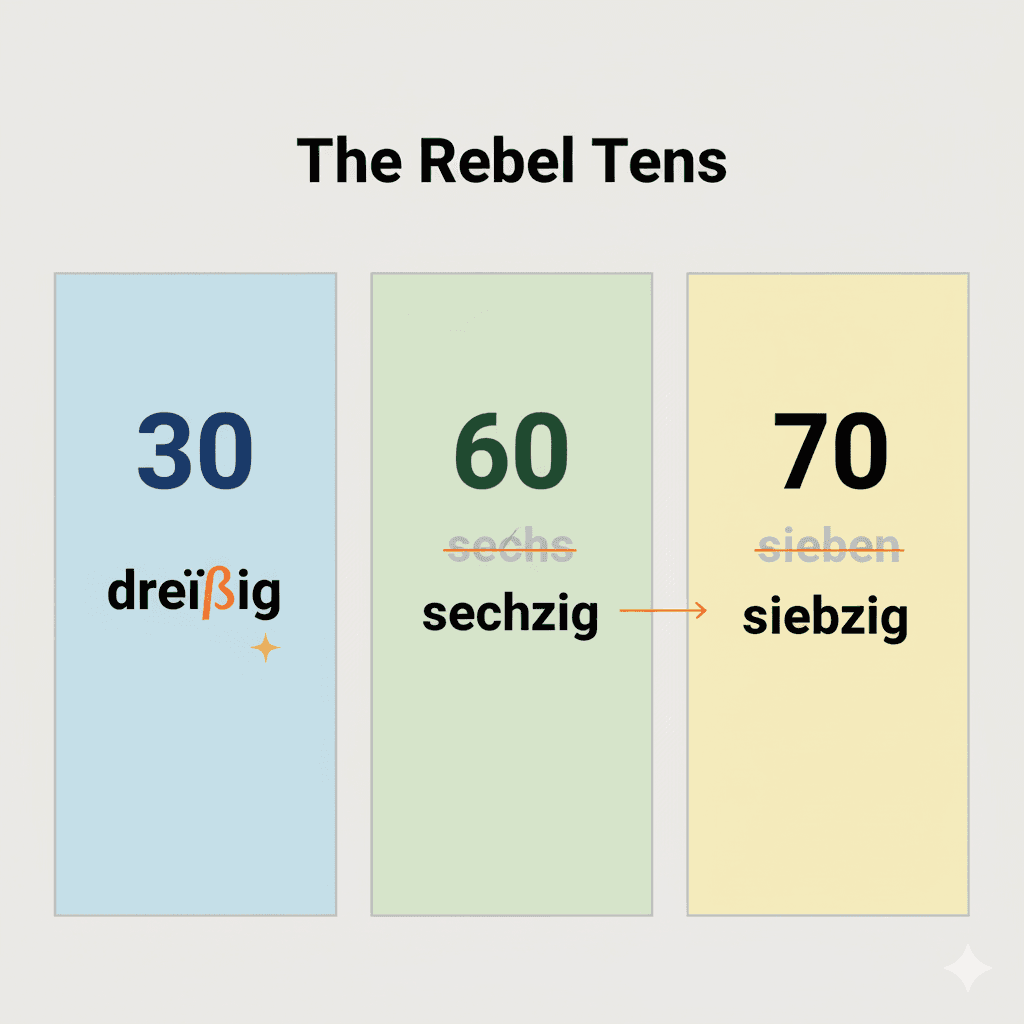
30= dreißig (The biggest exception)
40= vier+zig= vierzig
50=fünf+zig= fünfzig
60=sech+zig=sechzig(just skip the ‘s’ from ‘sechs’)
70=sieb+zig=siebzig( Skip the ‘en’ at the end of ‘sieben’)
80=acht+zig=achtzig
90=neun+zig=neunzig
100=eins+hundert=einhundert (s from the eins is removed)
| Number | German Word | The Exception and Voice Tip |
| 20 | zwanzig | This is the starting point for our backward counting system. |
| 30 | dreißig | The Big Exception: This is the only number to use the ß (Eszett). It stands out and refuses to use the normal -zig! |
| 40 | vierzig | Back to the pattern: vier (4) + zig. Nice and easy. |
| 50 | fünfzig | Fünf (5) + zig. See? Once you know the single digits, these are simple. |
| 60 | sechzig | The ‘s’ Disappears Again! Just like with 16 (sechzehn), the ‘s’ drops off sechs (6) here. Watch out! |
| 70 | siebzig | The Shortening Act! Like 17 (siebzehn), sieben (7) shortens to sieb- here. Always a little dramatic. |
| 80 | achtzig | Acht (8) + zig. Perfectly predictable. |
| 90 | neunzig | Neun (9) + zig. You’ve almost cleared all the tricky spots! |
| 100 | hundert | The grand finale! Often said as just hundert, or sometimes einhundert. |
How to Form German Numbers 21–99 (The “Flip” Rule)
No fluff here, just learn this pattern of making German numbers from 21 to 99.
Germans get cheeky. Instead of “twenty-three,” they say three-and-twenty → dreiundzwanzig. Weird? Absolutely. Fun? Totally.
ones + “und” + tens
The number in the ones place comes first, followed by ‘und’, and at the end, there is the particular tens name.
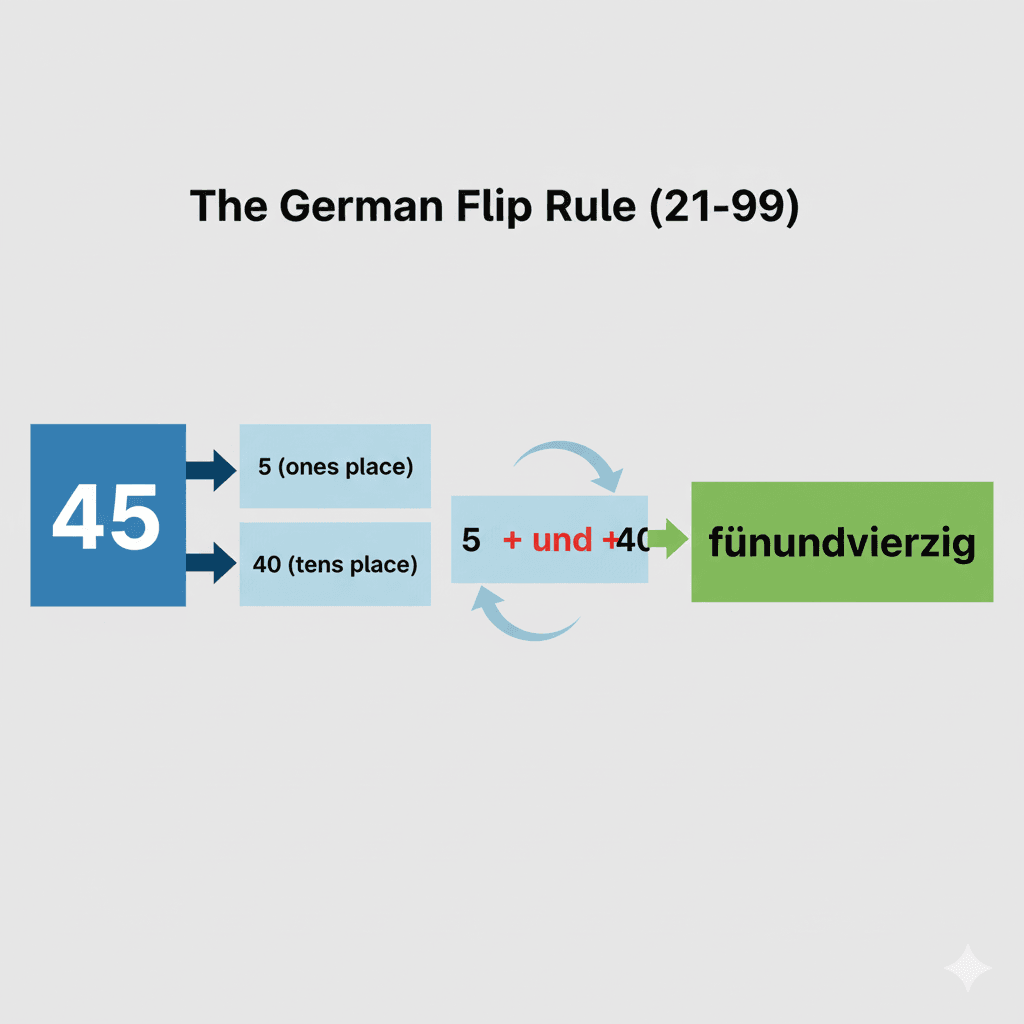
Let’s see the examples
23= Here the number in the ‘ones’ places is ‘drei’ and the particular tens number is zwanzig. So, the number according to the structure above will be:
- 23=‘Drei’ + und + zwanzig=dreiundzwanzig
- 34= vier+und+dreißig =vierunddreißig
- 41=eins+und+vierzig=einundvierzig( the ‘s’ at the ‘eins’ removes)
- 56= sechs+und+fünfzig=sechsundfünfzig
- 72 = zwei + und + siebzig = zweiundsiebzig
- 99 = neun + und + neunzig = neunundneunzig
Complete List of German Numbers 1–100 (Compact Table)
The list is a hands-on guide for all the German numbers you have learned.
Use German Numbers To Tell Prices, Phone Numbers, and the Year
Let’s put the German numbers to work.
Saying Prices In German
Example: €29,99 → neunundzwanzig Euro neunundneunzig(the comma in German numbers is the decimal number)
How Germans Tell Their Phone Numbers
Germans read in pairs:
0151 73 40 11 → null-eins-fünf-eins, dreiundsiebzig, vierzig, elf
How Do You Tell Which Year It Is in German
2024 → zweitausendvierundzwanzig
2025 → zweitausendfünfundzwanzig
2026 → zweitausendsechsundzwanzig
If you’re ready to turn these number rules into real practice, the Goethe-Institut offers free interactive German practice exercises. After you are done, we have more German language exercises to assess your comprehension skills.
FAQs
Q: Why do Germans reverse numbers?
Germans reverse numbers because, before the Arabic numerals, many Indo-European languages used this pattern. The number in the ones place is spoken first, followed by the number in the tens place. German still follows the same historical way of saying numbers.
Q: Why 30 in German is dreißig and not dreizig?
Dreißig is the only exception, and it is not dreizig because there was a shift in the sounds of consonants from High German to other Germanic languages. The air flow just supported the Dreißig better than dreizig.
Q: Why do 16 and 17 drop letters in German numbers?
It is the same as fifteen drop letters too in English numbers. So sechs (6) shortens to sech in sechzehn, and sieben (7) shortens to sieb in siebzehn.