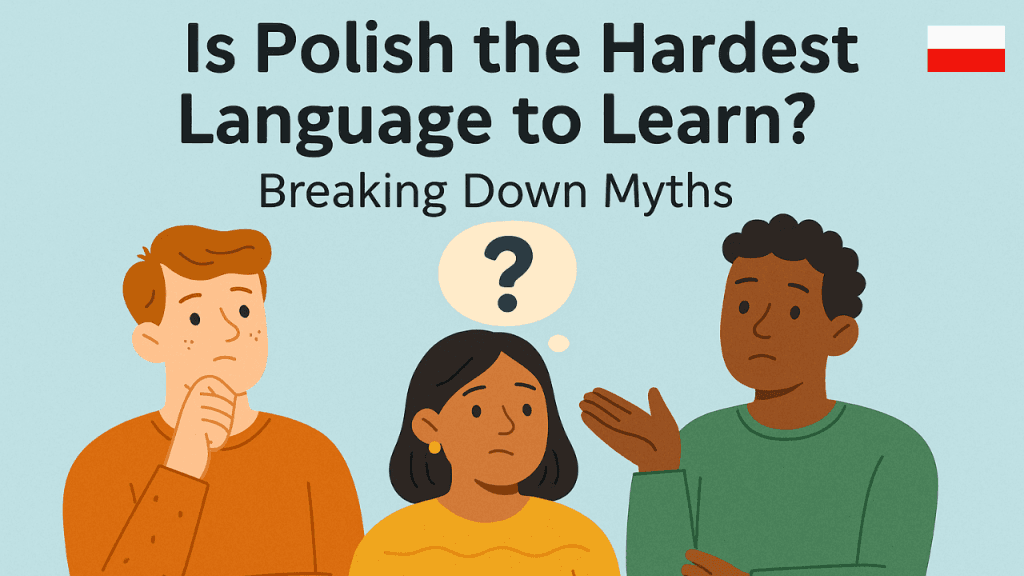
Is Polish genuinely the hardest language to learn? Or are we just overwhelmed by its quirks? Let’s break it down into bite-sized knowledge.
The Polish language has seven grammatical cases, 17 noun declension types, and a challenging pronunciation. While Polish has its challenges, there is no one language which is universally hard to learn, it depends on the learner’s background.
Polish is the official language of Poland, it is widely spoken and understood in a number of countries. It is spoken by some communities in countries including Slovakia, Ukraine, Latvia, East Germany, Northern parts of the Czech Republic, Western Belarus and in some parts of SouthEast Lithuania, as a second language.
With such a large number of Polish speakers, it is hard to consider it to be the hardest language to learn. 38 million Poles speak Polish in Poland alone, and many millions are dispersed throughout the world.
It might be challenging for people to learn Polish because of wide language differences from their native language.
Ready to tackle Polish? Let’s explore why some aspiring learners find it difficult to learn Polish by knowing the necessary Polish complications but simplified. Start your Polish learning journey today with tools designed for beginners—click here to explore.
Why There’s No Universal ‘Most Difficult Language’
First, an essential fact to keep in mind is that a newborn has the potential to learn any language to fluency with ease, regardless of how tricky the grammar is, how many exceptions there may be, and its pronunciation rules. For adults, however, learning a language can be more or less challenging depending on a few factors:
Your native language(s).
It’s pretty straightforward: the closer your target language is to your native language (or any language you are fluent in), the easier it will be to learn it. Language pairs like Spanish and French, German and Dutch, and even Russian and Polish all share some similarities. For native Russian speakers and for speakers of other Slavic languages, Polish might not be the hardest language to learn, given the overlapping grammar rules and vocabulary terms.
Past language experiences.
The more languages you learn, the easier it becomes to pick up new ones. If you have already learned other languages, adding further languages might feel easier and more intuitive. For example, if you have already studied Russian in school, even if it was a long time ago, you probably won’t feel like Polish is the hardest language to learn in the world. Even having studied Latin could help you understand Polish declensions better.
Personal attitudes.
Different languages pose different challenges, and this can change how difficult you perceive a language. For instance,
- If you are a visual learner, Chinese characters might be easier for you.
- If you learn well by listening, then tonal languages like Thai and Mandarin will come more naturally to you.
- If you are good at memorising long grammar tables, then Polish declensions might not look that tricky after all.
Motivation:
Learning a language requires a considerable investment of both time and energy. In the end, whether you will learn successfully or not often depends on your motivations for learning the language. Without a strong reason to learn, even an “easier” language can feel impossible to acquire. Polish might not feel like such a burden to learn if you have clear goals and are willing to invest time in it.
Most Importantly: The Right Tools.
Sometimes, a good teacher can make all the difference and convert a difficult grammar-heavy language into an enjoyable learning experience, helping students learn it effortlessly. In the same way, choosing the right language-learning app is crucial in simplifying the language and making it easier to understand. A language-learning app like Jolii adapts to you, proposing exercises that are right for your level while taking into account your goals, native language, and learning style. With Jolii, you can turn the hardest language to learn into a fun learning journey!
Why Learning Polish Is So Hard: Common Challenges
Why is Polish considered one of the hardest languages to learn? Here are four aspects of the Polish language that can be challenging for aspiring Polish speakers, often making it feel like the most difficult language to learn in the world.
In the Polish language, nouns change according to their function in the sentence. This process is called declension, and it involves seven different cases. Let’s take, for instance, the word kot (cat). It’s form can change in seven different ways:
1. Polish Nouns: Cases.
| Case | Form | Example Sentence |
| Nominative: Subject of a sentence. | Kot | To jest kot. (This is a cat.) |
| Genitive: Possession or negation. | Kota | Nie widzę kota. (I don’t see the cat.) |
| Dative: Indirect object. | Kotu | Daj mleko kotu. (Give milk to the cat.) |
| Accusative: Direct object. | Kota | Nie widzę kota. (I don’t see the cat. |
| Instrumental: Means or tools, and after certain prepositions. | Kotem | Bawię się kotem. (I’m playing with the cat.) |
| Locative: Used with specific prepositions to indicate location. | Kocie | Mówię o kocie. (I’m talking about the cat.) |
| Vocative: Addressing someone directly | Kocie | Kocie, chodź tutaj! (Cat, come here!) |
Polish nouns might look challenging, but there are some advantages. The language has no articles, and thanks to declensions, it requires fewer prepositions.
2. Polish Genders: Understanding Polish Genders: How Many Genders Polish Language Has
There is not only one declension because Polish nouns have different genders. The declension of a word depends primarily on its gender. Here is an overview:
Three Genders in Singular:
- Masculine (with a distinction between animate and inanimate),
- Feminine
- Neutral.
Two Categories in Plural:
- Masculine Personal
- Non-Masculine personal (objects, animals, and female persons).
And here is an example table for the nominative case:
| Gender in singular | Example | Plural category | Example |
| Masculine Animate | Pies (dog) | Masculine Personal | mężczyźni (men) |
| Masculine Inanimate | Stół (table) | Non-Masculine Personal | Stoły (tables) |
| Feminine | książka (book) | Non-Masculine Personal | książki (books) |
| Neuter | Jabłko (apple) | Non-Masculine Personal | Jabłka (apples) |
How to Master Declensions and Genders
Getting used to all genders and declensions can feel overwhelming. In order to learn them all, we recommend the following approach:
- Start with one gender or case, for instance, masculine accusative.
- Practice it thoroughly using real-life sentences
- Once confident, gradually introduce more cases and genders.
In this way, you will learn the cases and genders one by one while keeping an overview of the overall system.
3. Polish Verbs: Perfective vs. Imperfective aspect
In Polish most of the verbs have two aspects, which means a different verb is used according to the situation. Here is an example for the verb to write:
| Aspect | Infinitive | Example |
| Imperfective: used for ongoing or habitual actions | Pisać (to write) | “Piszę list.“ (I am writing a letter.) |
| Perfective: used for completed or one-time actions | Napisać (to write) | “Napiszę list.“(I will write a letter. / I will have written a letter.) |
The imperfective form “pisać” focuses on the process of writing, while the perfective form “napisać” emphasizes the completion of the action.
Verbs of motion like iść (to go on foot), chodzić (audio clip 28) (to walk, to go habitually), can also pose some challenges for Polish learners. Moreover, verbs in future, past, and conditional forms change according to the gender of the person they refer to.
For example:
| Past tense (Perfective) | Example |
| Masculine | Napisałem list. (I wrote a letter.) |
| Feminine | Napisałam list. (I wrote a letter.) |
Fewer Verb Tenses Than English
Although the aspect of a verb might look challenging at first, Polish actually has fewer verb tenses than English. It only has 5 (as compared to 16 in the English language):
- present tense
- past tense
- future tense
- conditional
- imperative mood
This makes Polish verb tenses simpler to grasp overall, even if mastering them requires practice with perfective and imperfective aspects.
Polish Pronunciation: So many consonants!
The Polish alphabet has 32 letters, including 8 vowels and 24 consonants. There are a few extra letters with diacritics: ą, ć, ę, ł, ń, ó, ś, ź, ż and sounds that can be tricky and difficult to distinguish for a non-native speaker.
Another challenge is the common consonant clusters, which make words difficult to pronounce. Take, for instance, the sentence:
Czy wszystko rozumiesz? (Do you understand everything?)
The combination of consonants in “czy” and “wszystko” might be difficult for learners to pronounce smoothly.
The good news is that Polish is largely written as spoken, with very few exceptions. This means that once you know a few pronunciation rules, you will be able to read almost any word.
Struggling with Polish pronunciation? Master it with our interactive audio tools—try it here.
Why Learn Polish?
Polish is spoken by West Slavic groups originated from Indo-European descent. Since Poland has rich cultural diversity and a deep heritage, it connects Slavic people with people all around. It is one of the most accessible Slavic languages, so these things make it important to learn Polish.
Is Polish the Hardest Language To Learn For English Speakers
Polish might be particularly tricky for English speakers to learn, especially because of its complex cases, gender distinctions, verb aspect, and pronunciation rules, which English speakers are not accustomed to. Below is a comparison table featuring the two languages to illustrate and summarize why Polish can be the hardest language for English speakers to learn.
Comparison Table Between Polish & English Language Learning
| Feature | Polish | English |
| Cases | 7 | None |
| Gender distinctions | 5 | None |
| Verb tenses | 5, two aspects | 16 |
| Alphabet | 32 letters (extra letters: ą, ć, ę, ł, ń, ó, ś, ź, żnot included: q,v,x) | 26 letters |
| Phonetic consistency | high | low |
Hands-on-Practice To Improve Your Polish
Learn 10 Easy Polish Sentences To Impress Your Polish-Speaking Friends
You meet different people in your life, and among them, you may have some Polish-speaking friends. Here is a collection of 10 easy Polish sentences with their audio so you learn actual Polish pronunciation. Impress your Polish friends today! Practice these sentences with our app—download now for free!
| English | Polish |
| Good morning | Dzień dobry |
| Nice to meet you | Miło mi cię poznać |
| Thank you | Dziękuję |
| You’re welcome | Proszę bardzo |
| Cheers | Na zdrowie |
| Sorry, I don’t speak Polish | Przykro mi, nie mówię po polsku |
| Sorry | Przykro mi |
| I don’t understand | Nie rozumiem |
| Bye | Cześć |
| Good night | Dobranoc |
Learn How To Say Polish Numbers From 1 to 10
How about learning basic Polish words, let’s start with the basics… counting! Here you are going to learn how to say Polish numbers; the audio here will help you along. Happy learning.
Strategies To Help You Understand Polish Better
Language learning happens when you are in the environment to speak that particular language. The more you speak, the better you become as a speaker. Speaking particularly with native speakers takes you closer to their native language where you can understand the accent and will learn the conversational language. This is a general rule for learning any language at a good pace.
Now we’ll consider strategies which can help us learn the Polish language.
- Start learning the untraditional way, do not learn the rules first.
- Learn nouns and sentences first, and leave grammar for a later time.
- Immerse yourself in fun and immersive learning of Polish with media.
- Use an app like Jolii to help you understand vocabulary better.
- Work on sounding consonant clusters to familiarize yourself with pronunciation.
Conclusion
Polish language has a strong cultural impact for being a Slavic language, and people find it difficult to learn, which might be true for those coming from different language learning backgrounds. It is not safe to say that Polish is the hardest language to learn in the whole world, but it has some hard setbacks that will make you struggle in your learning.
One of the best hacks to learn Polish is to get an immersive strategy. Don’t just follow textbooks, but try out different courses and YouTube videos in Polish, make friends with Poles and use Jolii, which is your best buddy on your road to learn Polish as a complete beginner.
FAQs
Q: Why do they say that Polish is a dead language? Is it true?
A: The statement that Polish is a dead language is completely false. Polish is widely spoken not only in Poland but in its neighboring countries where millions of people speak and understand it even today. One reason people say it is a dead language is that they might think of its future as being extinct, as they have seen other Slavic languages disappearing. However, at the moment, Polish is not considered at risk.
Q: Is Polish or Japanese more difficult to learn?
A: Saying that a language is hard or difficult to learn is a subjective thing. Polish has a complex mix of grammar and pronunciation rules, while Japanese has a unique writing style with its honorifics which are complex to understand. You can get help from the Jolii app in learning Polish or Japanese pronunciations and vocabulary.
Q: What makes a language difficult to learn?
A: The most difficult thing to learn in a language can be its grammar. Learning the verbs and using them correctly in spoken language is a difficult thing to handle.
Q: How to learn Polish better?
A: The best way to learn better Polish is to start speaking it with natives. Immersing yourself in the culture and being part of the language itself is the best way to get sharper at any language.
BONUS: 16 Easy Polish Words That You Already Understand