You finish an episode. You understood almost everything. So you feel like you’re making progress.
But what if I asked you to speak about what you just watched? You’d probably freeze.
That gap is normal. It’s also fixable. Here’s what to do about it.
TL;DR
- Watching Netflix can improve listening, vocabulary, and comprehension.
- But if you stop when the episode ends, progress slows.
- Real fluency develops when you use what you watched immediately after watching.
The best post-Netflix routine is simple:
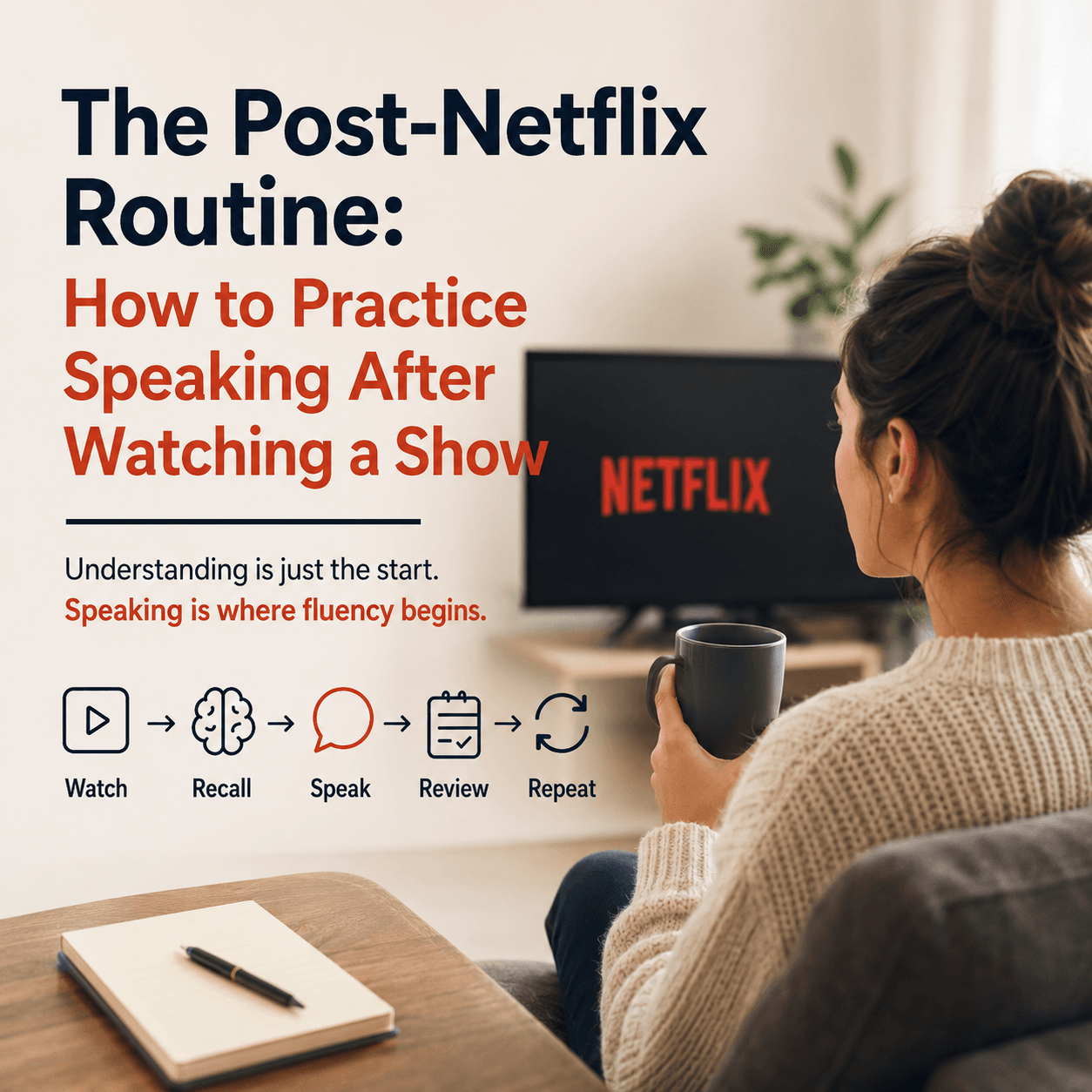
Watch → Recall → Speak → Review → Repeat
Why Watching Alone Is Not Enough
Many learners feel productive after watching a show in their target language. They:
- Recognize words
- Follow the story
- Hear natural pronunciation
- Feel immersed
And that is valuable. i have also done it many times. But comprehension alone doesn’t build speaking fluency.
During the episode, your brain is mostly receiving language. But fluency requires producing it — retrieving words, forming sentences, reacting in real time. Skip that step, and you end up understanding far more than you can actually say.
This is the input-output gap, and it’s the single biggest reason “I watch a lot of Netflix in [language]” doesn’t reliably turn into “I can speak [language].”
Why the First 10 Minutes After Watching Matter Most
Right after an episode, the language is fresh. Your brain still holds:
- Phrases you just heard
- Scenes you remember
- Emotions from the story
- Pronunciation patterns
This is the best moment to activate the language before it fades. Use the content immediately, and retention increases dramatically. Wait until tomorrow, and most of it is already gone.
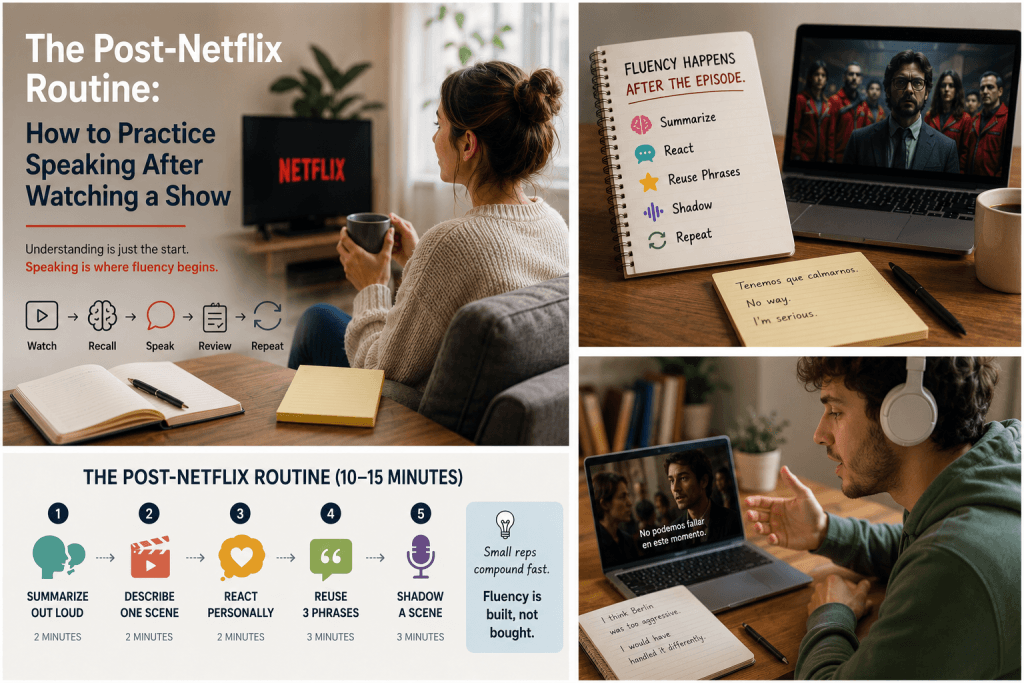
The Post-Netflix Routine (10–15 Minutes)
1. Summarize the Episode Out Loud (2 minutes)
Without notes, explain what happened, who did what, and what the main conflict was. Use simple language — it doesn’t need to be perfect. This trains recall and spontaneous speaking.
2. Describe One Scene in Detail (2 minutes)
Pick one memorable scene. Explain where they were, what people said, what the emotions were, and what happened next. This builds narrative fluency — the skill of telling a story in real time, not just answering questions.
3. React Personally (2 minutes)
Give your own opinions: Did you like it? Who was wrong? What would you have done? Was it realistic? This is what trains real conversation skills, because reactions require language you generate yourself, not language you’re recalling.
4. Reuse 3 New Phrases (3 minutes)
Take three expressions you heard and use each one in your own sentence. For example, if you heard “No way,” “I’m serious,” or “Leave me alone” — build a new sentence with each. This turns recognition into ownership.
5. Shadow One Short Scene (3 minutes)
Replay 20–30 seconds. Repeat along with the actors, copying rhythm, tone, pronunciation, and emotion. This is what improves speaking flow — not just accuracy.
Example Routine After Watching La Casa de Papel
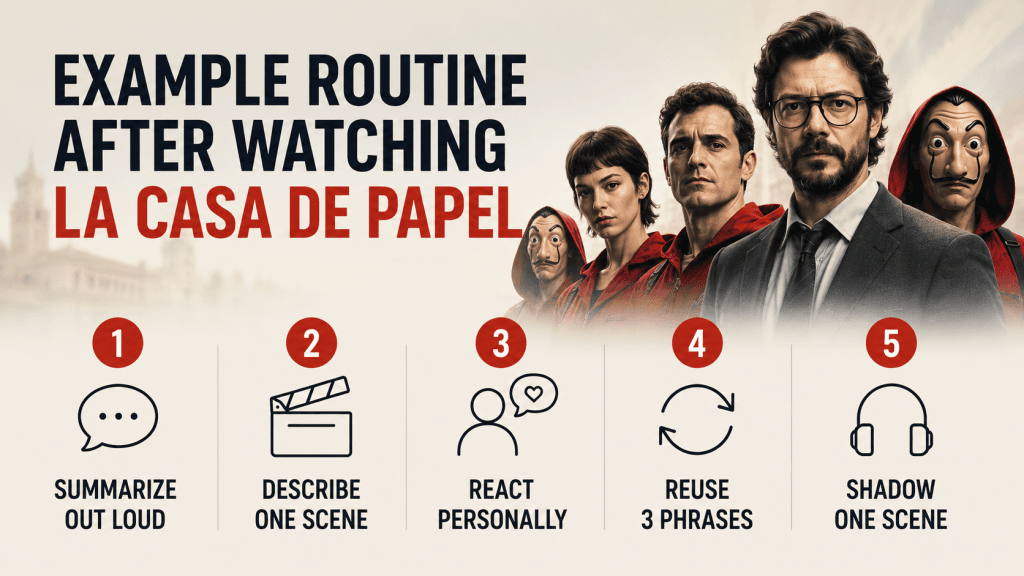
Here’s what the full routine looks like in practice, using a single episode of La Casa de Papel (Money Heist) — one of the most-watched Spanish-language shows for exactly this kind of practice.
1. Summarize out loud: El Profesor explicó el plan, pero Berlín no estuvo de acuerdo y discutieron frente al grupo. (“The Professor explained the plan, but Berlin disagreed and they argued in front of the group.”)
2. Describe one scene: Pick the scene where the tension peaks — the room, who’s standing where, the tone of voice, the silence right before someone speaks. Narrating it forces you to reach for descriptive language you wouldn’t use in a simple summary.
3. React personally: Creo que Berlín fue demasiado agresivo. Si yo fuera el Profesor, habría hablado con él en privado. (“I think Berlin was too aggressive. If I were the Professor, I would have talked to him privately.”) Notice this pulls in a different structure than the summary step — conditionals, opinions, hypotheticals.
4. Reuse 3 phrases you heard in the episode:
- Tenemos que calmarnos. → “We need to calm down.” Reuse: “I need to calm down before meetings.”
- No hay otra opción. → “There’s no other option.” Reuse: “There’s no other option, we have to leave now.”
- Confía en mí. → “Trust me.” Reuse: “Trust me, this plan will work.”
5. Shadow one scene: Replay 20–30 seconds of the argument between the Professor and Berlin. Match their pacing and emotional intensity — this is a show built on tense, high-stakes dialogue, which makes it unusually good shadowing material.
This is also the kind of practice Jolii’s Spanish activities for La Casa de Papel are built around — pulling real lines and scenes from the show and turning them into structured practice instead of leaving it up to you to remember to do it.
Why This Works Better Than Watching More Episodes
Many learners think: more Netflix = more progress. Not always. The more you watch, the more you improve. But is it the best way to improve?
One episode plus speaking practice often beats three passive episodes, because production strengthens memory faster than exposure alone. Ten focused minutes of output can do more for your fluency than an extra hour of input.
Common Mistakes After Watching
- Immediately starting the next episode — no activation happens, so nothing gets reinforced.
- Looking up 50 words — too much friction, it gets boring and overwhelming. You’ll quit before you speak a single sentence.
- Writing only — useful, but slower than speech for building fluency.
- Waiting until you feel “ready” — speaking readiness comes from speaking, not from more preparation.
The 30-Day Fluency Effect
If you do 10 minutes of speaking after every episode, over time:
- Vocabulary becomes usable, not just recognizable
- Response speed improves
- Confidence rises
- Passive knowledge becomes active speech
Small reps compound fast. This is a habit, not a project.
How Jolii Makes This Easier
Most learners know they should practice after watching. They just don’t know how, or don’t have anyone to practice with.
Jolii turns Netflix, YouTube, and music into structured speaking practice immediately after you watch. It helps you review key scenes, reuse phrases, answer speaking prompts, and practice out loud with AI — helping you turn that passive listening into active speaking.
That’s where the learning actually begins!
FAQs
Can Netflix alone make me fluent? Usually not. Of course it is helpful but it is best when paired with other tools that builds comprehension more than speaking.
How long should post-watch practice be? You don’t need to spend hours reviewing, searching for vocabulary, writing down words. Even 10 minutes is powerful. It gives a boost to your language skills while keeping you motivated.
What if I forget everything? That’s exactly why recall practice works. You will forget words if you don’t practice them actively after having acquired them.
Final Thoughts
Watching a show can expose you to real language. But fluency grows after the episode — not when you consume more, but when you use what you just consumed.
So next time Netflix ends, don’t just press next episode. Speak first.