Quick Answer (TL;DR)
You won’t become fluent just by watching Netflix—but with structured immersion, 30 days is enough to train your brain to recognize patterns, improve comprehension, and start speaking more naturally.
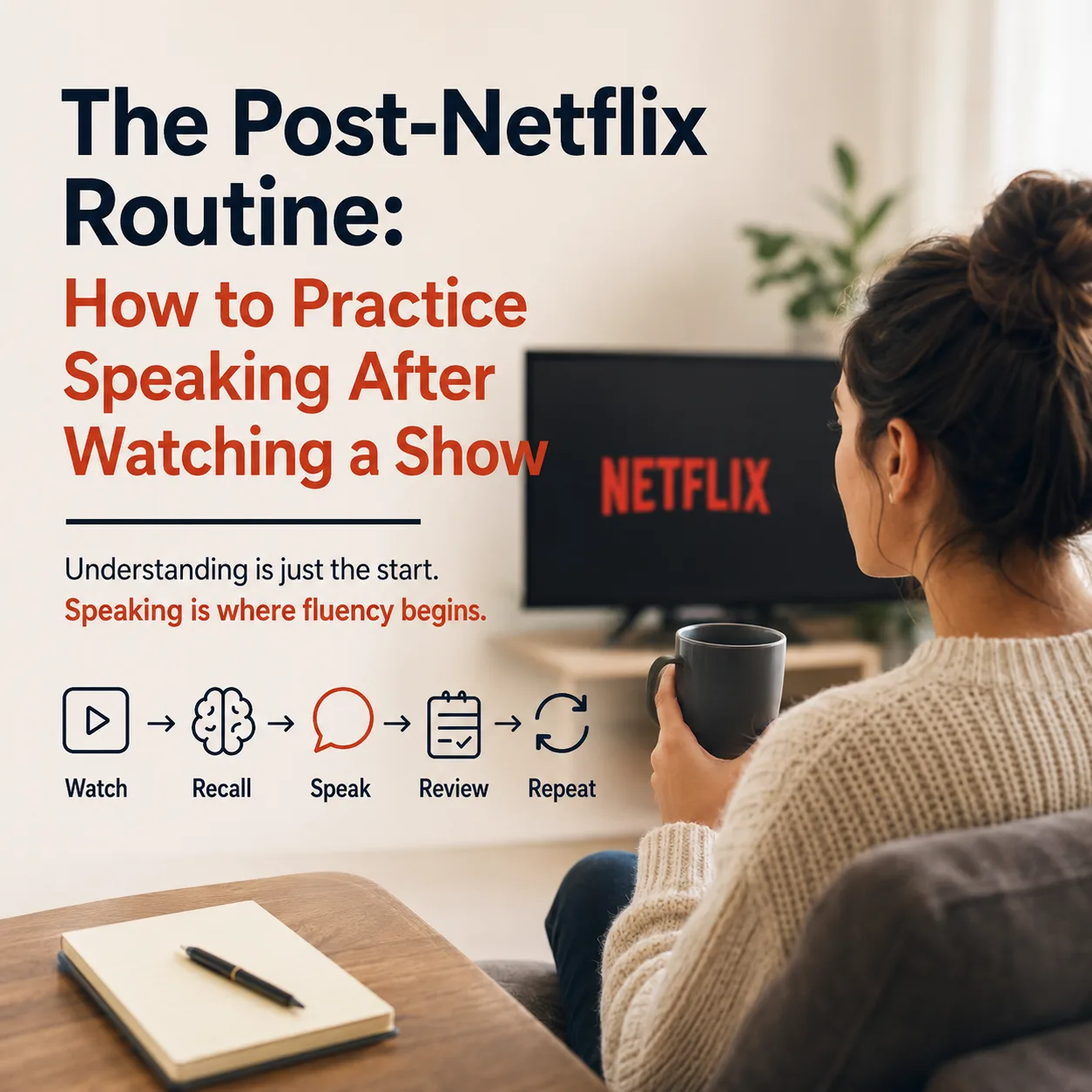
You don’t become fluent just by watching more Netflix.
At some point, most learners realize that understanding a show is not the same as being able to use the language.
However, if you structure your exposure the right way, even 30 days of consistent immersion can start changing how your brain processes language.
Instead of passively following the story, you begin to notice patterns, reactions, and how meaning is built in real situations.
And that shift is what leads to real fluency.
Why You Can Watch for Months—and Still Not Speak
A lot of learners are already “fans.”
They watch:
- Korean dramas
- Japanese shows
- Netflix series regularly
And at first, it feels like progress is happening.
You recognize words.
You follow scenes.
You understand more than before.
But then something doesn’t change.
You’re still:
- Slow to respond
- Unsure when speaking
- Stuck translating in your head
So even though exposure is high, output doesn’t improve.
The issue is not effort.
Instead, it’s how that exposure is structured.
The Cognitive Insight: Why Passive Watching Doesn’t Turn Into Fluency

Watching alone is not enough.
Because your brain does not automatically convert exposure into usable language.
There are a few key gaps happening here:
1. Recognition vs Retrieval
You may recognize a sentence when you hear it.
However, that does not mean you can retrieve it when you need it.
And without retrieval, speaking stays slow.
2. Exposure vs Study
Exposure builds familiarity.
Meanwhile, study builds awareness.
But fluency requires something else:
👉 Repeated exposure to usable patterns
3. Efficiency vs Precision
When you watch casually, your brain prioritizes:
👉 Understanding the story
Instead of:
👉 Noticing how language is structured
As a result, details get ignored.
4. Pattern Recognition Needs Repetition
Fluency is not built from single exposure.
Instead, your brain needs:
- Repeated structures
- Similar situations
- Recognizable patterns
Only then does prediction start to happen.
And prediction is what makes language feel fast.
Why This 30-Day Challenge Actually Works
What makes this challenge effective is not just consistency.
More importantly, it’s how your brain starts processing language differently over time.
As you revisit similar types of scenes, your brain begins connecting tone, situation, and meaning automatically.
Instead of translating word by word, you gradually understand how language behaves in real contexts.
Because of that, comprehension becomes faster—and more stable.
That shift matters.
Because fluency doesn’t come from memorizing more.
It comes from recognizing patterns earlier.
If you want to understand this mechanism more deeply, you can explore it here:
👉 Context is King: How Netflix & Jolii AI Rewire Your Brain for Fluency
And once that clicks, this challenge stops feeling like “practice”—and starts feeling like real progress.
Research on language acquisition shows that repeated exposure to meaningful input improves both comprehension and retention, especially when learners engage with similar patterns over time.
At the same time, studies on multimodal learning confirm that combining audio, visual context, and emotional cues helps the brain process language more efficiently.
In other words, the brain learns faster when language is experienced—not just studied.
A Moment I Realized This Myself
There was a time when I watched a lot of Korean dramas.
Almost every day.
And yet, nothing really changed.
I understood more.
But I still couldn’t respond naturally.
Then I tried something different.
Instead of jumping between shows, I focused on short scenes.
I repeated them.
Not too much—but enough to notice patterns.
At first, it felt slower.
However, after about two weeks, something shifted.
Certain phrases started to feel familiar.
Not because I memorized them.
But because I had seen them in similar situations.
And for the first time, speaking didn’t feel like guessing.
That’s when I realized:
👉 Exposure only works when it becomes structured.
From Fan to Fluent
Learning Mode | What It Feels Like | What the Brain Builds |
| Passive watching | “I understand the story” | Recognition only |
| Random exposure | “I’ve seen this before” | Weak patterns |
| Structured immersion | “I know how this is used” | Pattern recognition |
| Repeated context exposure | “I can say this naturally” | Fast retrieval |
The 30-Day Netflix Immersion Challenge
This is not about watching more.
Instead, it’s about watching differently.
Week 1 — Build Familiarity
Focus on:
- Short scenes (1–3 minutes)
- Simple conversations
- Clear emotional context
👉 Why: your brain needs stable input before patterns form
Week 2 — Notice Patterns
Start paying attention to:
- Repeated phrases
- Reactions
- Tone changes
👉 Why: pattern recognition begins here
Week 3 — Strengthen Listening
Reduce subtitle dependence.
Try:
- Listening first
- Then checking
👉 Why: speaking depends on sound, not text
Week 4 — Allow Natural Output
Do not force speaking.
Instead:
- Repeat phrases when they feel natural
- React to scenes
- Mimic tone
👉 Why: retrieval improves when patterns are already built.
Practical Framework: How to Apply This Daily

To make this sustainable, you don’t need long sessions.
Instead, you need consistency and structure.
1. Keep Sessions Short but Frequent
- 10–20 minutes
- Multiple times per day
👉 Why: frequency strengthens pattern recognition
2. Stay Within the Same Context
- Same show
- Similar scenes
- Familiar characters
👉 Why: repetition within context builds faster connections
3. Prioritize Understanding Before Output
- Don’t rush speaking
- Focus on clarity
👉 Why: confidence comes from understanding, not forcing
4. Replay What Feels Meaningful
- Emotional scenes
- Clear reactions
- Memorable lines
👉 Why: emotion strengthens memory
FAQs
1. Can I become fluent in 30 days?
No. However, you can significantly improve how your brain processes language.
2. Do I need to watch every day?
Yes. Consistency matters more than intensity.
3. What if I don’t understand much at first?
That’s normal. Understanding builds over repeated exposure.
4. Should I practice speaking during the challenge?
Not necessarily. Let speaking emerge naturally.
A Simple Way to Make This Work
The biggest challenge is not knowing what to watch.
Or how to structure it.
That’s where tools like Jolii help.
Instead of:
- Random episodes
- Inconsistent exposure
You get:
- Short, structured scenes
- Built-in repetition
- Clear patterns to follow
So learning becomes:
👉 Easier to repeat
👉 Easier to sustain
And that’s what makes the difference.
Final Thoughts
Most learners are already fans.
They watch regularly, enjoy the story, and over time, they begin to understand more than before.
But fluency requires something different.
It requires:
- Repetition
- Structure
- Pattern recognition
The 30-day challenge is not about doing more.
Instead, it’s about doing the same thing differently.
And once your brain starts recognizing patterns faster, something changes.
Language stops feeling random.
And starts feeling familiar.