First published: March 2026. Last updated: June 2026
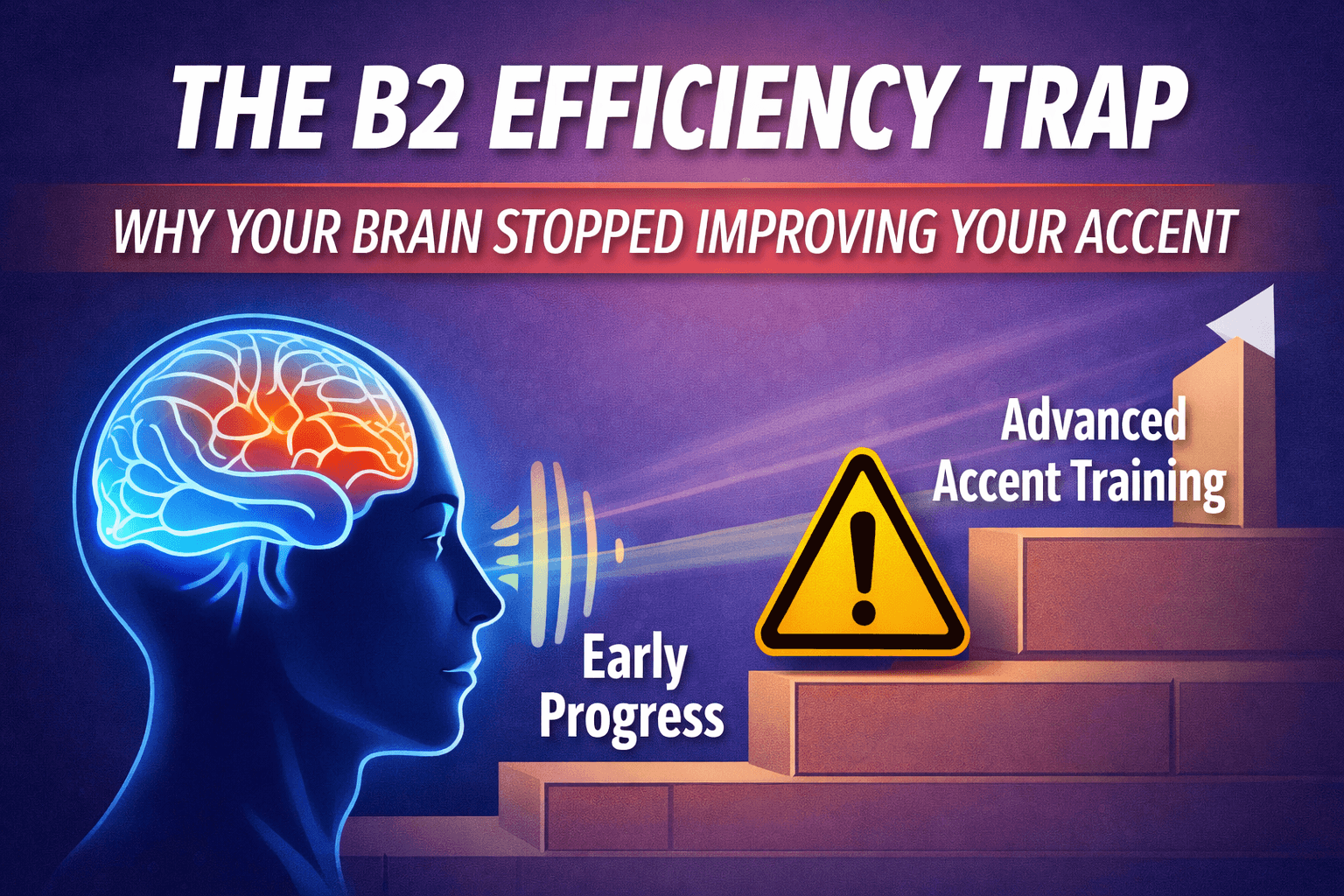
Many language learners notice that their accent improves quickly at the beginning, then suddenly stops improving around the intermediate stage.
This happens because the brain becomes efficient rather than precise.
Once communication works well enough, the brain stops investing energy in refining pronunciation.
In other words, your brain optimizes for communication efficiency, not accent perfection.
Improving your accent again requires deliberately retraining the brain to notice and reproduce finer sound differences.
Why Accent Improvement Often Stops at the Intermediate Level
During the early stages of language learning, pronunciation improves quickly.
Learners imitate new sounds.
They listen carefully.
They adjust their mouth movements.
Progress feels visible.
But something changes around the intermediate level.
You can communicate.
People understand you.
Conversations flow reasonably well.
At that point, the brain begins optimizing for efficiency.
Instead of refining every sound, it focuses on delivering meaning quickly enough to be understood.
This is often where accent improvement slows dramatically.
Not because learning has stopped.
But because the brain has decided the current pronunciation system is good enough for communication.
The Cognitive Mechanism: Efficiency vs Precision
The brain constantly balances two goals.
| Goal | Brain Strategy |
| Communication efficiency | Speak quickly and clearly enough |
| Phonetic precision | Produce accurate native-like sounds |
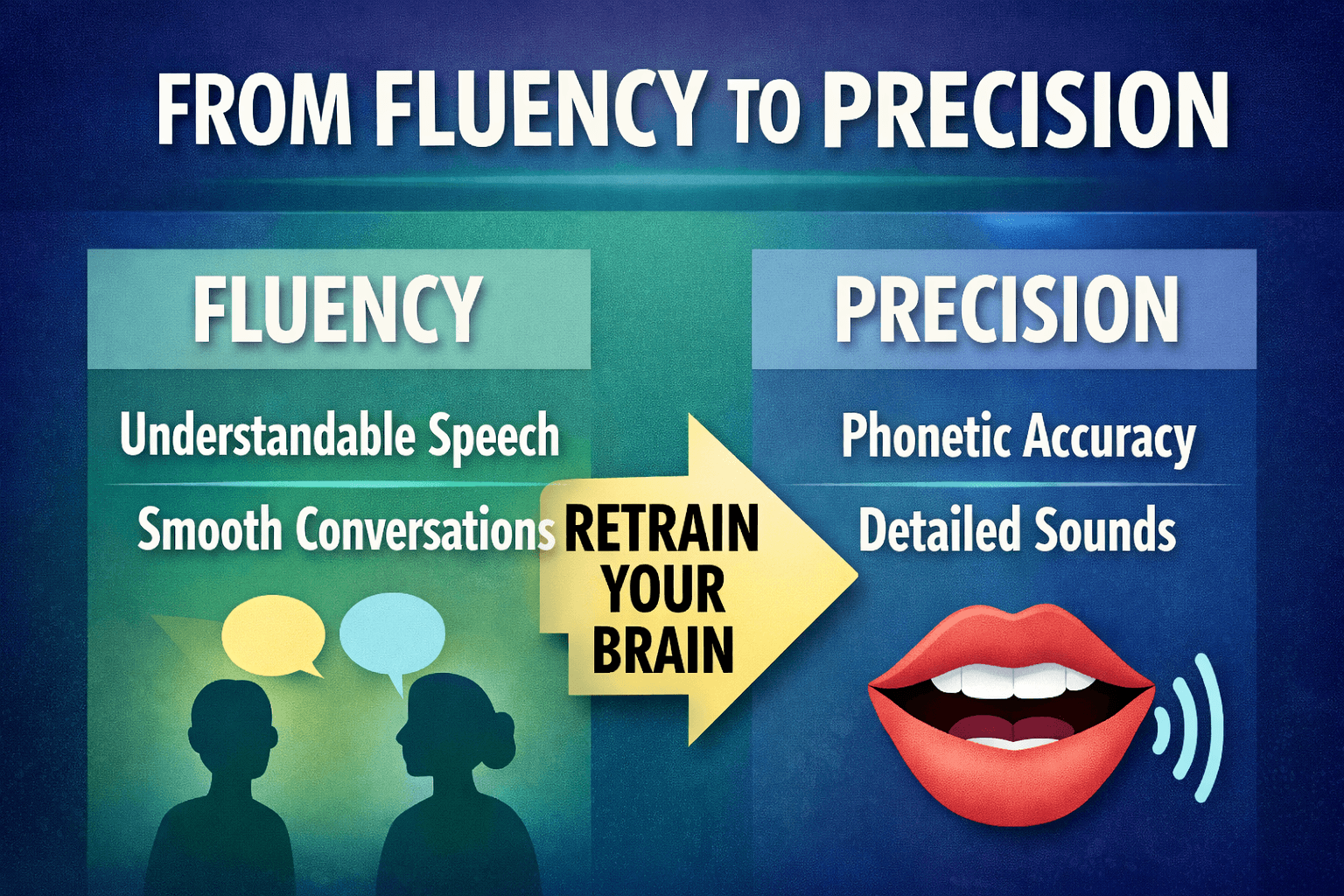
Early learning emphasizes precision because everything is unfamiliar.
Later learning shifts toward efficiency.
Once a pronunciation pattern works in conversation, the brain tends to reuse it automatically.
A well-established finding in second-language phonetics is that speech perception and pronunciation development are closely connected — the two skills reinforce each other rather than developing independently. Learners who train their ability to hear fine sound distinctions tend to show greater pronunciation improvement than those who focus on production alone. This is why accent training that starts with listening — rather than speaking — often produces faster results.
Once perception stabilizes, pronunciation often stabilizes as well.
Why Your Brain Stops Noticing Accent Errors
One surprising aspect of pronunciation learning is that improvement depends heavily on perception.
If the brain cannot clearly hear the difference between two sounds, producing the difference becomes extremely difficult.
Over time, the brain begins categorizing unfamiliar sounds using the closest sound from the native language.
This process creates a stable pronunciation pattern.
Communication works.
But phonetic refinement slows down.
This is the B2 efficiency trap.
The brain is no longer searching for better pronunciation—it is simply repeating a system that already works.
A Moment I Realized This Myself
I remember a moment at work that made this very clear to me.
At the time, I was already communicating quite comfortably with my colleagues in Japanese.
Daily conversations were smooth.
Meetings were manageable.
I could explain my ideas without too much hesitation.
So naturally, I assumed my pronunciation was good enough.
Then one day during a casual conversation, I said a word that sounded completely normal to me.
But my colleague suddenly paused and looked slightly confused.
“Wait… what did you mean?”
I repeated the word.
This time he laughed and said, “Oh! I thought you meant a different word.”
The way I pronounced it had changed the meaning.
It turned into one of those slightly awkward but funny moments at work.
What surprised me most was that I had never noticed the difference in my own pronunciation.
In my mind, the word sounded perfectly correct.
But to a native speaker, it sounded like something else entirely.
That moment made something very clear.
My Japanese had become efficient enough for conversation.
But my brain had stopped paying attention to the small sound differences that still mattered.
And that is exactly how the B2 efficiency trap works.
Signs You May Be in the B2 Efficiency Trap
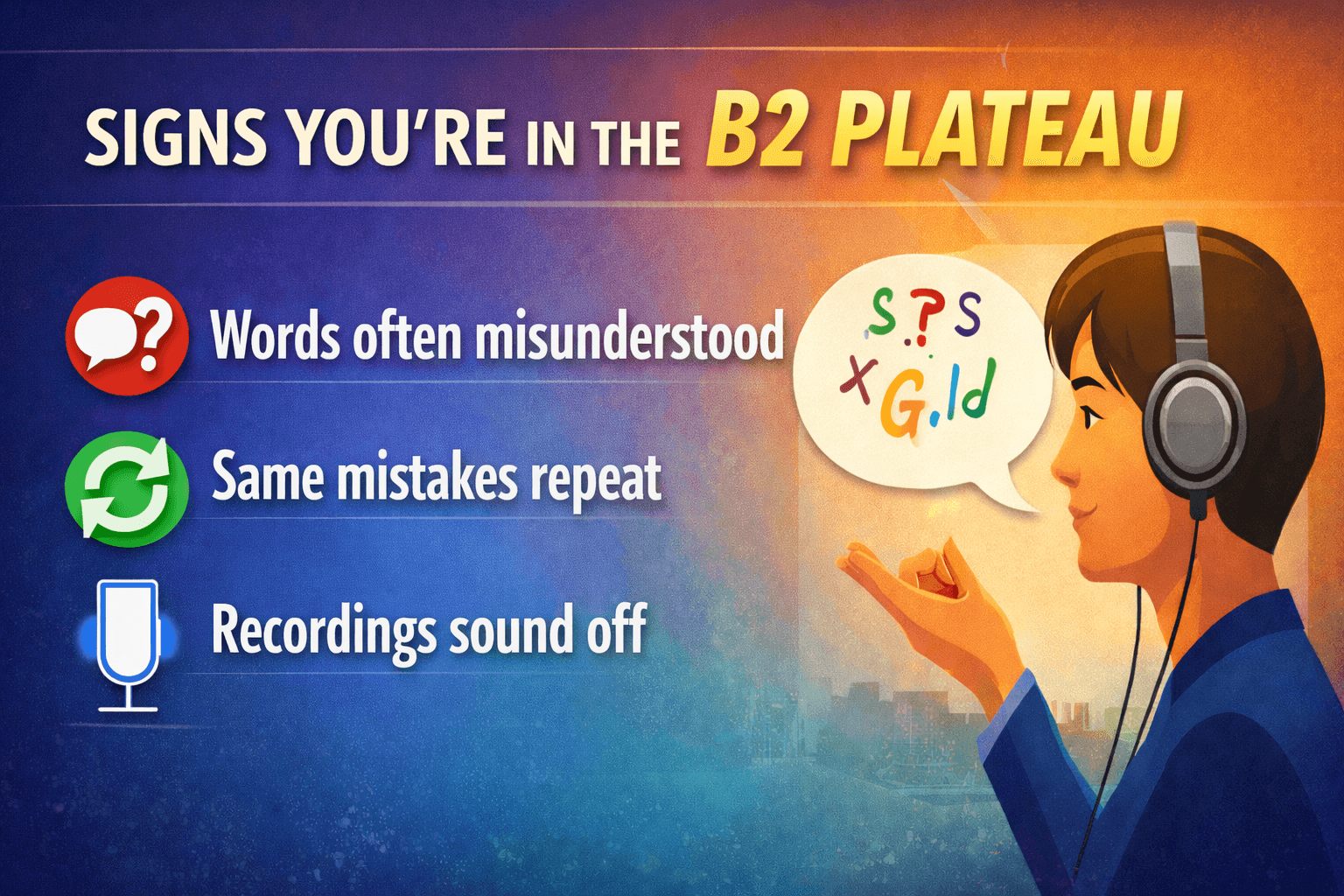
Many intermediate learners reach a point where communication works smoothly, but pronunciation stops improving.
The signs are often subtle.
For example:
- People rarely ask you to repeat yourself, but they sometimes misunderstand specific words
- Certain words are misunderstood again and again, even though you feel you pronounced them correctly
- When you listen to native speakers, their pronunciation sounds slightly different from yours, but you cannot clearly explain why
- You understand conversations easily, yet your own pronunciation still feels slightly “non-native” in ways you cannot fix.
- When speaking quickly, your pronunciation automatically returns to the same familiar patterns
- If you record yourself speaking, some sounds consistently differ from how native speakers pronounce them.
These signs usually mean your brain has stabilized a communication-efficient pronunciation system.
It works well enough for conversation.
But it is no longer actively refining the smaller sound differences that shape accent.
How Accent Development Changes Over Time
Accent improvement does not happen at a constant speed.
Different stages of language learning activate different priorities in the brain.
| Stage | What Learners Often Feel | What Actually Happens in the Brain |
| Early learning | Pronunciation improves quickly | The brain is actively exploring new sounds and adjusting articulation |
| Intermediate stage | Communication becomes easier | The brain stabilizes pronunciation patterns that already work |
| Advanced training | Small pronunciation details become noticeable again | The brain retrains perception and begins refining sound accuracy |
Accent improvement does not completely stop.
Instead, the brain temporarily shifts its focus from precision to communication efficiency.
Once learners begin paying attention to sound differences again, pronunciation can continue improving—even after the intermediate stage.
How to Re-Train Your Accent System
To move beyond the B2 efficiency trap, learners need to retrain both perception and production. Here are three practical strategies
1. Train Sound Perception First
Before improving pronunciation, the brain must learn to hear sound differences more clearly. Producing a sound you cannot clearly perceive is extremely difficult — your brain has no accurate target to aim for.
When you encounter an unfamiliar sound, your brain automatically maps it onto the closest sound from your native language. Over time this mapping stabilises. Training perception means deliberately disrupting it.
Three practical methods:
Minimal pair listening — find audio for word pairs that differ by one sound in your target language. Listen without looking at the written form and identify which word was spoken. Work on the specific contrasts that cause misunderstandings in your language, not generic exercises.
Focused shadowing — instead of shadowing everything, choose one target sound and listen specifically for it throughout a short clip. Then shadow the clip with slight exaggeration of that sound. Attention narrows the gap between what you hear and what you produce.
Recording comparison — record yourself saying a sentence and play it alongside a native speaker saying the same thing. Your ear catches differences your brain filtered out while speaking. Do this weekly rather than daily — the brain needs time between sessions to consolidate.
2. Slow Down Your Speech
When you speak at natural speed, pronunciation runs on autopilot. Slowing down interrupts that automaticity and creates space for adjustment. The goal is not to speak slowly forever — it is to build accurate patterns that can then be sped up.
Focus on three things when slowing down:
Vowel length — many languages use vowel duration to mark meaning. At normal speed these distinctions collapse. At slow speed they become audible and reproducible.
Consonant clarity — final consonants are frequently dropped at speed. Slow practice makes them audible first, then automatic.
Sentence rhythm — English is stress-timed. Many target languages are syllable-timed. Slowing down makes this difference perceptible and gives you time to adjust.
Practical routine: choose one sentence, say it at half speed while recording, compare to a native speaker, identify the largest gap, and repeat with that gap as your focus. Five minutes at the start of each speaking session. Within two to three weeks, normal-speed pronunciation begins to shift.
3. Use Targeted Repetition
Repeating a mispronounced sound reinforces the error. What works is focused repetition on one specific target — one sound contrast, one sentence rhythm, one problematic word — with attention to the gap between your production and the native model.
In practice:
One vowel contrast — choose two sounds you consistently confuse. Find five words containing each. Alternate between them slowly, paying attention to the physical sensation of each sound. For French learners: the “u” in “tu” versus the “ou” in “tout” is one of the most common sources of misunderstanding and responds quickly to this kind of focused drill.
One sentence pattern — grammar and pronunciation interact. Practice complete sentence patterns as rhythmic units, not words in isolation. Ten focused repetitions of one pattern produces more improvement than one hundred repetitions of isolated vocabulary.
Short clip shadowing — choose 20 to 30 seconds of audio. Shadow it three times: first for general rhythm, second for a specific sound, third matching the speaker’s exact pace. Each pass has a different focus. Unfocused repetition of the same material produces diminishing returns. Focused repetition with a shifting target produces compounding improvement.
Noticeable changes in specific sounds typically appear within two to four weeks of daily five-minute sessions. Full accent shift takes longer — but the brain does change pronunciation habits when practice gives it a clear target to move toward.
Why Accent Improvement Feels Slow Again
Once pronunciation becomes automatic, changing it requires overwriting old habits.
This takes time.
But it is possible.
Many advanced learners experience noticeable accent improvement once they begin focusing deliberately on phonetic detail rather than only communication.
Accent development is not limited by time.
It is limited by how carefully the brain listens and adjusts.
FAQs
1. Why does accent improvement slow down after intermediate level?
Because the brain prioritizes communication efficiency once pronunciation becomes understandable.
2. Is it still possible to improve accent as an adult?
Yes. Research shows that adults can improve pronunciation when they train both perception and production deliberately.
3. Do I need to sound like a native speaker?
Not necessarily.
Clear pronunciation is usually more important than perfect native-like accent.
However, many learners still choose to refine their accent for clarity and confidence.
A Simple Way to Notice Pronunciation Patterns
One difficulty in improving pronunciation is that many learners rarely hear themselves clearly while speaking.
Tools that combine listening, subtitles, and repetition can make pronunciation patterns easier to notice.
For example, Jolii’s interactive video learning system allows learners to replay short dialogue segments and observe how native speakers produce specific sounds and rhythms.
This type of repeated exposure can help the brain detect pronunciation patterns that are often missed during normal conversation.
If you are interested in how short bursts of authentic input improve language processing, you may also enjoy this article:
The Difference Between Feeling Fluent and Being Fluent
It explains that feeling fluent often comes from recognizing and understanding a language, while true fluency comes from automatically recalling and using it flexibly in communication.
Final Thoughts
The B2 efficiency trap is not a failure.
It is actually a sign that your brain has built a functional communication system.
You can speak.
People understand you.
But the brain has stopped refining pronunciation because it no longer seems necessary.
Accent improvement returns when the brain begins paying attention again.
Not just to meaning.
But to sound.
And once those small differences become visible again, pronunciation can continue improving long after the intermediate stage.